
Optical Fiber Sensing for Perimeter Inspection Solution
Build a smart perimeter with a new generation of AI-powered optical fiber sensing.
This site uses cookies. By continuing to browse the site you are agreeing to our use of cookies. Read our privacy policy>

Enterprise products, solutions & services

Build a smart perimeter with a new generation of AI-powered optical fiber sensing.
Next-Generation AI Fiber Sensing Safeguards Perimeters
Intrusion incidents are common in large perimeters such as railways and airports, and in small campuses such as substations and oil and gas stations. These incidents can lead to significant losses in safe operations and property. Complex weather and environments — including vegetation, animals, pedestrians, vehicles, wind, rain, snow, and fog — put a great deal of pressure on the reliability, adaptability, and stability of perimeter protection systems. Perimeter protection — which traditionally requires largely manual efforts — is transforming into a more sophisticated type of technical protection. Due to its easy deployment and cost-effectiveness, the vibration optical cable is suitable for detecting various intrusions along long-distance fences. This is why it is regarded as one of the most important technical measures for protecting campuses.
Gain the Edge

Comprehensive detection, zero false negatives
The enhanced oDSP chip can detect DAS signals with a dynamic range of 50+ dB across the entire segment — four times higher than the industry average. This ensures that both strong and weak signals are collected without distortion. The chip parses DAS signals on the entire segment in real time, achieving μs-level latency and zero false negatives.
Anti-interference, low false positives
The multimodal sensing model analyzes intensity and phase data, as well as local short-term details and surrounding long-term features. It also generates alarms based on all-domain situation awareness while resisting interference from force-8 winds and heavy rains. It achieves a false positive rate smaller than 1 time/km/day.
Fast learning, continuous evolution
The FDTS algorithm automatically optimizes sparse samples based on the FDTS gradient model and adapts to environment changes and user habits, improving the model library iteration efficiency 30-fold and continuously improving the alarm accuracy.
Products
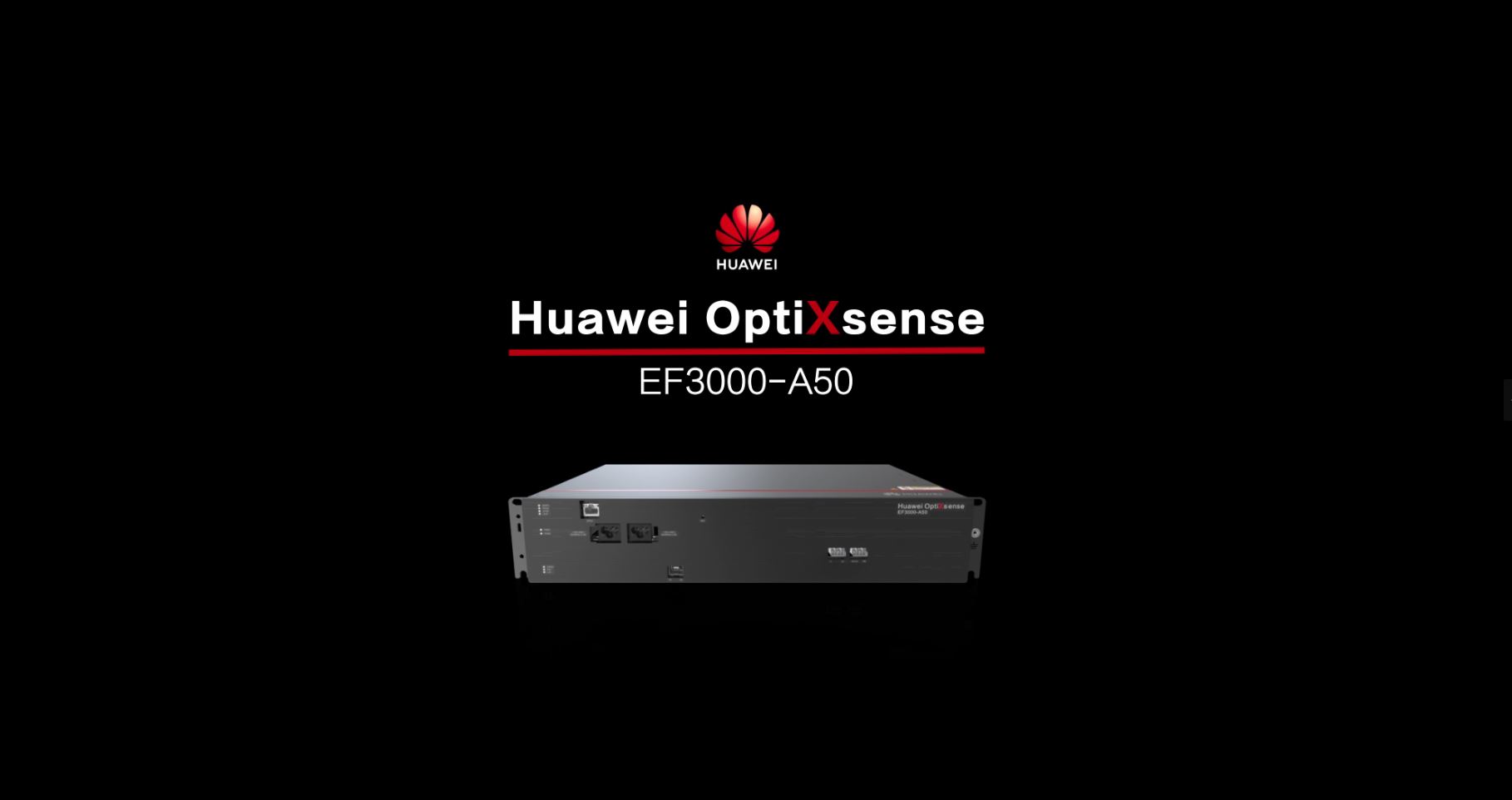
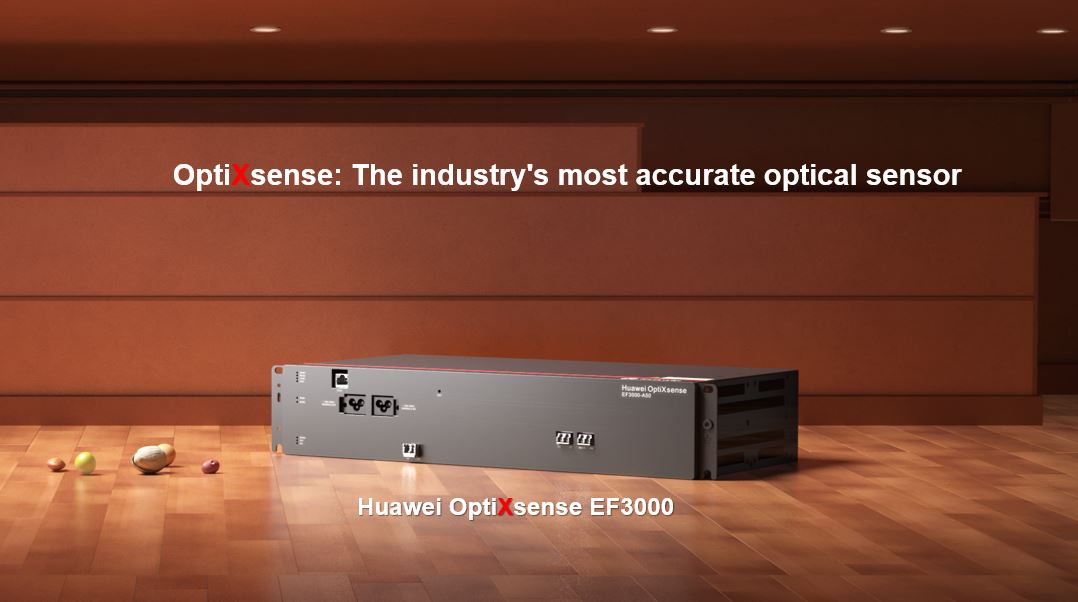
Huawei OptiXsense EF3000-F50
Huawei OptiXsense EF3000-F50 is a distributed optical fiber sensing system designed for perimeter security protection. It can quickly identify and accurately locate intrusions, and report alarms using optical fibers routed in perimeter fences to implement online real-time monitoring and security warning. It provides unattended inspection for protecting large perimeters such as railway and airport perimeters.
Learn More
OptiXsense EF3000-F05
Huawei OptiXsense EF3000-F05 is a distributed vibration sensing system designed for small perimeters. It can quickly identify and accurately locate intrusions, and report alarms using optical fibers routed in perimeter fences to implement online real-time monitoring and security warning. It provides the best solution for unattended inspection in substations, oil and gas stations, and data centers.
Learn More
News and Events
Resources
Load More
Copyright © 2026 Huawei Technologies Co., Ltd. All rights reserved.