This site uses cookies. By continuing to browse the site you are agreeing to our use of cookies. Read our privacy policy>

This site uses cookies. By continuing to browse the site you are agreeing to our use of cookies. Read our privacy policy>
Enterprise products, solutions & services
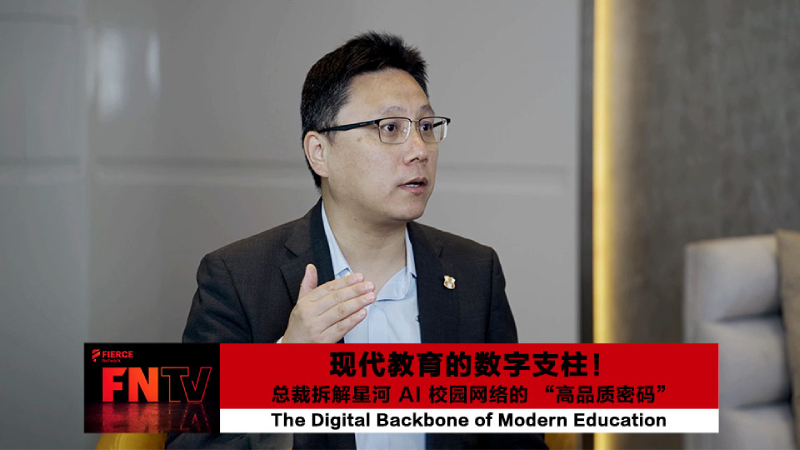
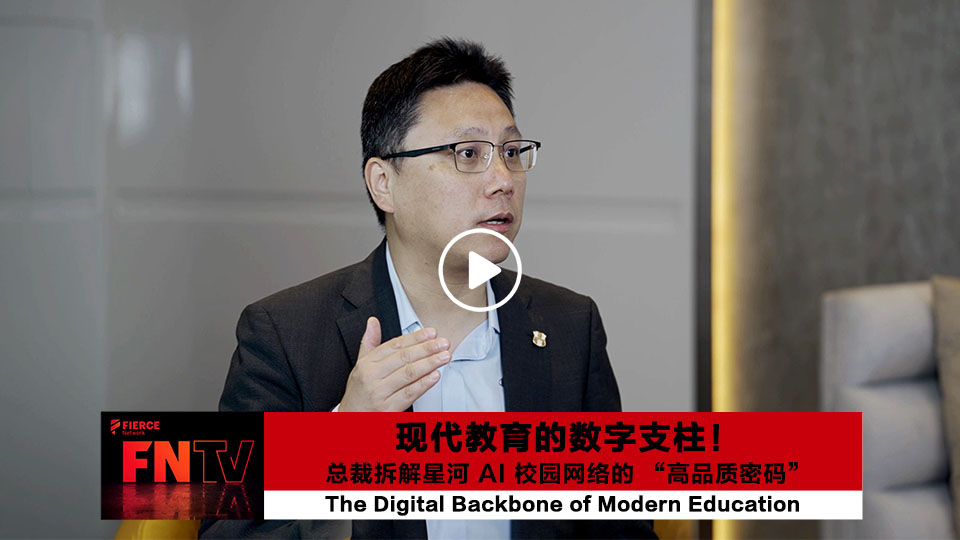
AI is transforming education faster than ever, bringing both new opportunities and challenges. It's driving education to become smarter, more personalized, and more inclusive.In this process, networks are key ICT infrastructure that bridges AI and education, speeding up the intelligent transformation of education.Mr.Sword Cheng , President of the Government and Enterprise Domain of Huawei's Data Communication Product Line was invited to participate in an interview with Steve Saunders, the founder of Fierce Network, to provide an in-depth explanation of the innovative achievements of Huawei's Xinghe Intelligent High-Quality School Campus Network Solution.
Steve Saunders:
Sword, I understand that there has been a big upgrade to Xinghe Intelligent High-Quality School Campus Network Solution. Can you tell me about that?
Sword Cheng:
This year we’ve made big upgrades to our Xinghe Intelligent High-Quality School Campus Network Solution. We've infused AI deeply into both the network devices and the network brain, so the network becomes more intelligent than ever. That is,boosts the network quality through intelligence.
We are building around four key pillars, namely high-speed campus, green campus, intelligent campus, and secure campus. This helps lay the foundation for smarter education.
Steve Saunders:
So campus networks need an information superhighway essentially. What sort of upgrades are you making to facilitate that performance?
Sword Cheng:
We build a high-speed campus through two aspects. First, we are using cutting-edge Wi-Fi 7 for 10 Gbps wireless access anytime, anywhere. We have the industry's most complete Wi-Fi 7 APs, which can cover all campus scenarios. Second, our innovative Passive Ethernet Network (PEN) architecture ensures simple, faster configuration and deployment. This greatly shortens the project delivery time. In particular, our noise-free remote units (RUs) or access switches can be deployed directly in rooms. In this way, we achieve 10 Gbps to the classroom without re-cabling, which saves many construction costs.
Steve Saunders:
But now there are so many more smart devices on the campus. I think a lot of the schools are worried about electricity consumption. How do you help them with that challenge?
Sword Cheng:
Huawei has introduced an unique Wi-Fi CSI-based intelligent space sensing technology. This technology does not require extra sensors or smart terminals to collect the data. It uses the AP to detect whether someone is in a classroom, office or meeting room, and when people come and go, it can automatically trigger the building management system(BMS) to turn the lights on or off. Huawei's Wi-Fi APs come with a special “tidal prediction algorithm”that helps save energy. During idle times, APs go into sleep mode and when it gets busy, they wake up. On a big campus with tens of thousands of APs, this can save about 20% of energy every year.
Steve Saunders:
Another concern of these schools and some of these schools are huge now, they have to do operations, they have to do maintenance, and they want to make those changes and those fixes very quickly. You already have a digital map solution. Is there anything new from Huawei in this area this year?
Sword Cheng:
This year we launched an autonomous driving network solution powered by our NetMaster, a network agent. It has two unique features. The first feature is the Wi-Fi Optimization Agent. It enables automatic decision-making and optimization upon network issues. As a result, 80% of wireless faults can be automatically resolved. The second feature is a network O&M Copilot. It works like a ChatGPT. You just talk to it in natural language and it turns complex maintenance tasks into simple conversations. This significantly increases O&M efficiency.
Steve Saunders:
Let's talk about security, campus security. Are you planning any upgrades in this area this year?
Sword Cheng:
Yeah. This year we made two key upgrades to our campus security solution. First, we developed an unique Wi-Fi Shield technology to fill the security gap in wireless air interfaces. It can work with AI-based scrambling and MACsec encryption to ensure zero data eavesdropping. This ensures secure data transmission for key users like VIPs on campus. Second, with our Wi-Fi CSI-based intelligent space sensing technology, the system can detect intrusions in real time and work with the campus security system to send alerts. It's perfect for privacy-sensitive areas or places without cameras because this ensures no blind spots.
Steve Saunders:
Wow, there are a lot of upgrades to one system. It's very impressive. Is the technology now being used by schools overseas as well?
Sword Cheng:
Yes. So far, Huawei's Xinghe Intelligent High-Quality School Campus Network Solution has been adopted by over 70,000 educational institutions across more than 110 countries and regions. It's helping schools accelerate digital transformation and intelligent upgrades. Looking ahead, we'll keep innovating, follow the latest technology trends, and integrate more AI capabilities into the solution. Our goal is to build a solid education network foundation that supports smarter, more inclusive and fair education for everyone.
Disclaimer: The views and opinions expressed in this article are those of the author and do not necessarily reflect the official policy, position, products, and technologies of Huawei Technologies Co., Ltd. If you need to learn more about the products and technologies of Huawei Technologies Co., Ltd., please visit our product pages or contact us.
Copyright © 2026 Huawei Technologies Co., Ltd. All rights reserved.