This site uses cookies. By continuing to browse the site you are agreeing to our use of cookies. Read our privacy policy>

Recherche

About the OlympusMons Awards

As a new factor of production, data has become a basic strategic resource in today's digital economy. However, explosive data growth and innovative data applications place higher requirements on data infrastructure. Sufficient storage capacity, premium usability, higher security, and better energy efficiency are now key priorities for industry, academia, and research organizations. In addition to ever-changing requirements for IT architecture, how to build data infrastructure with maximum energy efficiency is a major challenge for the industry.

Building a technological ecosystem, especially in the field of basic technology breakthroughs, requires the collaboration of all parties. That's why Huawei established the annual OlympusMons Awards in 2019 to lead the global research of data storage basic theories, break through key technical problems, accelerate the industrialization of scientific research achievements, and achieve industry-academia-research win-win collaboration.

Learn More

OlympusMons Awards
2024 Challenges

OlympusMons Awarding Results

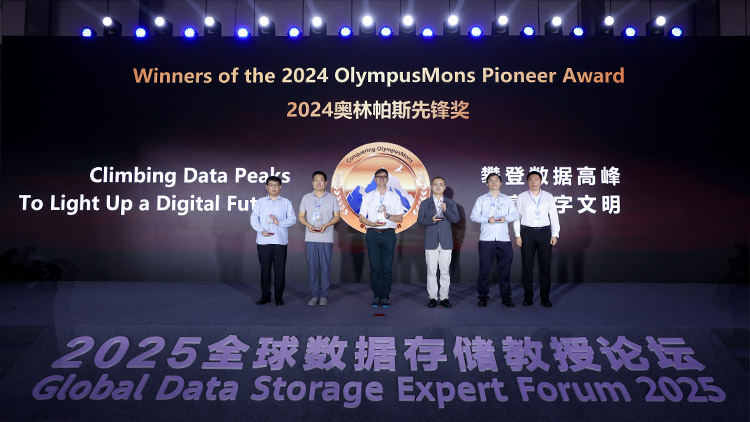
Winners of OlympusMons Pioneer Award Winners of OlympusMons Pioneer Award

Winner of OlympusMons Award Winner of OlympusMons Award

The 2025 Global Data Storage Expert Forum unveiled the shortlist for the 2024 OlympusMons awards. The OlympusMons Award was presented to Mr. Wu Yongwei and his team from Tsinghua University.

The OlympusMons Pioneer Award went to five teams: Mr. Zhang Kai (Fudan University), Mr. Zhou Ke (Huazhong University of Science and Technology, Peking University), Mr. Zhang Jingyu (Huazhong University of Science and Technology), Mr. Fan Fenglei (City University of Hong Kong), and Mr. Volker Markl (Technische Universität Berlin).

The 2024 OlympusMons awards received submissions from 95 experts and scholars from 19 universities worldwide. The winning teams are determined by the OlympusMons Review Committee, who evaluated all entries based on the technical and commercial value of their scientific research achievements.


OlympusMons Award

OlympusMons Award

Research Bonus: 1,000,000 RMB
  • Achievements:
    Trading More Storage for Less Computation: High-Performance LLM Inference System
  • Major team members:
    Tsinghua University
  •  
    Wu Yongwei
    Wu Yongwei
    Zhang Mingxing
    Zhang Mingxing
    Zheng Weimin
    Zheng Weimin
    Qin Ruoyu
    Qin Ruoyu
    Jiang Jinlei
    Jiang Jinlei
  • Achievement introduction:
    This research introduces the paradigm of trading more storage for less computation by tapping into the potential of memory outside the GPU, disks, and near-memory computing, so as to enable a globally shared KV-Cache reuse mechanism and a heterogeneous compute–storage coordination system. On top of the design, the research established two open-source projects—the Mooncake architecture and the KTransformers framework—which effectively alleviate the resource pressures associated with long contexts, agent clusters, and sparse LLM inference. The solution has been adopted by Moon's Dark Side Kimi, Alibaba, Ant Group, and iFLYTEK; its repositories have gained over 18,000 GitHub stars. The solution also won the Best Paper Award at FAST 2025, has been granted 36 invention patents, and has influenced NVIDIA Dynamo system, which incorporated Mooncake's architecture and core components.
OlympusMons Pioneer Award

OlympusMons Pioneer Award

Research Bonus: 200,000 RMB
  • Achievements:
    Approximate Retrieval Technology of High-Dimensional Vector for Multimodal Data
  • Major team members:
    Fudan University
  •  
    Zhang Kai
    Zhang Kai
    X. Sean Wang
    X. Sean Wang
  • Achievement introduction:
    This research focuses on high-dimensional vector query and retrieval of multimodal data. It addresses the issue of extremely low retrieval efficiency caused by out-of-distribution (OOD) between cross-modal query embeddings and cross-modal queried embeddings. By studying the distribution patterns of multimodal high-dimensional vector data, this research analyzes the reasons why OOD queries affect the performance of vector retrieval. Subsequently, based on learning the distribution connections between modalities, the vector distance relationship of the query distribution, and the association of the queried vectors, an efficient cross-modal graph index is constructed. Experimental comparisons have shown that this indexing technology alleviates the indexing efficiency issues caused by OOD in cross-modal vector retrieval tasks, thereby achieving several-fold performance improvements. The research results were published at VLDB'24, a leading database conference, and the technical solution won the OOD Track championship at the Big ANN Challenge hosted by NeurIPS.
OlympusMons Pioneer Award

OlympusMons Pioneer Award

Research Bonus: 200,000 RMB
  • Achievements:
    AI Data Foundation Driven by Efficient Cache Management and Multimodal Large Models
  • Major team members:
    Huazhong University of Science and Technology, Peking University
  •  
    Zhou Ke
    Zhou Ke
    Bai Xiang
    Bai Xiang
    Zhang Jie
    Zhang Jie
    Wang Hua
    Wang Hua
    Liu Yuliang
    Liu Yuliang
  • Achievement introduction:
    This research builds a new AI data foundation through key technologies like efficient cache management, heterogeneous large model inference, and multimodal large models, providing a technical solution for efficient large model inference under limited cache resources. The efficient cache management technology addresses the challenges of analyzing and managing caches to provide a solid foundation for quantitative cache management. What's more, by leveraging xPU and SSD-based heterogeneous cache technology, the research overcomes the high costs of KV cache caused by the reliance on HBM in current mainstream inference systems, offering a solution for processing large images with limited cache resources. Finally, by utilizing multimodal large models with efficient resource management, it enables higher input image resolution under constrained cache conditions, thereby enhancing the overall performance of multimodal large models.
OlympusMons Pioneer Award

OlympusMons Pioneer Award

Research Bonus: 200,000 RMB
  • Achievements:
    High-Density Magnetic and Optical Storage Media Technology with Superior Cost-Effectiveness
  • Major team members:
    Huazhong University of Science and Technology
  •  
    Zhang Jingyu
    Zhang Jingyu
    Wu Fei
    Wu Fei
    Chen Jincai
    Chen Jincai
    Luo Ke
    Luo Ke
    Gao Jichao
    Gao Jichao
  • Achievement introduction:
    This research focuses on increasing the capacity density of warm and cold storage media. In the field of magnetic storage, it pioneered a signal detection method called time-frequency collaboration awareness based on two-dimensional and three-dimensional magnetic recording. It also explored high-reliability read-write modeling and advanced signal processing techniques to achieve a twofold increase in storage density and provide theoretical guidance for efficient information reading and writing in ultra-high-density magnetic storage. In the fields of optical and glass storage, innovative five-dimensional recording methods and advanced higher-dimensional optical storage technologies have been developed. These approaches tackle the key challenges of permanent glass data storage, boosting storage density by two orders of magnitude and achieving a maximum single-disk capacity of 360 TB. The findings are expected to overcome the limitations of traditional storage technologies, offering a practical path toward ultra-large-capacity storage with the optimal per-bit cost-effectiveness.
OlympusMons Pioneer Award

OlympusMons Pioneer Award

Research Bonus: 200,000 RMB
  • Achievements:
    Hyper-Compression: Model Compression via Hyperfunction
  • Major team members:
    City University of Hong Kong
  •  
    Fan Fenglei
    Fan Fenglei
    Fan Juntong
    Fan Juntong
  • Achievement introduction:
    This research proposes a novel model compression algorithm named Hyper-Compression, which turns the model compression problem into the issue of parameter representation via a hyperfunction. Based on the ergodic theory, the trajectories of low-dimensional dynamic systems are used to encode high-dimensional model parameters, fundamentally breaking through the bottleneck that it is difficult to scale traditional pruning, quantization, and other methods for compression efficacy. The research is expected to overcome the physical limits of 1-bit compression in traditional algorithms, outperform quantization methods for data compression of large model parameters and KV cache, reduce inference costs across the board, and ease memory bandwidth pressure.
OlympusMons Pioneer Award

OlympusMons Pioneer Award

Research Bonus: 200,000 RMB
  • Achievements:
    Declarative Data Processing on Massive Heterogeneous and Distributed Data Sets and Streams
  • Major team members:
    Technische Universität Berlin
  •  
    Volker Markl
    Volker Markl
    Steffen Zeuch
    Steffen Zeuch
    Sebastian Schelter
    Sebastian Schelter
  • Achievement introduction:
    This research focuses on optimizing declarative data processing, especially for massive, heterogeneous datasets and data streams. Collectively, this research has not only bridged theory and practice, it has yielded open-source systems that have been impactful around the globe. From pioneering scalable stream processing with the Stratosphere platform, which evolved into Apache Flink—now a foundational technology for companies like Alibaba, Uber, and Google—to the current initiative, which involves the development of the NebulaStream system for IoT applications, the major accomplishments are: (a) contributions in parallel and distributed computing, including the development of new models for iterative algorithms, adaptive dataflows, and novel techniques for scalable data validation, to reduce the massive storage TCO, (b) the introduction of novel programming abstractions that unify workflow and dataflow semantics, which enhance data programmability and are beneficial to constructing efficient index for multimodal data, and (c) systems development that spans both traditional and modern hardware, including GPUs and custom processor-aware code generation.
Thanks to All the Teams Who Participated the OlympusMons Awards!

Thanks to All the Teams Who Participated the OlympusMons Awards!

As we move towards the intelligent era, we must cross the data peak.
OlympusMons represents Huawei Storage's unremitting pursuit and exploration on the road to data peaks.
The integration of industry, education, and research opens the door for innovation in data infrastructure.

TOP