
This site uses cookies. By continuing to browse the site you are agreeing to our use of cookies. Read our privacy policy>

This site uses cookies. By continuing to browse the site you are agreeing to our use of cookies. Read our privacy policy>
Produits, solutions et services pour les entreprises
In the renewable energy field, China has achieved world-class results in both power generation and load, while also facing immense challenges to its power grids. Digital intelligence is critical to addressing the uncertainties of the future power system, while an efficient communication network is the key to making this power system informatized, digital, and intelligent.
Construction of communications infrastructure should be driven by the communication target network. It is essential to address current issues and challenges while also anticipating the needs that will arise over the next five to ten years. In particular, when planning the communication target network, we need to focus on both business scenarios and communication technologies. We must find technologies for scenarios, and also scenarios for technologies.
The communication target network in the future power system offers four key features: an intelligent and robust main network, medium-voltage integration, low-voltage transparency, and full coverage, as shown in Figure 1. An intelligent and robust main network needs to be constructed with consideration for "optical power transportation" represented by the "East Data, West Computing" project, "electric power transportation" represented by edge computing, and the demands for renewables integration and peak shaving based on spatiotemporal characteristics. In addition, in past typhoon emergency response efforts, it was found that the 10 kV communication network is the weakest link in power grid communication, and is a typical blind spot. Overcoming this requires systematic planning of a communication target network made up of optical fiber and wireless private networks that delivers full wired and wireless coverage capabilities. Furthermore, given large-scale distributed PV access, charger access, distributed energy storage, user interaction, and potential load-side transactions, a systematic approach is needed for 400 V low-voltage transparent communication.
At the end of 2023, ETSI released the F5G-A standard. Today, the electric power industry is also planning the electric power communication target network by following the F5G-A roadmap and has achieved large-scale deployment. In main network communication, the State Grid Corporation of China has conducted pilot and commercial use of fgOTN, while EDM in Mozambique has put fgOTN into commercial use. For medium-voltage backhaul of power distribution networks, State Grid Shanxi and other power companies have deployed optical fiber networks such as hard-isolated PON. For low-voltage communication, State Grid Shaanxi and other power companies have utilized computing power and IoT connection technologies to achieve 400 V transparency.
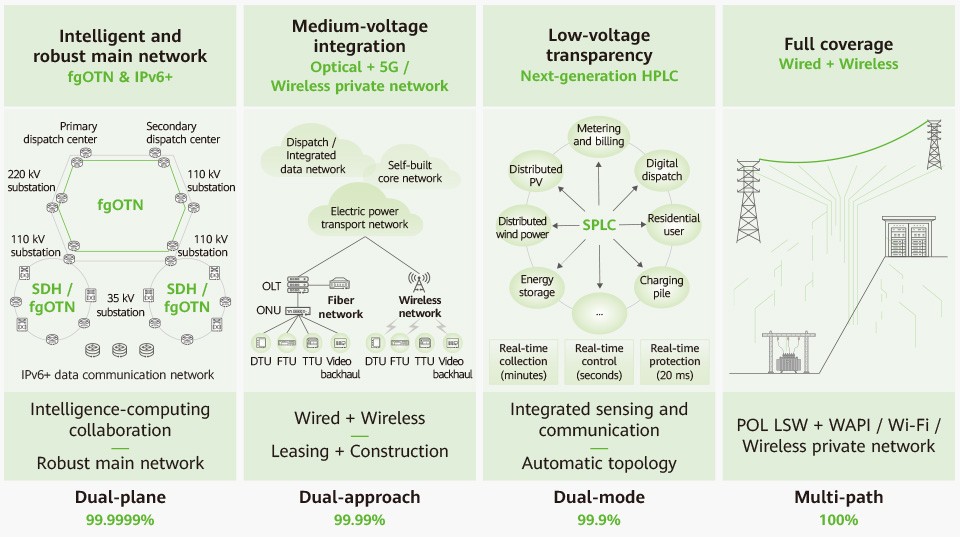
Figure 1: Four features of the power communication target network
fgOTN is introduced to seamlessly replace SDH networks, achieving generational evolution in communication networks. On power grids, there are abundant optical fiber resources, which play a vital role in addressing the core challenges of the future power system. The intelligent development of the electric power industry will demand a hundred times more network connections, ten times more bandwidth, and increasingly stringent requirements for network security and reliability. Additionally, the lifecycle of SDH is nearing its end, and the fgOTN standard was officially released by ITU-T in November 2023. fgOTN inherits SDH's hard pipe feature while providing tenfold bandwidth.
Network reliability is crucial, and a minimum of 99.9999% reliability is required to ensure deterministic computing connections. For one thing, low-latency and highly secure connection technologies should be selected to maintain high reliability. For another, a dual-plane assurance private network must be established to support highly reliable intelligent computing. The principle of "creating new planes before removing old ones" must be followed to ensure that there are always two active planes to deliver high reliability.
Main network communication can fully utilize existing optical fiber resources. For 10 kV backhaul in power distribution networks, coordination between optical fibers and wireless networks is essential. The question is, how can we establish a synergy mechanism among the optical fiber network, wireless private network, and wireless public network based on the target network?
Optical fibers support physical isolation, ensuring that services do not interfere with each other. This is the most effective solution for achieving high security and reliability in electric power networks. Fibers are also a critical asset for intelligent and digital development. Where possible, fiber networks should be deployed in all transformer districts, after which differential protection, RTU/FTU backhaul, and digital twin services can be further rolled out. In the past, digital twins needed to be configured with dedicated rendering hardware. Nowadays, optical fibers and universal tablet addresses can be combined to implement cloud rendering, cloud-edge synergy, and ultra-fast delivery, which is both cost-effective and practical.
In the past, power distribution networks had low requirements for communication and digitalization. If a fault occurred, the affected segment would either be switched or isolated from the network. Today, these networks are evolving from unidirectional to bidirectional and from passive to active, becoming more reliant on digitalization and intelligence. This shift necessitates a robust communication infrastructure. In extreme scenarios, the lack of reliable communication can lead to significant losses. Over time, establishing an electric power wireless private network has become essential for 10 kV backhaul. The medium-voltage hybrid communication network demands comprehensive planning of both optical fiber and wireless private networks, complemented by wireless public networks when necessary. Additionally, optical fiber dual-route protection, as well as network protection between the optical fiber and wireless private network, between the optical fiber and wireless public network, or between the wireless private network and wireless public network, should be implemented as needed to safeguard the future power system.
The challenge of building a future power system lies in power distribution networks, where communication is the key. With the rapid rise of new technologies such as widely distributed renewable energy and electric vehicles, maintaining the balance, stability, and security of distribution networks has become increasingly complex. Issues like reverse power flow and device overloading pose significant challenges. To address these, we need both top-down scheduling and bottom-up transformer district autonomy, along with greater transparency at the 400 V level to streamline primary and distribution networks and micro-grids.
High-speed power line carrier (HPLC) technology is already widely used in the 400 V transparent communication field, achieving good results. In the future power system, low-voltage 400 V must evolve from merely collecting customer satisfaction and power consumption information to enabling power generation-grid-load-storage interaction. Distributed PV, distributed energy storage, numerous charging piles, and user interactions mean that 400 V carrier communication should be added to the integrated communication network and managed as part of the target network to achieve over 99.9% reliability, second-level interaction, integrated sensing, communication, and computing, and topology identification. These capabilities will play a crucial role in systematically addressing 400 V challenges.
Source: HuaweiTech
Disclaimer: The views and opinions expressed in this article are those of the author and do not necessarily reflect the official policy, position, products, and technologies of Huawei Technologies Co., Ltd. If you need to learn more about the products and technologies of Huawei Technologies Co., Ltd., please visit our product pages or contact us.
Copyright © 2026 Huawei Technologies Co., Ltd. All rights reserved.