
This site uses cookies. By continuing to browse the site you are agreeing to our use of cookies. Read our privacy policy>

This site uses cookies. By continuing to browse the site you are agreeing to our use of cookies. Read our privacy policy>
Produits, solutions et services pour les entreprises
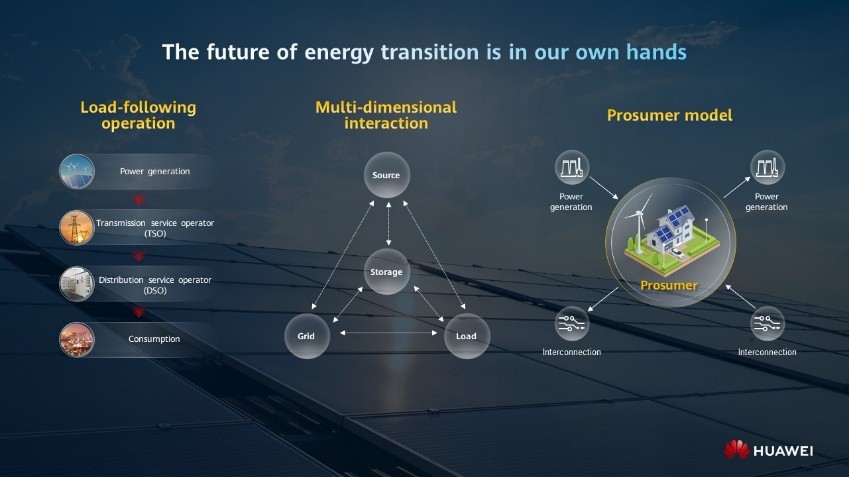
During energy transition, each country faces unique challenges. That's why it is especially important for us to choose a strategy aligned with our national resource strengths, focusing on continuous self-improvement, rather than simply following others or replicating their experiences.
Whether we follow the traditional generation-to-consumption model, shift to an interactive model integrating source, grid, load, and storage, or move towards the distribution-led prosumer model, the decision is ours to make.
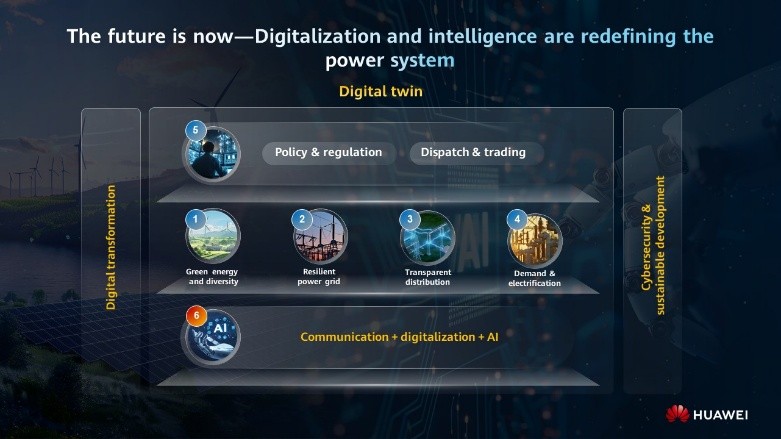
Regardless of the model we choose, the trend toward digital twins is already under way.
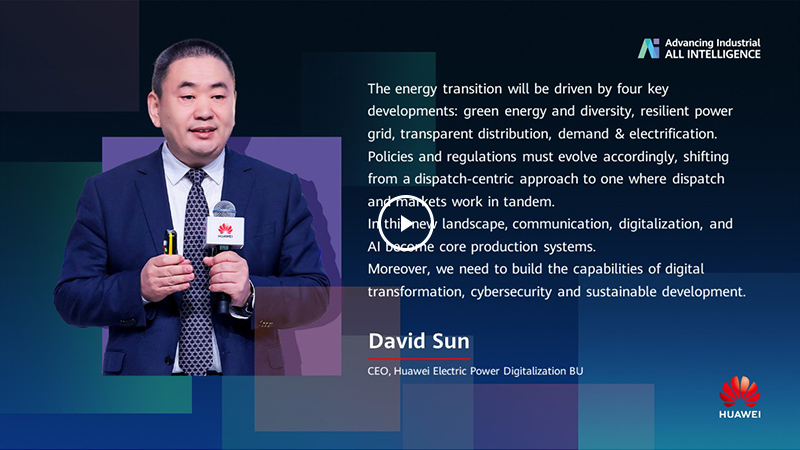
The energy transition will be driven by four key developments: green and diverse energy sources, strong grid, transparent distribution, and increasing electrification.
Policies and regulations must evolve accordingly, shifting from a dispatch-centric approach to one where dispatch and markets work hand in hand.
In this new landscape, communication, digitalization, and AI become core production systems.
Moreover, digital transformation and information security will be essential to sustainable business development.
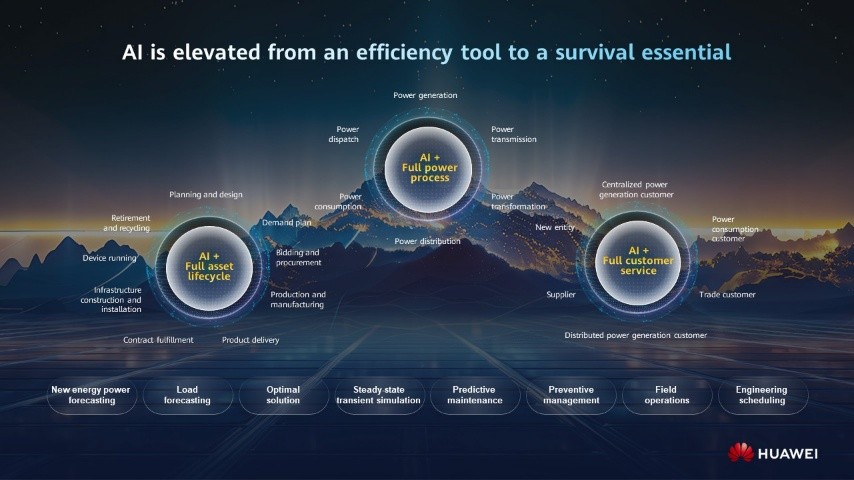
AI has evolved from an efficiency tool to a survival essential. To create real value, AI need to be integrated across three core streams
First, across the entire power process. As wind and solar penetration exceeds 30%, grid instability becomes the new normal. In areas such as renewable generation and load forecasting, AI can play a unique role. When it comes to transmission, stability is paramount. Power flow calculations and simulations rely on deterministic mechanisms, so AI must be applied with caution. On the distribution side, however, it’s a different story. Here, with complex scenarios like prosumers, AI becomes irreplaceable, actively defining safety boundaries to keep the grid secure.
Second, across the full asset lifecycle. By capturing and analyzing cross-domain data and building ontologies, AI enables predictive equipment maintenance. At a nuclear power plant, just one week after deployment, our AI solution identified a major risk an hour earlier, preventing an unplanned shutdown.
Third, across the full spectrum of customer engagement. Through two-way interaction, AI creates a dynamic link between customers and the grid. It matches supply with demand, delivers proactive services, and fully enables market-based transactions. For China, that means a 10% gain in renewable absorption, equal to the yearly output of two Three Gorges Dams.
For AI to evolve from an efficiency tool to a survival essential, one thing is clear: real-time, high-quality data is what makes it all possible. In the power system, such data is truly unique and irreplaceable.
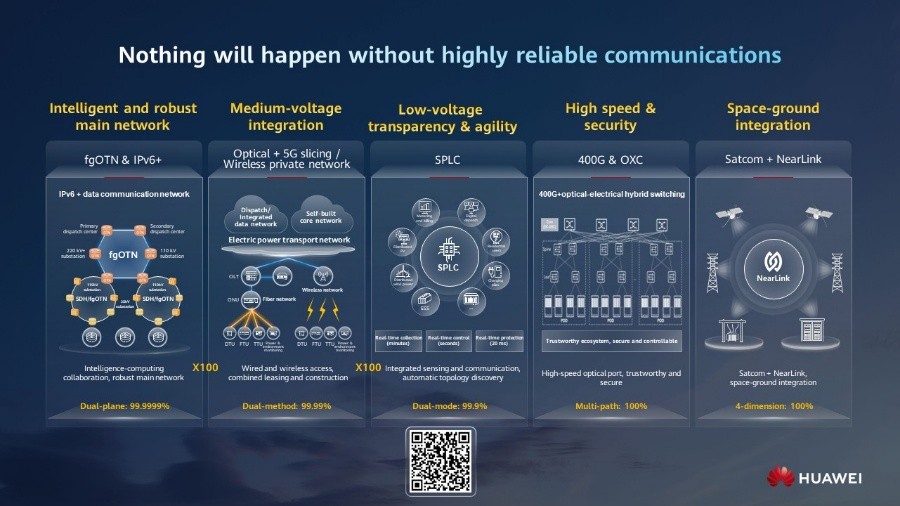
Without communication, there is no protection, no automation, no digitalization, and no AI.
For example, the high-voltage communication is the artery /ˈɑːr.t̬ɚ.i/ of the power system. It must go all-optical to enhance AI computing communications for digital twins and intelligent upgrades.
Medium-voltage communication is the weakest link today. Fiber and wireless private networks must integrate to make distribution networks more resilient and transparent.
As the "nerve endings", low-voltage communication can detect the real-time status of all elements, laying the foundation for the prosumer model.
The Communication Target Network White Paper has been released. You may scan the QR code to download it.
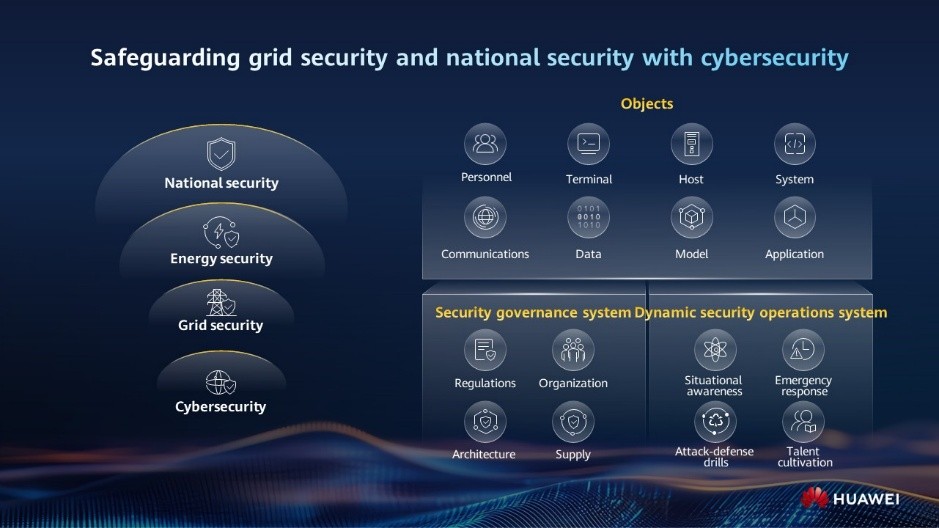
As access points surge by thousands of times and the geopolitical landscape grows more complex, cybersecurity in the power sector escalates from grid protection to energy security, and even national security.
We need a systematic approach to cybersecurity—a multi-layered, in-depth defense system built around eight objects. We must also strengthen governance across regulations, organizations, architecture, and supply, while ensuring dynamic security operations.
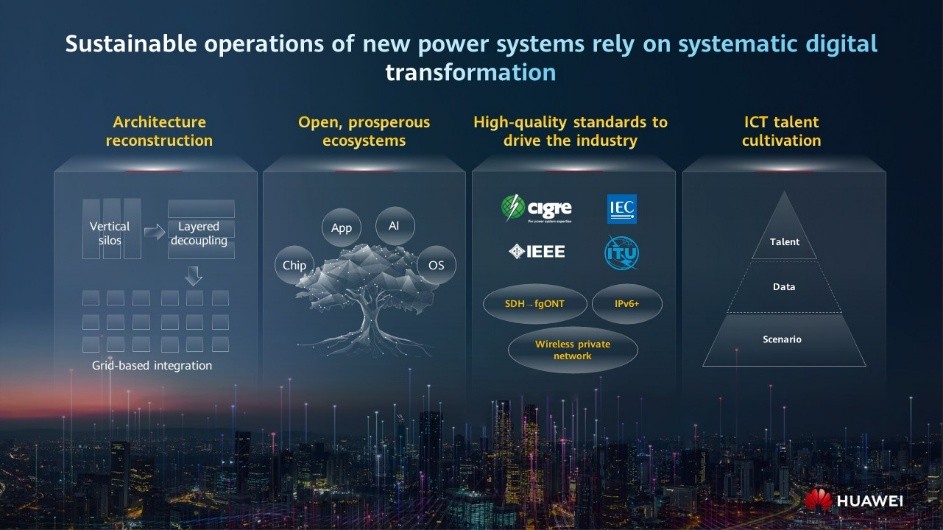
To build digital and AI capabilities at scale, we need to focus on four areas.
First, architecture. We're moving from vertical silos to cloud-edge-device decoupling, and then to grid-based integration for AI.
Second, ecosystem: In the digital age, no one can do it all. We need to know the ecosystem, both within and beyond our industry, and put it to work for us.
Third, standards. We need unified, forward-looking standards to align the industry, unlock digital and intelligent market opportunities, and drive industry upgrades.
And fourth, talent. We should turn power experts into AI experts, equipping them to lead. So more can step up and become the Mini CEO of their own grid. That's how we ensure sustainable growth in the power sector.
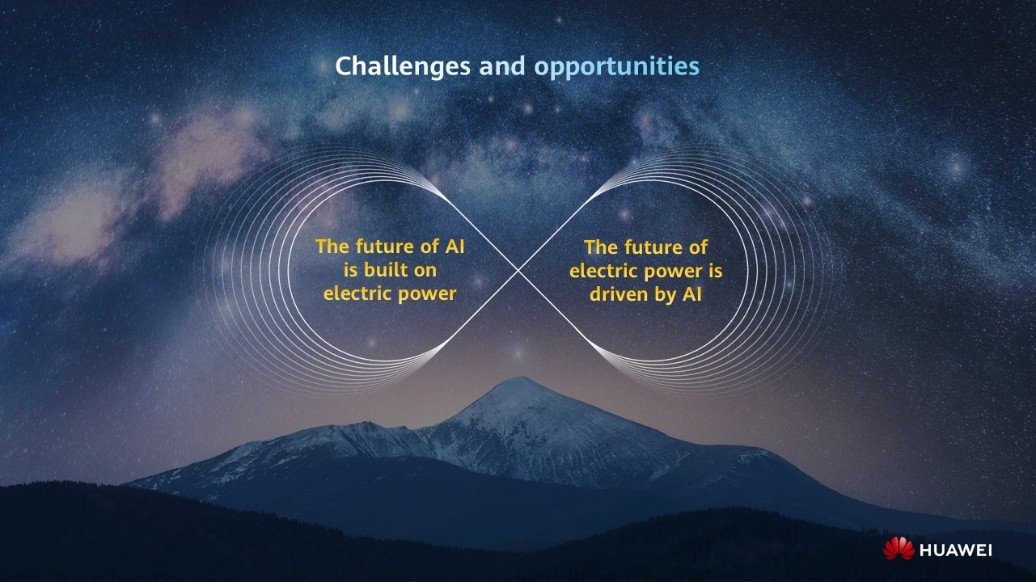
For the power industry, AI brings challenges and opportunities.
The future of AI is built on electric power. That means massive installed capacity, robust grids, fast access to electricity, and real-time high-speed communication, four pillars that define the opportunity ahead for our industry.
And the future of power is driven by AI. AI has become a survival essential and an integral part of the core production system.
Disclaimer: The views and opinions expressed in this article are those of the author and do not necessarily reflect the official policy, position, products, and technologies of Huawei Technologies Co., Ltd. If you need to learn more about the products and technologies of Huawei Technologies Co., Ltd., please visit our website at e.huawei.com or contact us.
Copyright © 2026 Huawei Technologies Co., Ltd. All rights reserved.