Produkte, Lösungen und Services für Unternehmen
Smartphones, PCs & Tablets, Wearables, mobiles Breitband und mehr
Über Huawei, Nachrichten, Veranstaltungen, Brancheneinblicke und mehr
[Guiyang, China, May 12, 2026] On April 29, Guizhou Wujiang Hydropower Development Co., Ltd. (Huadian Wujiang), together with Huawei, Guodian Nanjing Automation, and other partners, released the Huadian Zhiyu—Wujiang Ruisuan model. Built on Huawei Cloud weather model, it is the first AI model for runoff prediction.
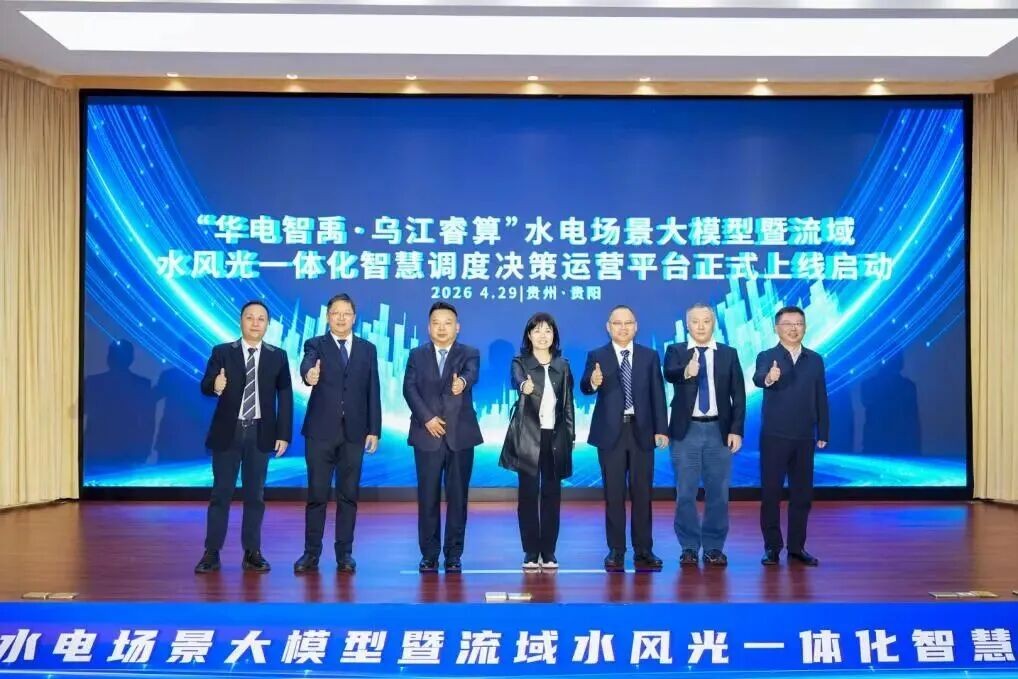
Official launch of the Wujiang Ruisuan model for hydropower scenarios, an integrated intelligent dispatching and decision-making platform for watershed water-wind-solar power
"The model involves the world's first deep integration of a weather model with hydrological mechanisms," said Chen Xiaobin, Director of the Science, Technology, and Digitalization Department at China Huadian Corporation. "It marks a fundamental shift from manual statistics and rule-of-thumb practices to algorithm-driven modeling and precision inference. With this platform now in operation, the power sector has overcome one of its toughest challenges—the integration of weather forecasting and runoff prediction, turning a long-standing bottleneck into a new competitive edge."
The core challenge of integrated water-wind-solar power dispatching lies in the uncertainties surrounding the weather, incoming water, wind, and solar output. Built on Huawei's hybrid cloud AI computing foundation and weather model, the Wujiang Ruisuan model marks the world's first application of a large model for river runoff prediction, filling a critical gap in the field.
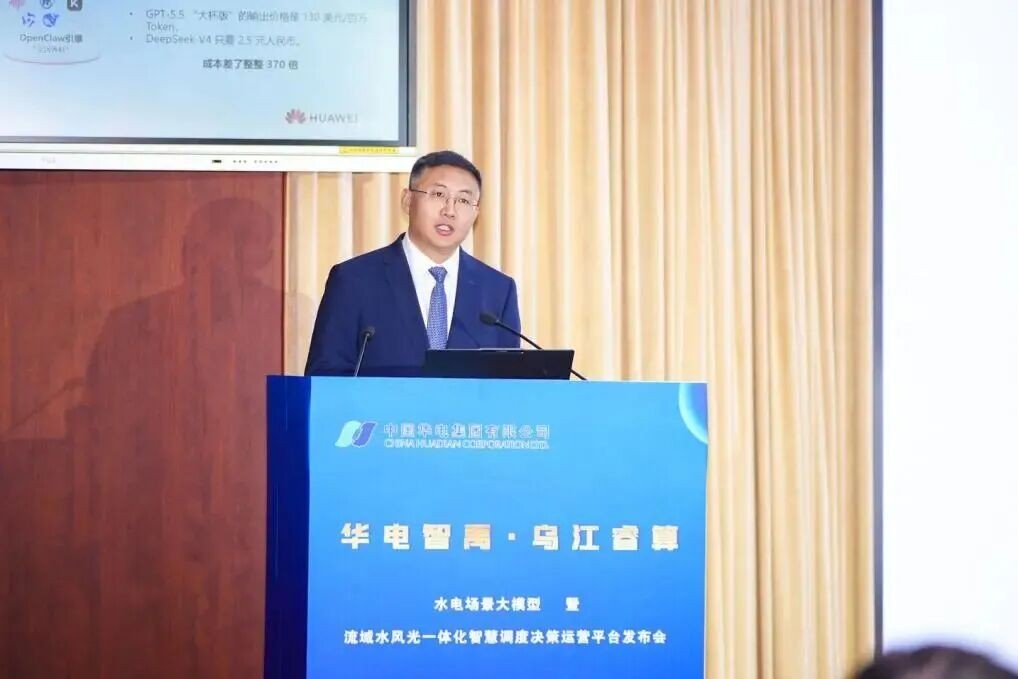
Tian Song, a Senior Program Director at Huawei's 2012 Labs, introducing the model
Tian Song, a Senior Program Director at Huawei's 2012 Labs, detailed the technical logic behind the model: It uses a spatiotemporal graph neural network to reconstruct runoff generation mechanisms, accurately capturing the deep coupling between rainfall and dynamic hydrometeorological characteristics. Data shows that the model improves short-term runoff prediction accuracy by more than five percentage points compared to conventional mechanism models, with inference completed in seconds.
Given that a new AI model is released on average every 1.5 days, the question amid this proliferation is how to ensure that AI capabilities deliver stable, sustained value in energy operations. According to Huawei, a deterministic AI platform is needed to manage the uncertainty of rapidly evolving models.
Huawei's hybrid cloud AI compute foundation features an innovative cloud-edge collaborative architecture. China Huadian Corporation builds its AI development and training platform on this foundation, while Huadian Wujiang handles local scenario-specific inference. With software-hardware synergy for computing power scheduling, rapid model adaptation, and end-to-end security, the solution abstracts away underlying hardware complexity. This enables the rapid deployment and continuous optimization of the Wujiang Ruisuan model across scenarios like weather forecasting, runoff prediction, and power generation forecasting. According to Huawei, architecture defines competitiveness, and effective, reliable application of large models in energy operations cannot be achieved without embedding multimodal data fusion and mechanism integration capabilities into the foundation.
This platform-based approach means that AI capabilities are not limited to Huadian Wujiang. With a high-quality dataset of over 50 TB covering three major categories and more than 60 data types accumulated through the project, the solution can be seamlessly extended to broader applications, including flood control, drought relief, ecological protection, and transportation logistics.
The launch of the Wujiang Ruisuan model marks a significant milestone in developing new quality productive forces for Huadian Wujiang. It also stands as a major advance in clean energy operations under China Huadian Corporation's computing-electricity integration strategy.
As a benchmark AI project among China's central state-owned enterprises, the Wujiang Ruisuan model tackles long-standing hydropower challenges through technological innovation and drives an AI-powered upgrade in watershed power station command and dispatching. Going forward, the model will continue to evolve through rapid iteration, scaling from its origins in Guizhou across China and beyond. It is ready to deliver a replicable and scalable Chinese solution for digital transformation in the global energy sector.
Copyright © 2026 Huawei Technologies Co., Ltd. All rights reserved.