
Thailand's KBank Enters a New Era of Intelligent Finance
Продукти, рішення, послуги для організацій

Amid the global wave of digital-intelligent transformation in the financial sector, Thailand's financial market is standing out with its highly digitalized growth trajectory. KASIKORNBANK (KBank), a leading player in Thailand's banking industry, was founded in 1945 by Thai-Chinese entrepreneurs. From its origins serving the agricultural sector, it has evolved into a comprehensive bank with extensive coverage of commercial and industrial businesses, holding a dominant position in SME lending, and successfully listed on the stock exchange. In recent years, KBank has accelerated its FinTech strategy. Its mobile application, K PLUS, not only offers core banking services but also extends deeply into lifestyle scenarios such as healthcare, shopping, and entertainment. The results have been remarkable—in 2021, FinanceAsia named KBank Best Bank, Best Sustainable Bank, and Best Private Bank.
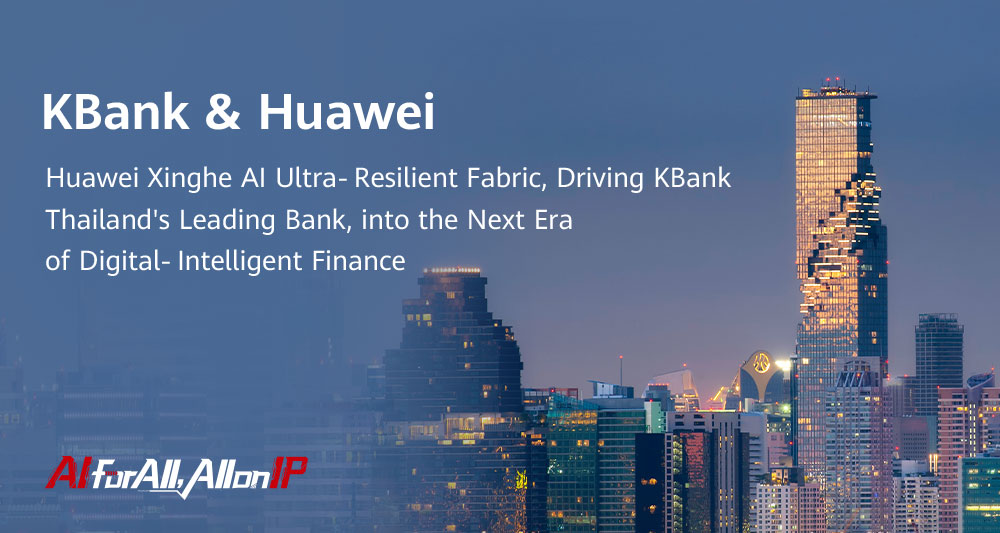
As the digitalization of Thailand's financial industry continues to advance, KBank is also facing significant challenges. In its data center network, the bank's app user base and transaction volumes have surged explosively. The number of users is approaching 20 million, with an annual growth rate of 17%, while annual transaction volume has reached an astonishing 285 billion, growing at 42% year-on-year. To address this trend, KBank invests over US$100 million annually in ICT infrastructure, with data center construction as a top priority. However, its existing data center network architecture has exposed a series of critical issues that are constraining further growth.
• Low reliability, unable to meet high service demands
KBank's data center network is heavily dependent on a single-vendor device environment. Previously, a sudden core switch failure caused a three-hour outage of the live network, during which mobile banking services were disrupted. This incident had a severely negative impact on user experience and highlighted the vulnerability of a single-vendor architecture in handling unexpected events. To improve network reliability and resilience, KBank urgently sought to introduce a second vendor to build a more robust network architecture.
• Lengthy fault location, severe economic losses
In network operations and maintenance (O&M), KBank's current network lacks effective fault location tools. In one outage incident lasting three hours, foreign exchange transactions at the airport were interrupted, causing direct economic losses and other impacts, while also undermining user confidence and damaging the bank's reputation. The prolonged fault location process meant the bank was slow to respond to network issues and unable to restore services quickly.
• Service quality gaps, delayed customer response
The current vendor lacks an in-country service team in Thailand. When incidents occur, KBank has to rely on partners to resolve issues. This often leads to delayed responses, with faults taking hours to fix, making it difficult to meet customer expectations for efficient and stable financial services. In Thailand's highly competitive financial market, such service quality issues significantly weaken KBank's competitiveness.
To address KBank's challenges, the Huawei Xinghe AI Ultra-Resilient Fabric solution, backed by strong technical capabilities and professional services, delivered a comprehensive network upgrade plan.
• Stable reliability—ultra-fast integration of heterogeneous networks with millisecond failover
Huawei built a new Availability Zone (AZ) for KBank. Leveraging end-to-end automation for heterogeneous networks and a unified network element model, the integration cycle for heterogeneous networks was shortened from months to days, greatly improving deployment efficiency. At the same time, KBank adopted Huawei's dual-plane architecture to significantly enhance network resilience. With Huawei's openness and compatibility, the bank can build an active-active network with both Huawei and existing vendor devices, enabling rapid service switchover and ensuring service continuity. At the link layer, M-LAG link failover can be completed within milliseconds, dramatically reducing the impact of network faults on services and providing a solid and reliable foundation for KBank's core operations.
• Intelligent O&M—minute-level fault location, leap in operational efficiency
Through the iMaster NCE management and control platform, Huawei's solution enables real-time monitoring of network status and precise fault location within minutes. Compared with the previous network, which required hours to locate faults, this greatly shortens troubleshooting time, allowing O&M teams to take swift action to restore services and minimize downtime and losses caused by network issues. This high-efficiency O&M capability provides strong assurance for KBank's service continuity.
• Professional in-country services, rapid customer response
Huawei has a professional in-country service team in Thailand that can respond to KBank's needs immediately. When network issues arise, Huawei engineers, with deep technical expertise and rich experience, quickly engage in fault diagnosis and repair to ensure timely and effective resolution. Compared with a partner-dependent service model, Huawei's direct service greatly improves response speed and problem-solving capability, enabling KBank to handle network incidents with greater confidence.
Through deep collaboration with Huawei, KBank successfully deployed the Xinghe AI Ultra-Resilient Fabric solution, achieving zero service interruption in fault scenarios and delivering more stable and efficient financial services to customers. This partnership not only resolved KBank's current network challenges but also set a new benchmark for the digital-intelligent transformation of Thailand's financial industry.
Looking ahead, as financial technology continues to innovate and evolve, data center networks will face even more complex challenges. Huawei will uphold its commitment to continuous innovation, working closely with KBank to explore deeper integration of AI and financial networks, injecting powerful intelligent momentum into the development of Thailand's financial sector.
Copyright © 2026 Huawei Technologies Co., Ltd. Усі права захищені.

