
Dragon City in South Africa Picks Huawei to Reimagine Digital Commerce
Продукти, рішення, послуги для організацій

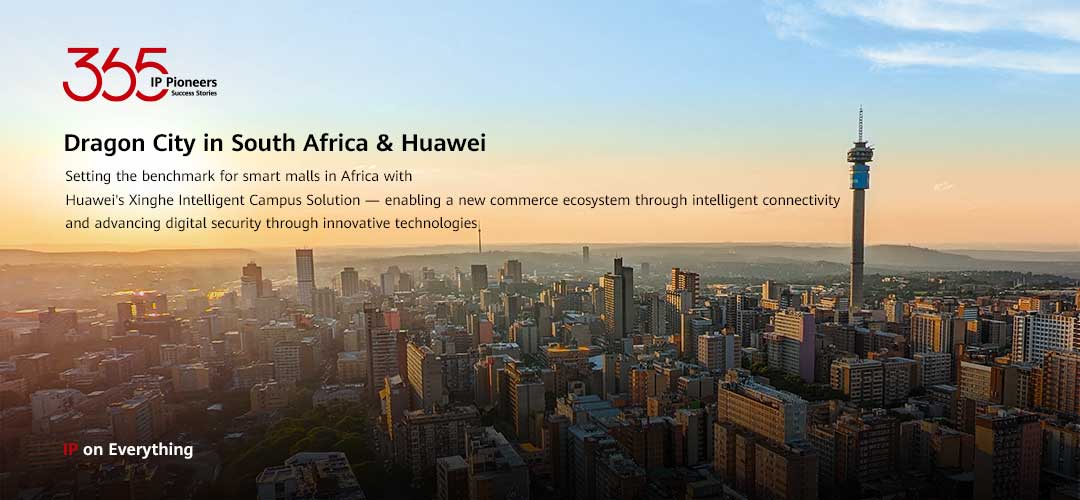
Johannesburg, South Africa, is known as the "City of Gold." Although it's not very large in size, it is home to nearly 20 Chinese-run shopping malls of various sizes. Since most of the commodities sold in these malls originate from China, their names often feature prominent Chinese cultural elements such as "Dragon," "Oriental," or "China."
Dragon City is one of the most prominent examples. From sparkling hair clips and rhinestone jewelry to colorful ribbons, formal dresses, and a wide variety of textiles, Dragon City offers affordable, high-quality commodities that are deeply favored by African consumers.
It's hard to imagine that a mall focused on small commodity wholesale could reach an annual procurement volume of nearly CNY40 billion, yet Dragon City has done just that—cementing its status as a "super hub" for small commodities in Southern Africa.
What's arriving in South Africa from China isn't just small commodities. A wave of digital business models, including mobile payments, livestream e-commerce, and digital platforms, is booming across the region. However, these new forms of commerce rely heavily on robust infrastructure. Unfortunately, legacy network infrastructure has become a bottleneck, holding back traditional malls like Dragon City from fully taking off in the digital era.
Dragon City is home to over 800 shops and attracts tens of thousands of visitors. Shoppers flock here to source a wide range of everyday and commercial goods, often sharing their finds and experiences on popular short-form video apps. The phrase "Here you can find everything you need" has become a recognizable slogan in their videos. However, Dragon City's previous network infrastructure made it challenging for visitors to share their shopping experiences on social media.
Dragon City began building its network infrastructure a decade ago. However, with the rapid growth of digital business, network demands have surged. Merchants frequently encounter issues such as endless loading screens and frequent disconnections for maintenance, leading them to jokingly describe the mall as "having network access, but no usable network."
Examples of key network challenges are as follows:
• Severe network congestion during peak hours: During peak periods, hundreds of users connect simultaneously, resulting in significant wireless interference. Merchants are particularly frustrated with electronic payments—due to heavy network congestion, each transaction takes nearly two minutes on average, with frequent failures. This severely impacts both the customer shopping experience and the mall's operational efficiency.
• Low network operations and maintenance (O&M) efficiency: Beyond its role as a wholesale hub, Dragon City is evolving into a mixed-use complex that includes hotels and residential spaces. However, the mall's large footprint and fragmented layout have led to uneven distribution of network resources. Communication between departments is inefficient, making fault locating and troubleshooting complex and costly. This reactive maintenance model has become a major obstacle to Dragon City's smart transformation.
• High network security risks: In recent years, cybersecurity threats across Africa have intensified, largely due to insufficient protection of network infrastructure. Cybercriminals have repeatedly exploited system vulnerabilities to steal and resell merchants' customer data, encrypt critical information, and demand ransom—causing significant financial losses. Dragon City's legacy network lacks effective security mechanisms, making it especially vulnerable in this challenging environment. These risks not only threaten the mall's day-to-day operations but also fuel hesitation around adopting wireless access. To safeguard its future, Dragon City urgently needs to establish a comprehensive "wired + wireless" layered security architecture—one that proactively defends against threats before they strike.
Without innovation in network infrastructure, there can be no sustainable development of the commercial ecosystem. To break free from the constraints of traditional network architecture and overcome the challenges of outdated infrastructure, the management of Dragon City has set its sights on building a fully connected, digitally empowered commercial ecosystem. With this vision, they have chosen to partner deeply with Huawei—officially embarking on the "smart mall" journey.
Through in-depth communication and research with Dragon City, Huawei's team designed a solution centered on building a high-performance mall network defined by speed, intelligence, and security. The breakthrough came in the form of a three-pronged approach: 10 Gbps high-speed network, intelligent O&M platform, and Wi-Fi 7 Shield technology. Together, these capabilities empower Dragon City to build an industry-leading smart mall network.
Key features of this new network include the following:
• Optical fiber-based 10GE access for bandwidth assurance: To address severe network congestion and payment delays during peak hours, Dragon City built an ethernet all-optical campus network with Huawei's CloudEngine S5731 series 10GE switches. Designed with 10GE high-speed ports, these switches boost the mall's core link bandwidth to 10 Gbps. More importantly, these switches can be paired with the latest Wi-Fi 7 access points (APs) to effectively resolve issues such as high-density access congestion and payment transaction lag on the mall network.
• Intelligent O&M for higher efficiency: To address the challenges of difficult network O&M and long fault resolution cycles, Dragon City set up a fully visualized network management system with Huawei's iMaster NCE-Campus and iMaster NCE-CampusInsight platforms. As the next-generation autonomous driving network management and control system, iMaster NCE-Campus enables automated campus network deployment, service policy automation, and intelligent O&M. Meanwhile, iMaster NCE-CampusInsight, the autonomous driving network analyzer, provides a range of features like real-time experience visibility, minute-level fault locating, and intelligent network optimization. Together, these platforms transform Dragon City's network O&M from manual-driven to data-driven, making network O&M more efficient, intelligent, and transparent.
• Wi-Fi Shield + MACsec for physical-layer (PHY) protection and end-to-end link security: To counter risks such as eavesdropping and data leakage, Dragon City chose Huawei's AirEngine 6776-58TI, a next-generation Wi-Fi 7 access point (AP). This AP features Huawei's exclusive Wi-Fi Shield technology, which leverages beamforming and unique AI-based signal scrambling to emit randomized noise toward areas beyond the locations of target users. This technology prevents attackers from demodulating valid signals while ensuring that target users remain unaffected. As a result, wireless security is significantly enhanced, evolving from "hard-to-eavesdrop" with traditional encryption to "impossible-to-eavesdrop" with PHY protection.
With a robust network infrastructure in place, Dragon City has significantly boosted bandwidth and demonstrated outstanding performance during high-concurrency scenarios. In electronic payments, for instance, the average transaction time has dropped from two minutes to just a few seconds. At peak hours, customers now enjoy zero wait time at checkout, with service efficiency improving by 80%. Additional benefits include more streamlined network operations, network-wide visibility, minute-level fault locating, and an average service recovery time of less than one hour. Service downtime has decreased by 80%, while operational efficiency has doubled. Most importantly, network security has been greatly enhanced. With zero packet capture and zero data leakage, critical customer data such as membership and payment information is fully protected, giving shoppers complete peace of mind when using electronic payments.
Today, Dragon City is emerging as an exemplary smart mall in Africa and is actively exploring the integration of more intelligent scenarios into its commercial ecosystem. Its practices in transforming network infrastructure are inspiring other enterprises to harness advanced digital technologies to renew and reshape their own business ecosystems. As a result, Johannesburg—the "City of Gold"—now gleams with a new brilliance: a digital journey powered by intelligent networks.
Copyright © 2026 Huawei Technologies Co., Ltd. Усі права захищені.

