Produits, solutions et services pour les entreprises
AI is moving from labs into the operating core of finance and driving structural changes in the industry. The winners will be banks that move quickly to adapt their operations to the new normal.
The ambition is clear: “In the future, we believe there will be two types of banks, AI banks and other banks,” says Jason Cao, CEO of Huawei Digital Finance.
Digitization transformed banking from an offline to an online experience. AI has shifted it yet again. Banks that once focused the bulk of their resources on a few high-value clients can now extend premium, hyper-personalized services across the board.
This shift is more than cosmetic. The arrival of AI agents changes how value is delivered. These systems are context-aware, proactive, and capable of taking action, transforming banks from service portals into financial stewards. This leads to better resource utilization, reduced error rates, and increased revenues.
“Providing hyper-personalized services will become a core competency for financial services institutions,” says Cao. “In the digital era, the app was the gateway for all services. In the AI era, it will be a super assistant on a mobile phone. Where banks previously had to consider pleasing their customers, they now also need to satisfy the needs of their customers’ AI agents. Every financial institution will need to rethink how to adapt to this change.”

Customer utilizing online banking services
Huawei’s thesis aligns with what banking leaders are already seeing: the next phase of AI transformation depends less on model quality as it’s progressing rapidly and more on operational execution. The service model is shifting from passive to active, and with that, human-machine collaboration is moving from humans and their AI tools to humans and their AI colleagues. Decision-making will evolve from data-driven to data and knowledge-driven.
“Financial institutions should not underestimate the long-term impact of AI, nor should they overestimate short-term results,” says Cao. Instead, the key is for banks to integrate AI into their overall strategic framework, as several leaders are already doing.
“AI transformation is not easy, but it is a must,” says Cao. To support financial institution’s AI execution, Huawei is jointly exploring eight critical areas with its financial customers: infrastructure, data-to-knowledge, models, tools & engineering, architecture, business scenarios, talent, and ecosystem.

"This is a big shift. In the long run we are jointly exploring the future architecture, and in the short run, we are working on the tools and engineering which enable successful business scenario implementation."
Jason Cao
CEO of Huawei Digital Finance
While comprehensive strategies are important, people remain at the heart of transformation. The tone from the top matters, particularly as budgets rotate from pilots to production. “It isn’t enough for the management level to advocate digital transformation. Everyone needs to be on board,” says Cao.
The rapid development of mobile payments in China over the last decade has provided a reference for global financial institutions undergoing their own digitalization transformation. Chinese banks have swiftly transitioned from traditional to digital banking, with their business model, ecosystems, culture and organization, technology architectures, and platforms evolving in step. The transition to AI is no different. Chinese financial institutions have widely implemented AI across the spectrum of their businesses.
In one example, a leading Singapore institution sent over 1,000 employees to visit Huawei in China, an effort he says underscores that transformation can’t be a management-only initiative.

Integrating AI models into digital banking
The transformation of financial institutions is shifting from traditional financial services models to a “platform + ecosystem” model, where the ecosystem provides crucial value. Huawei has been deeply involved in the digital transformation of the financial industry in China. As a company that has been providing technology solutions to financial institutions for the past 15 years, Huawei now assists financial services firms in advancing their AI transformation and achieving business success. One such way is through RongHai, Huawei’s global FSI partner program.
RongHai provides a global platform that serves as a bridge between global financial clients and emerging financial partners who start their business from a certain local market, especially the leading partners from China. Through the initiative, Huawei collaborates with such partners to “go global”, engaging in deep collaboration on solution development and innovation specific to its customers’ financial scenarios. The program actively promotes the global replication of industry best practices, helping more financial institutions across the world to achieve digital and intelligent transformation.
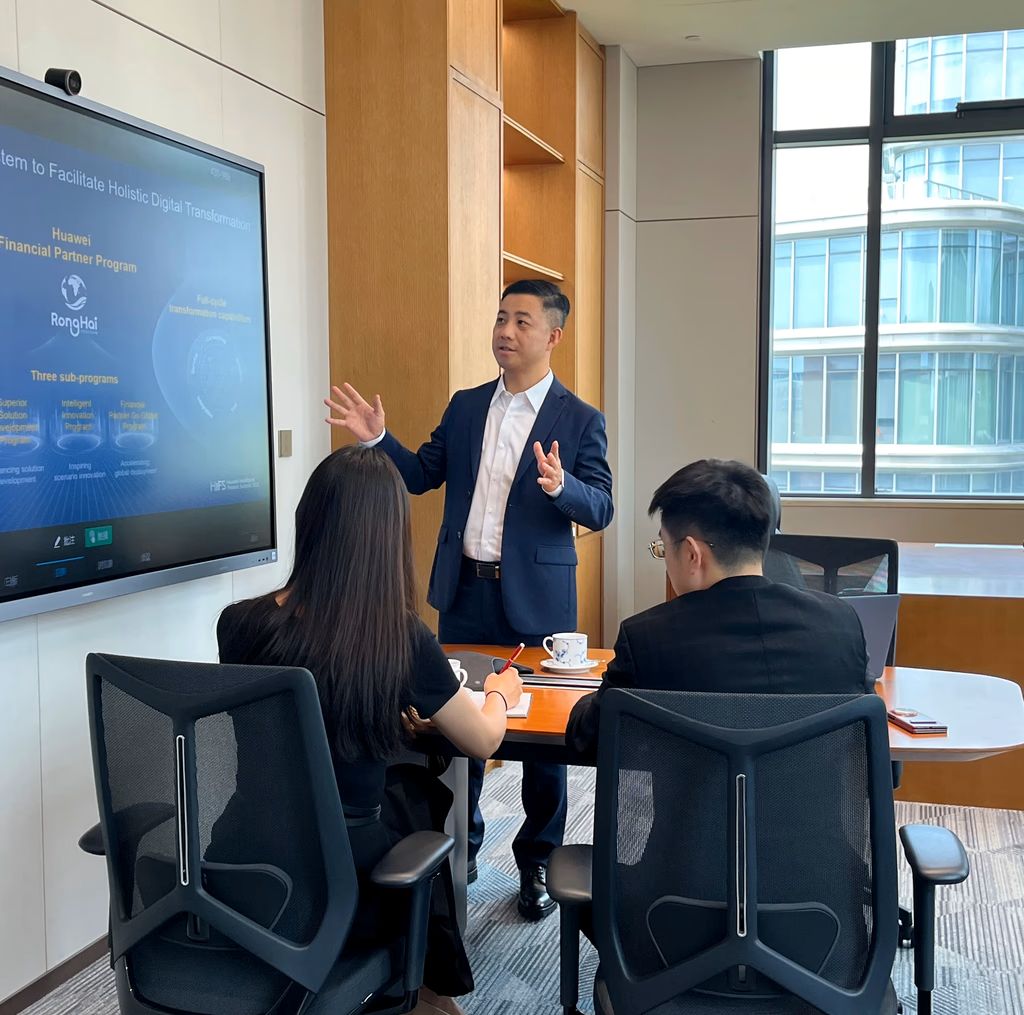
Jason Cao making an introduction about Huawei global FSI partner RongHai program.
Through RongHai and one of its sub-programs, the Financial Partner Going Global Program (FPGGP), a leading bank in Southeast Asia collaborated with Huawei and one of its technology solution partners to develop a new anti-fraud capability. In another instance, working with Huawei and its partner, a digital bank in Southeast Asia was able to build a new core banking system within 35 days when it normally could take six months to over a year. That experience has now been replicated to banks in the Middle East and Central Asia through RongHai . “Many financial customers mentioned to us that we bring ‘China speed’ to the world, and that this accelerated speed is key to their transformation,” says Cao.
Huawei also emphasizes the importance and depth of partner engineering behind efforts to deploy AI rapidly. “We can’t view everything from the perspective of the traditional vendor-buyer model. We have to go for a new model of co-creation,” says Jason Cao, CEO of Huawei Digital Finance.
That’s not just positioning. At Huawei Connect 2025, the company unveiled the FinAgent Booster (FAB), a platform that collates the company’s extensive experience and engineering capabilities in the global financial field. FAB offers a series of ready-to-use templates, solutions, and toolkits. By optimizing models and computing resources, it significantly reduces the technical difficulty and development cycle of AI implementation, enabling financial institutions to more easily and efficiently innovate and deploy AI agent applications, thereby quickly realizing business value.
Using FAB’s intelligent loan review template, Huawei assisted a city commercial bank in China in launching an intelligent review system within just two weeks, when it normally would have taken months. Similarly, the program enabled a leading bank in the Middle East to launch an intelligent credit card approval solution, which reduces card application approval times from 10 minutes to 20 seconds, significantly enhancing efficiency and customer experience.
FAB supports Huawei’s broader ecosystem strategy to advance intelligence across all domains, accelerate the shift from data to knowledge, and build resilience for an AI-powered financial system. This isn’t about generic AI adoption; it’s about enabling banks to operationalize AI with speed and accountability.
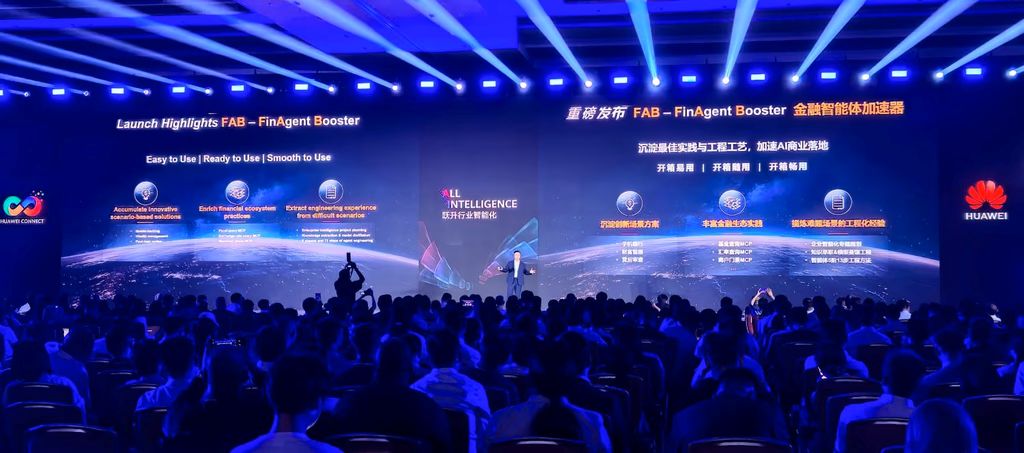
Jason Cao, CEO of Huawei Digital Finance, delivering a keynote speech
New regulatory frameworks are guiding, not stalling, progress. Europe’s AI rulebook and digital operational resilience requirements have raised the bar, but they aren’t the only story. Across Asia, principles from Singapore and Hong Kong share a similar emphasis on accountability, transparency, and fairness. These regulations, while evolving, share a common message: AI in finance must be explainable, auditable, and human-centered.
Winners will be those who move fast and meet the spirit of these standards. This includes designing systems that allow human oversight for high-impact decisions and tracking data lineage from training to outcome. In that context, infrastructure decisions directly affect compliance readiness.

Employees attending a class on artificial intelligence compliance
An increasing number of financial institutions believe that AI will inevitably bring about structural changes, positioning AI as the core of their strategic planning.
Banks that can compress decision cycles, maintain oversight, and implement AI responsibly will have the edge. The advantage will go to institutions that treat regulation not as a constraint, but as a competitive differentiator and to partners who help them scale that edge.
“Partnership is critical to set the pace and accelerate the transformation of banks. For sure, we try to be such a partner,” says Cao.

Banks that can compress decision cycles, maintain oversight, and implement AI responsibly will have the edge.
Copyright © 2026 Huawei Technologies Co., Ltd. All rights reserved.