ผลิตภัณฑ์ โซลูชั่น และบริการสำหรับองค์กรธุรกิจ
A complex, fast-changing global landscape and exponential AI advancements are reshaping the transportation industry, presenting both unique opportunities and challenges.
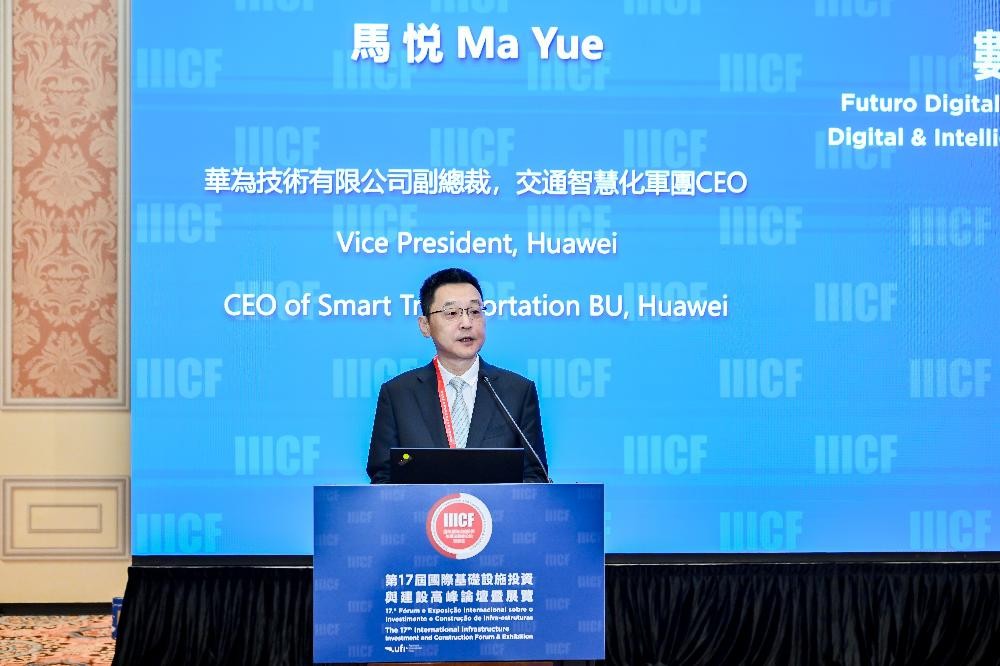
Ma Yue, Vice President of Huawei and CEO of Huawei's Smart Transportation BU
First, digital and intelligent transformation has become a defining global trend. Smart transportation stands as a critical strategy to ensure safe travel and efficient logistics.
In recent years, deep shifts in global supply chains have unlocked new opportunities for regions like Africa, Latin America, Central Asia, and Asia Pacific, enabling them to attract new industries and fuel local economic growth. High-quality transportation infrastructure is crucial to supporting this expansion. Consequently, many countries and regions have already launched smart transportation initiatives, using digital and intelligent tools to optimize both passenger and freight flows while building regional logistics hubs.
Where we once treated ports, airports, rail, roads, and urban transportation separately, we now integrate them to enable one-stop travel and multimodal transport. Powered by digital and intelligent technologies, this integration will deliver safer, faster, and more enjoyable journeys.
Beyond mobility, combining transportation with energy, tourism, trade, campus, and other sectors is opening up even greater possibilities. Today, airports are no longer just for catching flights; they are transforming into vast business centers as the momentum toward "airport cities" accelerates. Ultimately, by sharing data across all areas and deploying smart tools, we can redefine travel experiences and cut logistics costs.
Second, drawing on the smart transportation milestones of leading nations like China offers valuable insights. The key lies in adapting solutions to local conditions and choosing the right paths and deployment models.
Decades of hard work have built China's massive transportation network. Now, we are moving fast toward deeper integration, higher safety, digital upgrades, and green transformation.
In our new five-year plan spanning 2026 to 2030, we will fully speed up the convergence of AI and actual business scenarios, aiming to unleash the complete value of data and scale smart transportation from local pilot projects into widespread application.
Looking back at China's journey in digital and intelligent transportation, the biggest takeaway is that smart transportation must go beyond merely stacking technologies or products. It should be driven by business strategies and supported by overall planning, wise execution, and long-term operations. We must integrate digital mindsets and tools into the entire lifecycle, from initial planning and construction to ongoing management. Since nations and regions vary in their economic drivers, population sizes, industries, and travel habits, smart transportation cannot be one-size-fits-all. Every region must choose the right path and solutions tailored to its own reality and actual needs.
Third, Huawei remains committed to investing in the digital foundation of smart transportation. Together with our partners, we will accelerate the transformation and sustainable growth of the global transportation industry.
As a leading digital and intelligent infrastructure provider, Huawei is driven by the conviction that innovation powers the future.
We continue to prioritize foundational research in math, physics, chemistry, and materials science. Through new technologies, next-generation architectures, and advanced systems engineering, we foster ongoing innovation and convergence across sensing, connectivity, computing, storage, cloud, big data, and AI. Alongside our partners, we dive deep into actual business scenarios to construct a secure, efficient, and robust digital foundation for comprehensive transportation and logistics, ultimately optimizing passenger, logistics, business, fund, and information flows.
Over the years, we have spearheaded a special program to help our Chinese partners go global, bringing together over 40 partners in engineering, construction, and smart transportation. We offer a full range of services, covering consulting, planning, design, financing, construction, management, operations, and talent development. So far, we have supported smart transportation projects across over 170 countries and regions worldwide.
This year, Huawei is significantly stepping up its investment in global markets. We have established five Global Capability Centers across key regions, including Asia Pacific, Latin America, Africa, Middle East & Central Asia, and Europe, to deliver faster responses and better serve diverse industries.
To date, Huawei has served more than 100 ports, more than 210 airports and airlines, over 300 urban rail lines, over 180,000 kilometers of railways, road networks extending over 200,000 kilometers, ITS projects across over 70 cities, and more than 200 logistics enterprises across the globe. Looking ahead, Huawei will remain committed to openness and collaboration for shared success. The company specializes in developing transportation hubs, transportation networks, and passenger/freight flows to establish a digital and intelligent foundation for comprehensive transportation and logistics. Huawei is dedicated to "driving mobility and logistics into the intelligent world," empowering smart transportation.
Disclaimer: The views and opinions expressed in this article are those of the author and do not necessarily reflect the official policy, position, products, and technologies of Huawei Technologies Co., Ltd. If you need to learn more about the products and technologies of Huawei Technologies Co., Ltd., please visit our website at e.huawei.com or contact us.
Copyright © 2026 Huawei Technologies Co., Ltd. All rights reserved.