
WeBank: Transforming Database Architecture
Este sitio utiliza cookies. Si continúa navegando en este sitio, acepta nuestro uso de cookies. Lea nuestra política de privacidad>

Enterprise

Ms. Li, a clothing store owner in Hangzhou, has been approved for a loan of CNY200,000. Mr. Zhang, a programmer in Guangzhou, has paid off his home decoration loan on his phone.
These ordinary yet powerful moments in the lives of regular people are now possible with financial services. That is why WeBank does what it does: making financial services accessible for all.

Since its founding in 2014, WeBank, China's first digital bank, has been setting benchmarks for technology-driven growth in the financial industry.
• 24/7 services for 420 million individual users
• Credit loan support within minutes for 5 million SMEs and micro enterprises
• CNY2 per year for single-account IT O&M, less than one-tenth the industry average
Technology fuels the bank's large-scale innovation at low cost.
"Back in 2014, when we were just getting started, we had two options for our core production system." recalled Hu Panpan, manager of the WeBank database platform department. "One was to adopt the traditional centralized IOE architecture for a quick rollout; the other was to explore a distributed architecture—something no financial institution in China had attempted before."
Driven by its mission to make finance accessible to the general public, WeBank opted not to follow the conventional path. Instead of relying on traditional IT infrastructure, the bank transformed its cost structure by using cutting-edge technology to develop a sustainable business model that serves SMEs and micro enterprises as well as the general public. WeBank embarked on a bold journey of innovation to build the world's first distributed core banking system with standard servers and open-source software.
The system handles a massive customer scale and high-concurrency transactions at remarkably low cost. It breaks the "impossible triangle" of large capacity, low cost, and high availability in core banking systems. Even with 1.4 billion daily transactions, it maintains 99.999% reliability for core services—surpassing carrier-grade standards—while keeping average IT O&M costs per account at just CNY2.
The rise of AI and explosive growth of data in the past ten years presents a host of new challenges. At WeBank, the volume of data has grown from less than 10 PB to over 110 PB, and the number of servers has increased 20-fold to 20,000. The bank's legacy database architecture built on servers with local disks struggled to handle rising costs and O&M workloads.
• Service Continuity Risks: With the storage-compute coupling architecture, servers had a high rate of single-disk failure, which limited single-server availability to around 99.9%. Server faults would trigger database active/standby switchover, causing service jitter and heavy O&M workloads.
• Low Resource Utilization: Tight coupling between compute and storage resources resulted in uneven resource utilization across nodes. Over 80% of servers had an average CPU usage of below 10%, which resulted in high resource costs.
• Poor Resource Scalability: The fixed capacity of single local disks capped the performance and scalability of single instances. This made it difficult to scale capacity up or down.
• Slow Data Reconstruction: Full data replication from the faulty server node was required. Data reconstruction took 2 hours per terabyte, during which database instances remained in a high-risk state, with potential threats to database availability in the event of a second failure.
To overcome these challenges, WeBank transformed the underlying hardware architecture of its core database system. After extensive evaluation, comparison, and validation, it ultimately settled on a diskless architecture with storage-compute decoupling.
• Servers without Local Disks (Diskless): Local disks are separated from servers and form a large-capacity storage pool that supports remote access and centralized management. Applications are directly mounted to LUNs, partitions, and volumes for on-demand storage resource allocation.
• Stateless Computing: Only the CPU and memory are retained on the database compute node. Compute resources are flexibly allocated using virtualization and containers.
• Dual-Layer HA Guarantee: The database software layer provides high availability (HA) based on TDSQL databases' strongly consistent active/standby synchronization and HA automatic switchover. The external storage pool achieves HA through the dual-controller mechanism and RAID of the storage disk enclosure. This enables more stable and reliable database services.
• Lightweight Semi-Centralized Storage-Compute Decoupling Architecture: Three storage disk enclosures and several compute nodes form a database resource pool (distributed in three local data centers) to provide multiple database instance services. The network-wide environment consisting of multiple database resource pools enables a lightweight semi-centralized storage-compute decoupling architecture. This architecture addresses the pain points of the coupled storage and compute and eliminates risks caused by centralized storage deployment.

Huawei OceanDisk Smart Disk Enclosure can meet the performance, reliability, and scalability needs of database scenarios, which makes it a lightweight yet powerful option over traditional storage devices.
• Fast: The next-gen 2 U disk enclosure provides up to 175 GB/s bandwidth and 5.2 million IOPS.
• Stable: The multi-level reliability (disk, architecture, and system) provides 99.999% reliability.
• Simplified: The smart disk enclosure inherits the RAID/EC and other software and hardware capabilities of professional storage, and comes with simplified redundancy functions of traditional storage. In addition, it seamlessly connects to TDSQL/TiDB databases, eliminating the need for application reconstruction.
• Efficient: The high-density hardware (2U, 36 disks), high-ratio EC (23:2) algorithms, and lossless data compression save maximum cabinet space and energy.
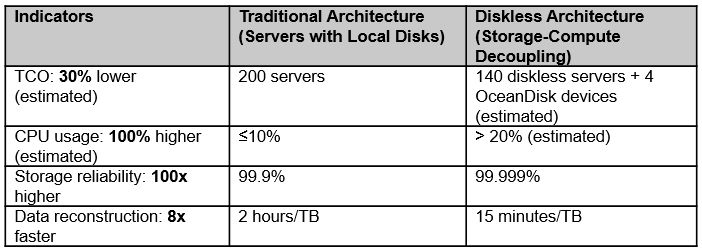
It is predicted that this architectural transformation will reduce the bank's overall database hardware costs by 30%. Elastic scalability and high availability are enabling explosive data growth in the AI era. This is the foundation for more inclusive finance.
A loan can be issued in the blink of an eye, and a repayment can be made with a tap. This kind of fast-paced innovation is what WeBank has achieved after a decade of pushing limits and expanding what is possible in financial services.
WeBank shattered the "impossible triangle" of large capacity, low cost, and high availability with its revolutionary distributed architecture, and rose above data explosion with a diskless storage-compute decoupling architecture. With Huawei OceanDisk Smart Disk Enclosure, WeBank is charging forward on its mission to provide inclusive finance, creating value for all.
Copyright © 2026 Huawei Technologies Co., Ltd. Todos los derechos reservados.

