This site uses cookies. By continuing to browse the site you are agreeing to our use of cookies. Read our privacy policy>

This site uses cookies. By continuing to browse the site you are agreeing to our use of cookies. Read our privacy policy>
Produits, solutions et services pour les entreprises
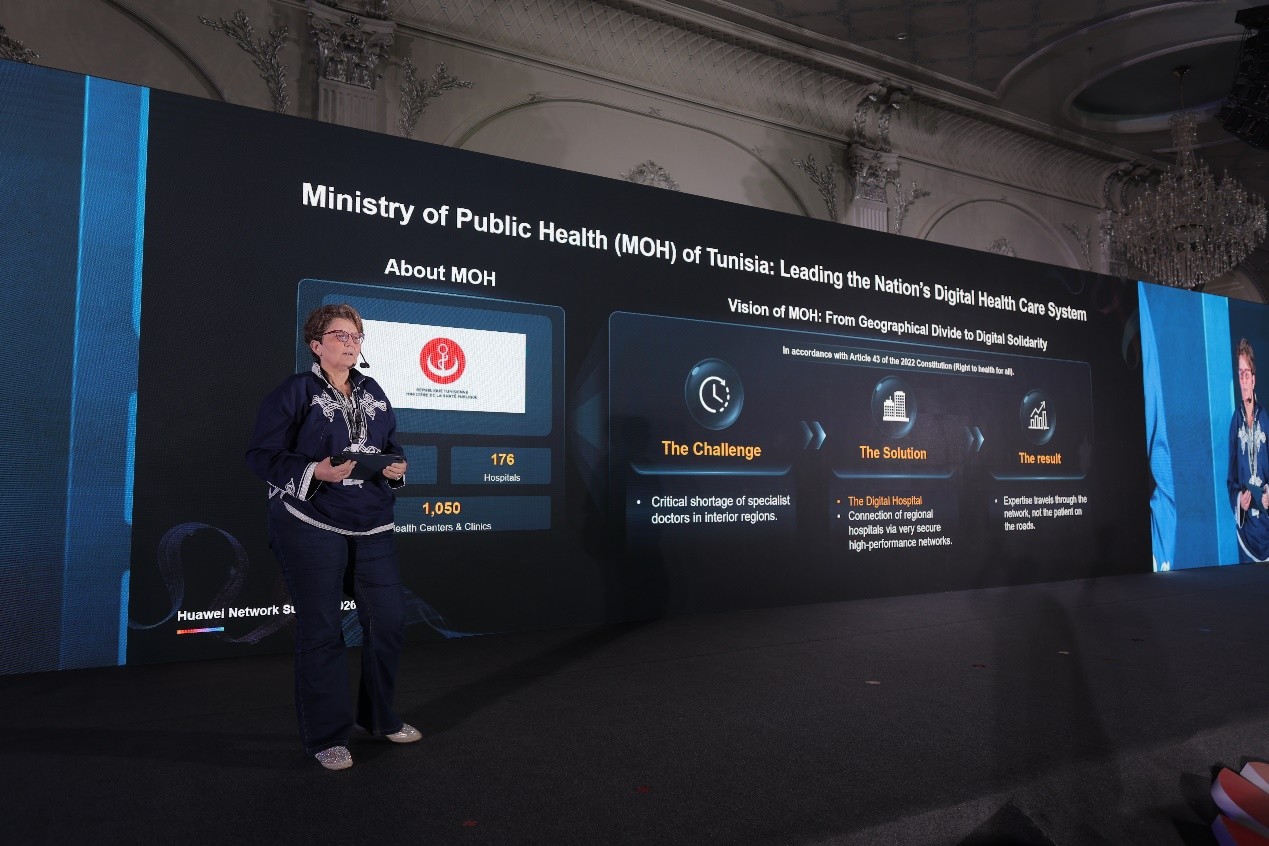
At Huawei Network Innovation Summit 2026 Northern Africa (HNS 2026 Northern Africa), Dr. Habiba Mizouni, Professor of Radiology and a member of the digital hospital team, delivered a keynote speech titled Network Security & AI Empower Equitable Care with Digital Sovereignty.

Dr. Habiba Mizouni, Professor of Radiology and a member of the digital hospital team delivered a speech.
She elaborated on Tunisia’s healthcare digital transformation anchored in digital sovereignty. Leveraging AI-powered Security Operations Center (SOC) and secure SD-WAN interconnection, Tunisia is building a fair, secure and self-contained national healthcare service ecosystem, setting a benchmark for digital health development across Northern Africa region and beyond.
Dr. Habiba Mizouni stated that Tunisia is advancing in-depth reform of its healthcare system under a national digital strategy. By deploying high-performance network infrastructure and establishing a national healthcare AI center, the country is modernizing medical services and enabling equitable access to quality care nationwide.
As a key contributor to Tunisia’s first digital hospital, she emphasized that the digital hospital initiative is far more than a technological upgrade — it is a people-centric project designed to bridge regional medical resource gaps. Powered by secure SD-WAN interconnection, high-level medical expertise is extended to grassroots institutions, realizing a new service model that brings expertise to patients rather than requiring patients to travel for medical treatment.
She highlighted that digital sovereignty stands as the fundamental prerequisite for healthcare digitalization. Medical data is highly sensitive and strategically critical to national livelihoods. Only by achieving independent control over data, core technologies and end-to-end security systems can solid trust be established to sustain long-term digital transformation.
Tunisia stays committed to independent domestic healthcare AI development. By training AI models based on local medical data and real-world scenarios, the country delivers more accurate, inclusive and context-adaptive medical services, avoiding algorithmic bias and over-reliance on external technologies. This sovereign digital healthcare model is replicable and exportable, positioning Tunisia as a regional leader in digital health transformation.
Tunisia has already deployed a full portfolio of mature telemedicine applications. The national teleradiology system covers imaging diagnosis demands across regional hospitals, connecting 25 medical facilities and completing over 50,000 examinations. Multidisciplinary teleconsultation services link more than 30 healthcare institutions covering dermatology, cardiology, diabetology and psychiatry.

Large-scale applications including tele-ophthalmology, breast cancer screening, tele-stroke emergency management and tele-pathology have been widely implemented. Coupled with localized healthcare AI innovation, these services perfectly fit domestic clinical needs and reduce dependence on imported technological solutions.

Dr. Habiba Mizouni fully recognized Huawei’s technological strengths in network connectivity, network security and intelligent SOC operations, and thanked Huawei for its solid support for Tunisia’s digital hospital construction.
She expressed that Tunisia looks forward to deepening strategic cooperation with Huawei in network infrastructure construction, AI innovation and security operation system deployment. Supported by Huawei’s Xinghe AI network security and intelligent SOC capabilities, both sides will consolidate the secure digital foundation, empower inclusive AI healthcare, and enable digital technologies to better serve public health and advance equitable medical services across the region.
Copyright © 2026 Huawei Technologies Co., Ltd. All rights reserved.