
Tsuyama Chuo Maniwa Hospital Powers Its Digital and Intelligent Transformation with Huawei DCS Solution
Empowering Healthcare with Technology for a Healthier Tomorrow
This site uses cookies. By continuing to browse the site you are agreeing to our use of cookies. Read our privacy policy>

Produits, solutions et services pour les entreprises

Empowering Healthcare with Technology for a Healthier Tomorrow
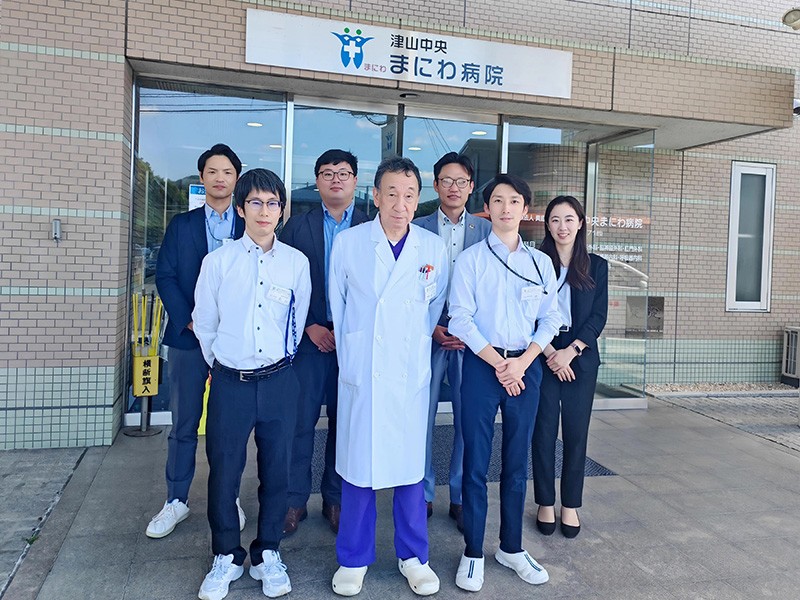
Tsuyama Chuo Maniwa Hospital staff and the Huawei team
Since its establishment in 1961, the hospital has been dedicated to its mission of safeguarding the health of local residents. Today, however, it faces a challenge. It must evolve traditional healthcare and embrace innovation, where digital and intelligent transformation is no longer a choice—it's a necessity. As Miyashima Takanao, the hospital's chairman of the board, has said: "As a healthcare institution, if we keep providing medical care and nursing only in the traditional way, we will face a survival challenge." He explained: "Every day, I hope to focus on delivering comprehensive care and services at the individual level, while also working to sustain and improve the broader healthcare environment in the community."
After careful evaluation, the hospital decided to upgrade its data storage solution to centralize and strengthen the management of both its data center and wider information technology (IT) infrastructure, which lie at the foundation of its healthcare. This would, in turn, stabilize and unify the management of service systems including the hospital information system (HIS) and the picture archiving and communication system (PACS), improving the utilization of healthcare resources and service agility.
With collaboration between hardware and virtualization software, Huawei's DCS solution has helped the hospital build a more lightweight, flexible, and intelligent data center. Indeed, the core technical strengths of the virtualization suite at the resource pool layer fully addresses the needs of the healthcare industry.
New intelligent scheduling mode: The FusionCompute virtualization engine virtualizes compute, storage, and network resources, centrally scheduling and managing virtual resources through a unified interface. This enables the efficient transfer of medical resources in the system. This management approach—of all-in-one resource integration—significantly reduces the hospital's IT operational costs while also enhancing the resilience for mission-critical healthcare data. The virtual image management system (VIMS) in the FusionCompute cluster eliminates the limitation of applying virtualization to a single storage system. This enables massive amounts of healthcare data to flow seamlessly in the virtual environment. Designed, deployed, and optimized for virtual server environments, it allows multiple virtual machines (VMs) to access an integrated cluster storage pool. This ensures that doctors can view full patient health records anytime and anywhere, improving resource utilization.
New intelligent disaster recovery (DR) and backup paradigm: eBackup software serves as a digital immune system for healthcare data. Thanks to the collaboration between backup servers and backup proxies, eBackup provides flexible protection policies for mission-critical healthcare data such as computerized tomography (CT) images and medical records. It is also fully compatible with local disks, network-attached storage (NAS), and S3 storage, ensuring that the entire medical data ecosystem can be quickly restored in any scenario.
Huawei Data Storage's ongoing collaboration with Tsuyama Chuo Maniwa Hospital is helping to ensure that every single patient experiences smarter, safer, more efficient, and more compassionate healthcare services, all backed up by state-of-the-art technologies.
Copyright © 2026 Huawei Technologies Co., Ltd. All rights reserved.

