このサイトはCookieを使用しています。 サイトを閲覧し続けることで、Cookieの使用に同意したものとみなされます。 プライバシーポリシーを読む>

このサイトはCookieを使用しています。 サイトを閲覧し続けることで、Cookieの使用に同意したものとみなされます。 プライバシーポリシーを読む>
企業ユーザー向け製品、ソリューション、サービス
[Shanghai, China, May 20, 2026] The Huawei Intelligent Finance Summit (HiFS) 2026 (Global Session), themed "Hello Fintelligent World: Beyond Digital, Advance to Agentic Banking," opened today at Huawei's Lianqiu Lake Campus in Shanghai. The event brought together over 800 representatives from financial institutions across more than 60 countries and regions, along with over 70 industry partners. At the summit, Huawei announced six key initiatives to accelerate the large-scale deployment of financial AI, launched its Financial Data Intelligence Solution 6.0 and Digital CORE Solution 6.0, and unveiled a resilience infrastructure for both general-purpose and AI computing. These efforts aim to empower global financial institutions to unleash AI productivity, driving the digital and intelligent transformation and business success of customers worldwide.
During the summit, Jason Cao, CEO of Huawei Digital Finance BU, noted that over the past 16 years of deep engagement in the financial sector, Huawei's financial strategy has continuously evolved from financial-grade hardware and software to industry solutions. By driving sustained innovation in foundational software and hardware, building systematic engineering capabilities, developing a diverse ecosystem, and providing localized services, Huawei has established an effective business growth flywheel.
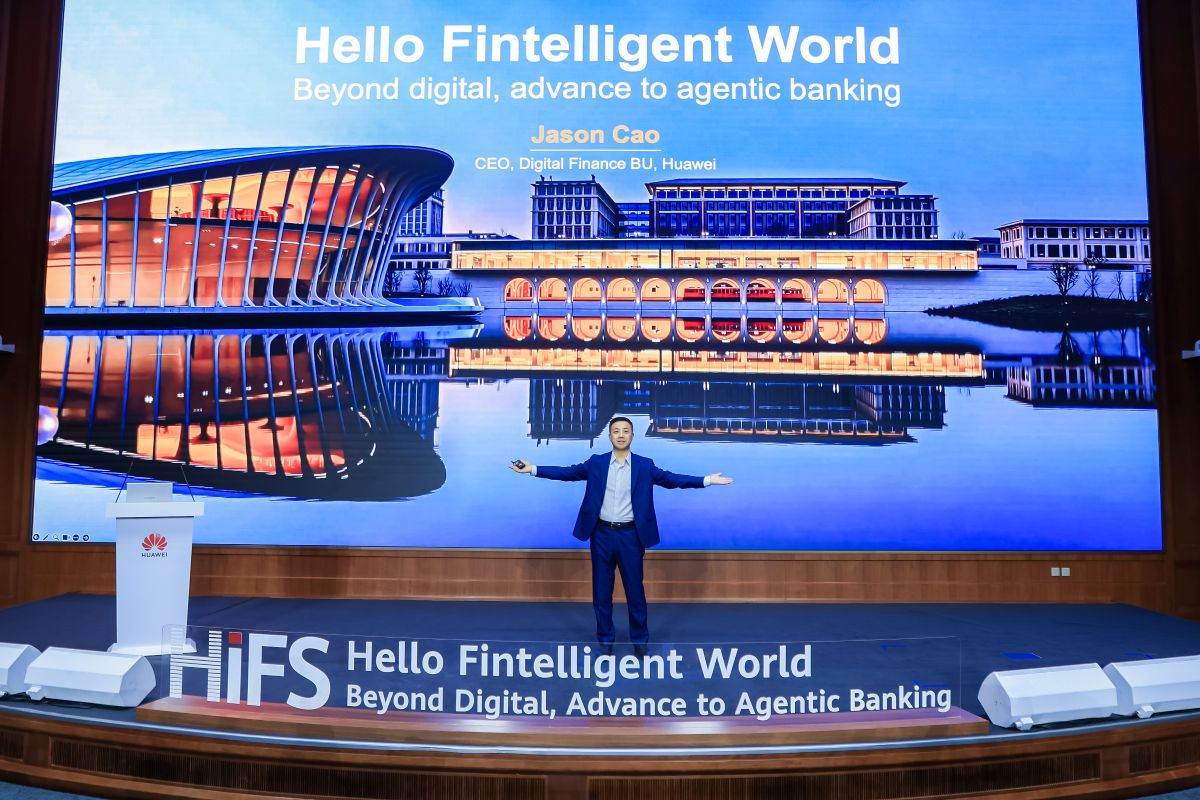
Jason Cao, CEO of Huawei Digital Finance BU, delivering a keynote speech
Huawei Digital Finance is committed to advancing its four core business strategies. Backed by Huawei's resilient ICT infrastructure, the company continues to deepen its RONGHAI global partner ecosystem, co-creating financial solutions to foster a new "4-Win" collaboration model encompassing customers, ISVs, SIs, and Huawei. As Agentic AI crosses the inflection point toward production-grade intelligence, accelerating its effective, large-scale adoption becomes paramount. To this end, Huawei has introduced a hybrid AI architecture powered by open-source foundation models, empowering global financial institutions to scale AI across high-value scenarios. In international financial markets, Huawei is focusing on six key initiatives—scenarios, architecture, engineering, data, AI infrastructure, and talent—collaborating with customers and partners to accelerate the transition to Agentic Banking.
In 2026, Agentic AI is crossing a critical inflection point, rapidly advancing toward production-grade intelligence. AI is evolving from an assistive tool into an advanced productive force capable of autonomous task orchestration and execution. On one hand, it is accelerating the deep digitalization of finance, enabling a leap from the digital economy to the real-time economy. On the other hand, it further drives deep intelligence, ushering in the new Agentic Banking model where "every user has a super steward and every employee has a super avatar."
• Redefining user experience from GUI to LUI: Enabling intent- and memory-driven hyper-personalization.
• Transforming human-machine collaboration: Building adaptive, dynamic business processes through agent collaboration.
• Reinventing business decision-making: Shifting from "rules + data" to "ontology + knowledge" to enable forward-looking risk control and operations.
Building core advantages based on open-source models is becoming the strategic direction for global financial institutions. By building domain-specific models from general-purpose foundation models, institutions can harness advanced engineering capabilities to accelerate deployment, enhance scenario adaptation, and boost commercialization efficiency—driving comprehensive breakthroughs in implementation speed, cost-effectiveness, and systemic integration. The combination of open-source models and private deployment ensures regulatory compliance, enables deep domain-specific optimization, and minimizes costs. Furthermore, a hybrid AI architecture spanning on-cloud and on-premises deployment safeguards data security, continuously optimizes token consumption, and ultimately achieves large-scale commercialization and sustainable AI.
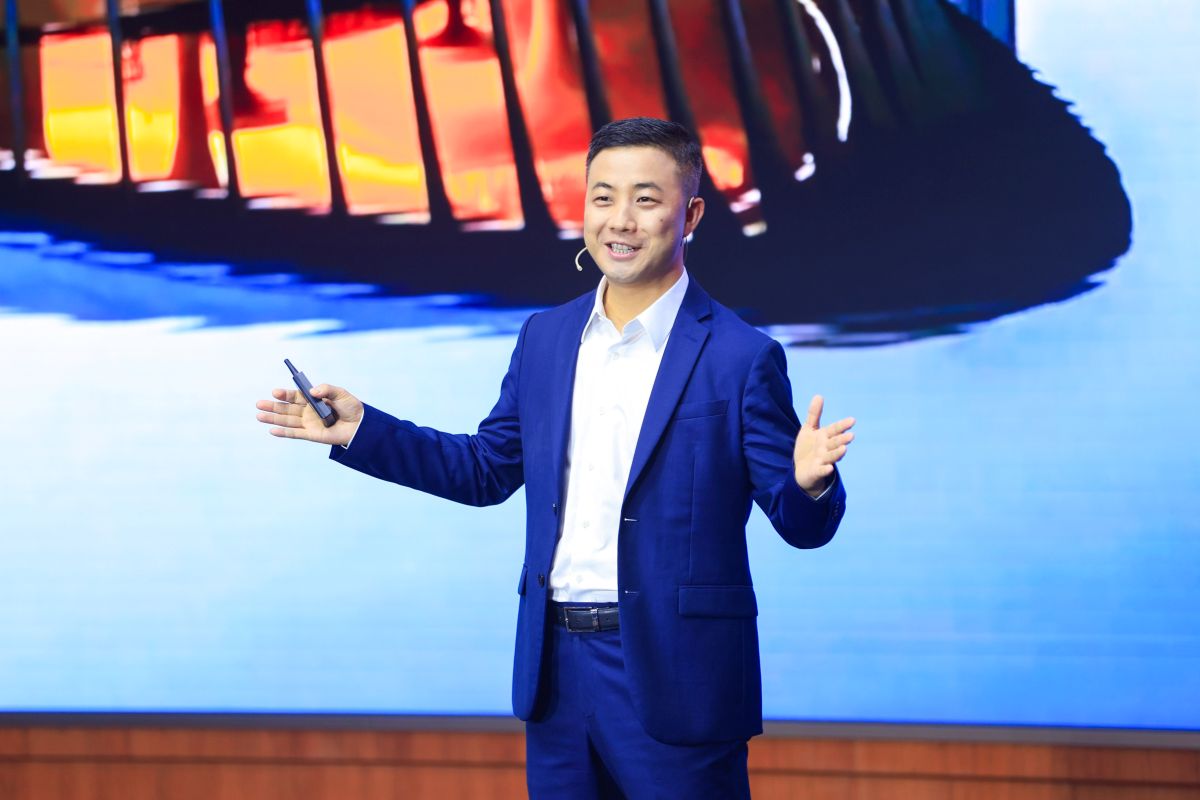
Jason Cao, CEO of Huawei Digital Finance BU
Leveraging open-source models and hybrid AI architecture, Huawei is driving six key initiatives spanning scenarios, architecture, engineering, data, AI infrastructure, and talent:
• Targeting high-value scenarios to accelerate deployment: Focusing on high-value scenarios is critical to successful AI implementation. Aiming at four major domains—intelligent interaction, efficient operations, intelligent risk control, and revenue growth—Huawei and its partners have jointly launched nine AI agent business solutions.
• Building a hybrid AI architecture that balances security, compliance, business performance, and cost: Ensuring data security while leveraging engineering optimization to minimize token costs, enabling the large-scale deployment of innovation.
• Consolidating leading engineering practices to accelerate AI adoption: Leveraging open-source models and open compute power, Huawei drives low-latency AI interactions, optimized domain-specific models for risk control, and deep agentic engineering with seamless partner integration. Through computing engineering, model engineering, and agentic engineering, Huawei enhances both the effectiveness and speed of AI adoption for financial institutions.
• Building a digital-intelligent foundation: Delivering a three-layer capability upgrade across data platforms, governance, and applications to establish an AI-ready R.A.C.E. foundation for finance.
• Building an enterprise-grade, high-performance AI computing foundation: Unveiling the Huawei Atlas 850E SuperPoD, which provides an enterprise-grade, efficient AI computing foundation powered by a leading compute architecture and high-performance networking.
• Launching an AI talent development program: Over the next three years, Huawei aims to cultivate more than 10,000 interdisciplinary "Finance + AI" experts for the global financial industry.
At the summit, Huawei launched its Financial Data Intelligence Solution 6.0. Built on an open, peer-to-peer interconnected AI computing foundation and backed by an open hybrid AI architecture that safeguards data security while optimizing expansion costs, the solution establishes systematic engineering capabilities across open compute and AI agents. By leveraging open-source models and an open ecosystem, Huawei, together with 10 RONGHAI ecosystem partners, unveiled nine AI agent business solutions across four major domains—intelligent interaction, efficient operations, intelligent risk control, and revenue growth—accelerating financial institutions toward Agentic Banking.
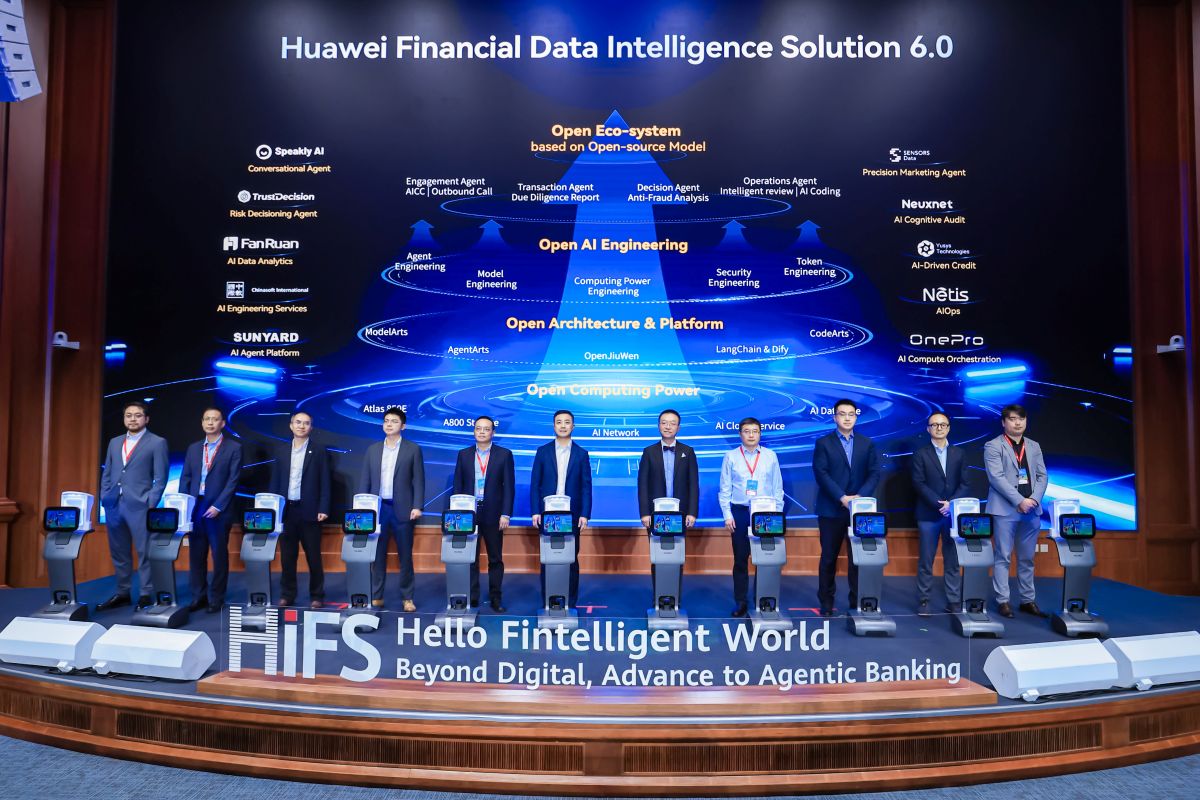
Huawei and RONGHAI partners jointly launching Financial Data Intelligence Solution 6.0
AI is driving data capabilities to evolve from being data-driven to achieving data-AI convergence. All-domain data is transitioning from unstructured formats to knowledge accumulation. Predictive models built on domain knowledge have improved the accuracy of risk identification by 25%. Real-time processing has advanced from stream computing to real-time inference, boosting customer retention. Meanwhile, data platforms have evolved from lakehouse architecture to data-AI convergence, while the data consumption experience has shifted from manual analysis to Agentic automated analysis, driving a 10-fold efficiency gain in risk case analysis. To facilitate this data upgrade for customers, Huawei has constructed the R.A.C.E data capability framework, encompassing Real-time processing, All-domain data, Converged platform, and Experience-driven.
Huawei unveiled its Financial Data Intelligence Solution 6.0, delivering a three-layer capability upgrade spanning data platforms, data governance, and data applications.
• Building a converged data-AI platform: This layer delivers AI-ready, high-quality data. Powered by hardware-software synergy, the newly launched AI data lake supports multimodal storage and computing, enabling the efficient processing of unstructured data such as documents and videos.
• Establishing one-stop data governance: In collaboration with Keyrus and Sunline, Huawei has developed a comprehensive data governance framework designed to enhance data utilization efficiency.
• Advancing data-AI applications: Together with Sensors Data, Huawei has introduced a hyper-personalized marketing solution that utilizes over 5,000 customer tags to deepen user operations. In addition, a joint intelligent anti-fraud solution developed with TrustDecision achieves a 30-millisecond detection response time, incorporating AI-driven case analysis to drive a 40-fold efficiency gain.
Huawei will continue to collaborate with top-tier data partners to help the financial industry unlock the full value of data, establishing a solid data foundation for AI.
As financial institutions transition toward Agentic Banking, cloud-native applications serve as the essential foundation. Drawing on over a decade of expertise in core application modernization, Huawei has developed systematic capabilities across four pillars: platforms, databases, engineering, and O&M. To date, these capabilities have empowered more than 150 financial institutions worldwide to modernize their core systems, utilizing AI to further accelerate the "Free Legacy" process for financial core architectures.
At this summit, Huawei unveiled its Digital CORE Solution 6.0, featuring comprehensive upgrades across scenarios, AI-powered development, engineering, architecture, and platforms:
• Enriched core scenarios: Leveraging established core banking modernization capabilities, Huawei is collaborating with top-tier global partners to co-develop new solutions across three pivotal domains: credit cards, central bank payments, and insurance core modernization.
• AI-powered application modernization: Driven by Huawei CodeArts and co-developed with Stefanini and Sunline, the AI-powered mainframe code transpilation solution achieves an adoption rate of over 90%, significantly accelerating application modernization.
• Engineering and process upgrade: Comprehensively upgrading application refactoring and zero-downtime migration solutions to shorten planning and design cycles by over 50%; collaborating with ecosystem partners to build the Switchover system, ensuring seamless, zero-downtime service switchovers.
• Enhanced cell-based architecture: Deepening cell-based and auto-scaling architectures to support 10-fold traffic surges, while minimizing the blast radius to achieve 99.999% high availability.
• New cross-platform container solutions: Capitalizing on its multi-core, high-concurrency performance, TaiShan general-purpose computing has empowered application modernization for over 80% of Chinese banks and financial institutions across eight countries. This year, Huawei has further partnered with container leaders like Alauda and Rancher to co-develop a cross-platform container solution. Already deployed at scale across leading banks in Asia-Pacific and South Africa, this solution enables more flexible application containerization.
From traditional DCs to cloud DCs, and further to AIDCs, resilience remains an indispensable foundation for financial institutions. Anchored by its "4 Zeros" resilience value proposition and the product framework of the R-A-A-S solution, Huawei has comprehensively upgraded its architecture, solutions, and infrastructure. By delivering cutting-edge capabilities that span DR consulting, intelligent traffic scheduling, and heterogeneous DR, Huawei upgrades active-active DR capabilities to a premium level. Facing the AI computing era, Huawei is further constructing a converged general-purpose and AI computing resilience architecture. Through its AIDC integrated inference and full-lifecycle intelligent DC O&M solutions, Huawei empowers global financial institutions to fast-track AI innovation while building future-proof, resilient infrastructure.
Deeply rooted in the financial industry for over 16 years, Huawei has served more than 7,100 financial institutions across over 80 countries and regions. Looking ahead, Huawei remains committed to serving as the trusted strategic partner for global financial institutions in their digital and intelligent transformation. By collaborating with global ecosystem partners, Huawei aims to go beyond digital, advance to Agentic Banking, and co-create infinite possibilities in the era of financial intelligence.
Copyright © 2026 Huawei Technologies Co., Ltd. All rights reserved.