

Dip the Quill into the Data Universe and Write a New Poem of "Heavenly Questions"
Productos, soluciones and servicios para los negocios

Through the river of time, this romance endures, and our drive to explore the vastness of the cosmos and the minuteness of particles is still engrained in our genes.
In today's digital era, a group of people chooses to use high-energy physics as their pen and ink to continue writing the magnificent "Heavenly Questions."
Among all scientific fields that explore the ultimate questions, high-energy physics stands out as particularly captivating.
The purpose of high-energy physics research is to explore the fundamental particles that make up everything in the world, to uncover the structure of microscopic substances, and to understand the interactions between them.
From familiar molecules and atoms to quarks, leptons, gluons, and other subatomic particles in the microscopic world, high-energy physicists use large colliders to accelerate and collide particles and study their properties. They also use large astronomical detection devices to observe the universe and capture cosmic rays in extreme environments.
The insights they gain bring us ever closer to the origin of all things and the evolution of the universe. Here, the grandest and smallest wonders of nature converge.
In order to gain these insights, scientists have spared no effort.
The Institute of High Energy Physics of Chinese Academy of Sciences (the IHEP of CAS) has built a series of large-scale scientific facilities to enable the Chinese scientific community and humanity at large to continue writing the "Heavenly Questions," in pursuit of the origin of everything.
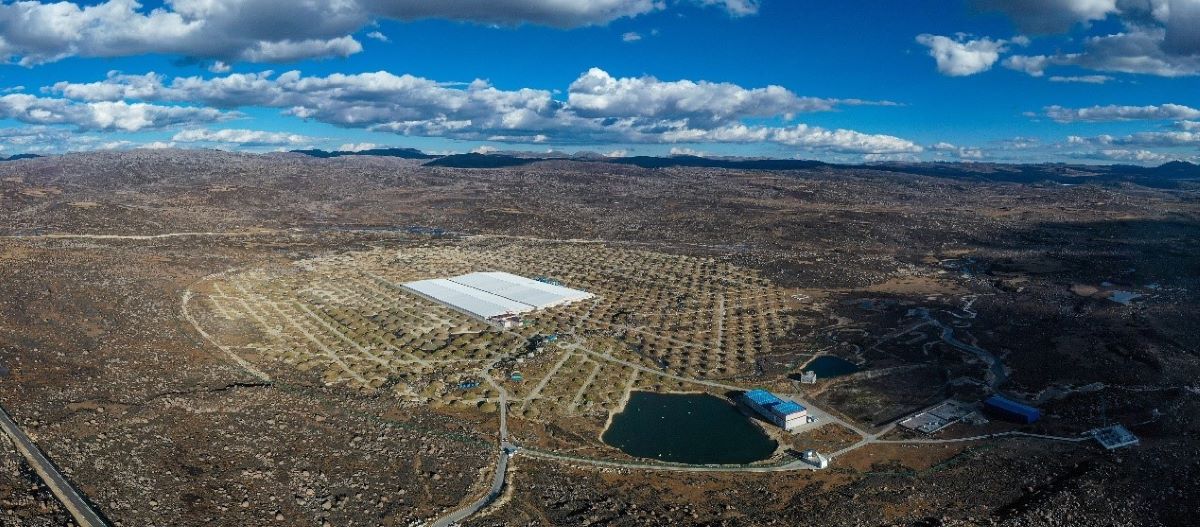
On Haizi Mountain in Daocheng, Sichuan, amid the bitter cold, the IHEP of CAS has established the Large High Altitude Air Shower Observatory (LHAASO). Perched 4,410 meters above sea level on the "roof of the world," this enormous net continuously captures countless cosmic rays arriving from outer space.
This is the world's largest and most sensitive ultra-high-energy gamma-ray detector. In 2022, LHAASO recorded the entire process of the collapse and explosion of a "super sun"—a massive star 20 times the mass of our Sun.
In just a few hundred seconds, 60,000 high-energy photons were recorded in a precise energy spectrum. By observing this once-in-a-millennium, dazzling display of "cosmic fireworks," LHAASO—the only ground-based detector capable of seeing Tera-electronvolt (TeV) gamma rays without blindness—helped humanity fill a long-standing gap in the TeV afterglow light curve.
In Huairou, Beijing, the IHEP of CAS has also built a large-scale scientific facility—the High Energy Photon Source (HEPS).
Here, a high-energy electron beam is accelerated to nearly the speed of light by a circular booster. As it curves along its orbit, it releases a stable, high-energy, and high-brightness stream of electromagnetic radiation—synchrotron radiation light—which is emitted tangentially to the path. This light carries a wealth of microscopic structural information through scattering, diffraction, and absorption.
To date, about 70% of the world's known biological macromolecular structures have been detected with the help of synchrotron radiation.
HEPS, whose very design resembles an enormous magnifying glass, can emit light a trillion times brighter than the Sun. It will be China's first and the world's brightest fourth-generation synchrotron radiation source. Together with the APS in the United States, the ESRF in Europe, SPring-8 in Japan, and PETRA-III in Germany, it will take its place among the world's five leading high-energy synchrotron radiation sources, continuing to help humanity uncover the mysteries of the microscopic world.

High Energy Photon Source (HEPS)
Yet even as we write this new poem of "Heavenly Questions," large-scale scientific facilities in high-energy physics all face a challenge. But this challenge does not come from black holes or stars—it comes from the digital world.
To reach the heart of scientific truth, large-scale scientific facilities must navigate three "deluges".
The first one stems from astronomical observation—the stellar deluge that must be overcome. The second originates from the physical world—the microscopic deluge encountered in particle research. The third is the unavoidable data deluge that arises from the challenges of storing and utilizing this vast amount of data.

Array of thousands of detectors in the LHAASO project
In the LHAASO project, 1,188 muon detectors, 5,216 electromagnetic particle detectors, 18 wide-field Cherenkov telescopes, and a 78,000-square-meter water Cherenkov detector array work together seamlessly to capture every particle that arrives like raindrops.
This unprecedentedly massive and incredibly sophisticated advanced system has also overcome the long-standing limitation that previously prevented scientists from conducting observations during moonlit nights.
The collected observational datasets will be rapidly processed and temporarily stored at on-site small data centers. Then, the results will be transmitted to the large data center in Beijing for large-scale processing and collaborative analysis.
Let's look at another example—in a particle research experiment, all signals are recorded in binary format using high-precision detectors. These valuable raw data are then converted by computers into Monte Carlo simulation data for event reconstruction, enabling the analysis of relevant physical information such as momentum and collision points.
Even a single, slight collision in the microscopic world can trigger a massive upheaval in the digital realm, generating over 1,000 files and 500 terabytes of data.

The enormous volume of data, combined with the demands for long-term retention and open sharing, has created tremendous pressure on storage systems. The hybrid workloads—random reads and writes of many small files at the front end, alongside write-once, read-many access to large files at the back end—pose significant challenges for storage infrastructure.
An even greater challenge is that the data is scattered across Beijing, Dongguan, Chengdu, Daocheng, and requires joint analysis with international partner institutions. Managing such massive amounts of cross-regional data is a major difficulty in itself.
Despite the immense challenges, humanity's relentless quest for the truth of the universe has never stalled at any stage.
In fact, every cutting-edge scientific experiment is fundamentally driven by massive volumes of data. Faced with an annual data growth exceeding 20 petabytes, the IHEP of CAS partnered with Huawei to deploy the underlying data infrastructure—Huawei OceanStor Pacific scale-out storage—for its large-scale scientific facilities.

High-energy physics experiments generate massive amounts of data, requiring highly automated data processing and analysis. Furthermore, to ensure that observational data can be effectively applied to scientific research, powerful data fabric capabilities are also essential.
These are exactly the strengths of Huawei OceanStor Pacific all-flash scale-out storage. With this in mind, the IHEP of CAS worked with Huawei to build a research data lake and carried out joint testing and tuning.
By leveraging advanced flash media and combining high-capacity SSDs with a high-density hardware design, OceanStor Pacific delivers a 30% boost in performance and space efficiency—ensuring fast, reliable throughput for research data workflows. What's more, the IHEP of CAS and Huawei jointly developed an AI-powered lossless compression algorithm tailored for common scientific file formats such as ROOT and HDF5, achieving up to 50% savings in storage costs.
At this point, the data deluge, just like every great unknown before it, has been tamed into a gentle stream that humanity can effortlessly wade through on their path forward.
True to its name, Huawei OceanStor Pacific scale-out storage acts like a vast ocean, ingesting data and capturing every fleeting trace of civilization. Ultimately, it's becoming the bedrock of the IHEP's research blueprint, helping the IHEP to reach new heights.
From the ancient Heavenly Questions that spans millennia to today's observations of planets and quarks, our human curiosity has remained constant. What has changed are the ever-evolving scientific research tools and digital technology.
And so, we are fortunate enough to stand one step closer than our ancestors in our quest to understand the primal chaos and to peer into the infinite.
Obscure is the light, and dark the shadow. Let us, then, be the explorers. This unique poetry is a tribute to the cosmos and to the ultimate truth.
Copyright © 2026 Huawei Technologies Co., Ltd. Todos los derechos reservados.

