Продукти, рішення, послуги для організацій
[Shanghai, China, September 18, 2025] At HUAWEI CONNECT 2025, Huawei officially launched its F5G-A FTTO Solution, reaffirming its leadership in next-generation campus network innovation.
During his keynote speech titled Boosting Computing with Fiber: Powering Campuses with Inclusive AI, Perry Yang, President of Huawei Enterprise Optical Domain, emphasized: "As AI becomes locally deployed across campuses, all-optical infrastructure is emerging as a massive trend. Huawei's F5G-A FTTO solution leverages fiber-based transmission to deliver a green, cost-effective network with a 30-year lifecycle, smooth bandwidth evolution, and reduced need for ELV rooms. It has become a must-have for AI-powered campuses. Huawei's F5G-A FTTO solution has already been deployed in over 12,000 smart campuses worldwide. Huawei is advancing with the belief of 'No Fiber, No AI', and working hand-in-hand with customers and partners to build futuristic smart campuses."
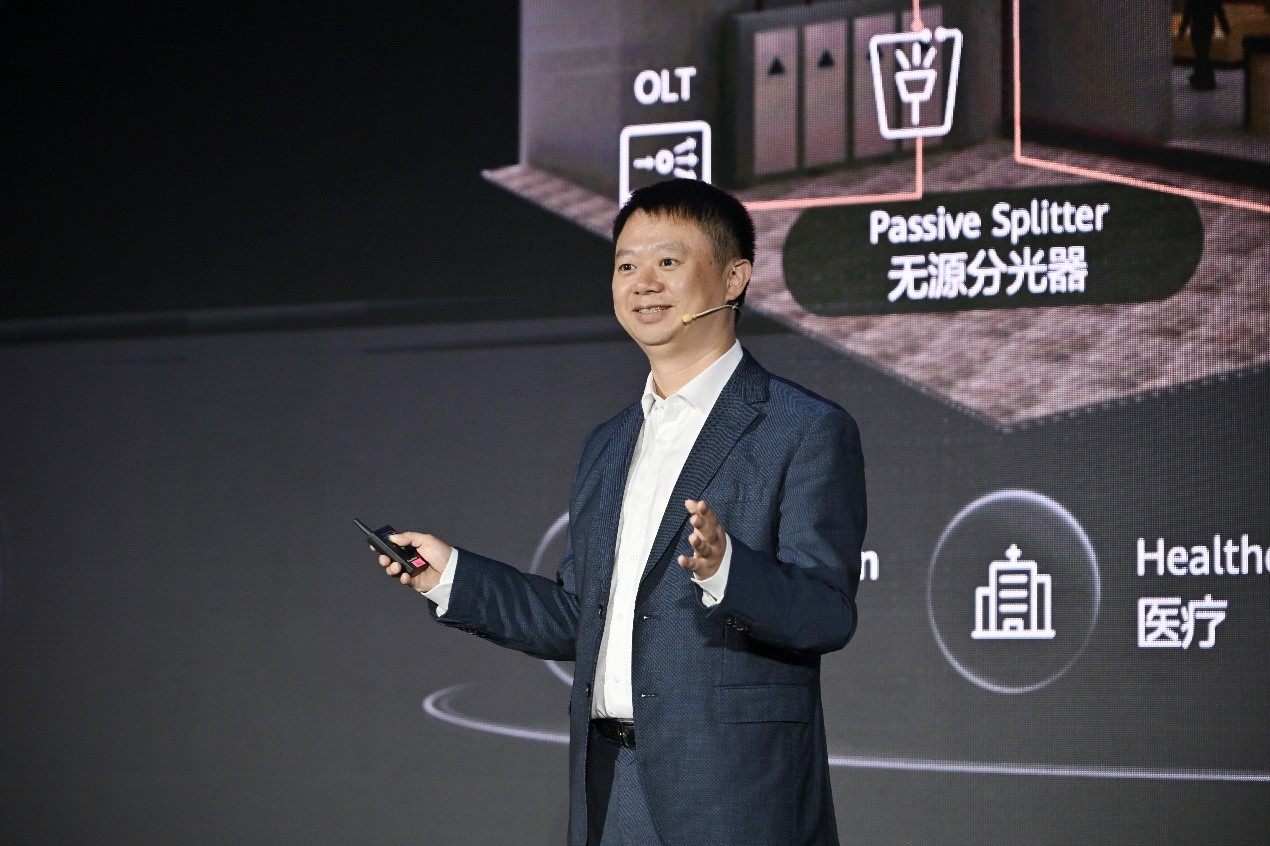
Perry Yang, President of Huawei Enterprise Optical Domain
Huawei's newly released F5G-A FTTO series centers on the concept of "Boosting Computing with Fiber", offering four key strengths to support AI-driven digital transformation:
• Ultra-broadband: Industry-first commercial symmetric 50G PON boosts bandwidth 5 times over previous generations. Seamless upgrade from 10G to 50G PON enables 50 Gbps to rooms and 10 Gbps to Wi-Fi—ideal for VR classrooms, pathology labs, and other bandwidth-hungry scenarios.
• Simplified architecture: A native 2-Layer architecture delivers fibers directly to rooms, eliminating the need for ELV rooms and reducing cabling costs by up to 80%. Hard slicing technology enables multi-network convergence, cutting TCO by 30%. One fiber supports Ethernet, Wi-Fi, and POTS—deeply integrated and collaborative.
• Smart connectivity: AI-powered Wi-Fi anti-interference improves access performance by 20% in complex environments. Dedicated Wi-Fi air interfaces ensure zero-lag experiences for key applications like video conferencing and remote healthcare.
• Intelligent sensing: Optical APs with integrated CSI sensing enable behavior recognition and environmental monitoring, linking seamlessly with energy and building management systems—making the network truly "understand what you need."
Huawei also introduced a range of new F5G-A products tailored for education, healthcare, hospitality, and manufacturing, delivering ubiquitous 10G experiences:
• Healthcare: The symmetric 50G PON terminal P992H enables 50 Gbps to rooms and 10 Gbps to devices. AI pathology analysis time drops from 1 hour to just 5 minutes—a 12-fold efficiency boost. The 10G M45 P892M ONU is neat and compact, and can be installed in the bed head panel to route a fiber directly to each ward bed without an information box.
• Education: Dormitories for 6–8 students can use an 8-port Wi-Fi 7 optical AP W827E-30 for unified wired, wireless, and telephony access. Long-distance power supply over PoF cables ensures uninterrupted connectivity upon power outage and prevents unauthorized access.
• Office: A 4-port panel ONU P802P brings fiber to the desktop with 10 Gbps access. The product features a sleek design and robust security. The high-performance Wi-Fi 7 optical AP W817H supports seamless roaming and energy-saving features like motion-triggered lighting.
• Hospitality: Huawei's 3-in-1 Wi-Fi 7 optical AP W827E and outdoor model W817T provide full indoor-outdoor coverage, boosting the speed by 20% and enhancing connectivity with intelligent interference mitigation.
Huawei will continue to innovate, integrating F5G-A technology with diverse industry scenarios to build high-quality optical network foundations. Through collaboration with customers, partners, and industry organizations, Huawei aims to explore new applications, incubate new solutions, and advance new standards—co-creating a smart, digital future for campuses in the AI era.
Copyright © 2026 Huawei Technologies Co., Ltd. Усі права захищені.