

Red Maule - Huawei Collaboration Accelerate Chile Public Health Digital Transformation
Продукти, рішення, послуги для організацій

The Chilean Healthcare Facilities Concession Program is a strategic public-private partnership (PPP) initiated in the 2000s to address aging infrastructure and a lack of hospital beds. This "Design-Build-Operate-Transfer" (DBOT) model is managed by the Ministry of Public Works (MOP).

The primary significance of the program lies in rapidly closing the national healthcare infrastructure gap by leveraging private capital for construction and long-term maintenance. This approach smooths out government expenditure over the 15 - 30 years concession period and transfers construction and maintenance risks to the private sector. The model ensures that essential non-clinical services (like catering and security) operate efficiently, while core clinical services and medical management remain strictly under the purview of the public Ministry of Health (MINSAL). This balance ensures high-quality facilities for the public without privatizing clinical care, representing a critical, long-standing national strategy for infrastructure development in Chile.
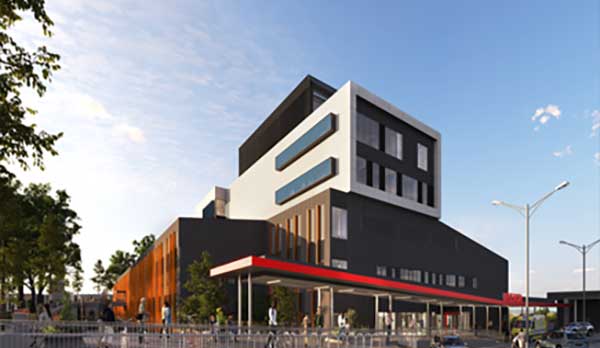
Among them, Red Maule is part of the second phase of the project's construction plan. It corresponds to the construction and subsequent operation of three medium-complexity medical facilities located in the communes of Cauquenes, Constitución, and Parral, with a total estimated area of 157,000 m². The concession will provide the health system with 368 beds, of which 136 beds are for the Cauquenes Hospital, 111 beds for the Constitución Hospital, and 121 beds for the Parral Hospital. This is expected to benefit an estimated population of 59,000 people.

Huawei deployed an end-to-end solution designed to transform Red Maule into a highly connected, future-ready campus:
Next Generation Wi-Fi 7 Network:
Red Maule became one of the first institutions in Chile enabled for Wi-Fi 7 connectivity, providing higher speed, lower latency, and improved performance in high-density academic environments. Core, aggregation, and access layers were refreshed with Huawei enterprise switches capable of supporting high-bandwidth traffic, unified management, and simplified O&M.
Centralized NCE management and monitoring:
Through Huawei’s network management tools NCE-Campus, IT team gained improved visibility, faster troubleshooting, and unified control over wired and wireless networks.
Intelligent Collaboration IdeaHub:
IdeaHub Bring a Smart Working Style to Everyone. In the hospital, it is used in meeting rooms, for teleconsultations, interactive clinical case discussions, or training.
Intelligent Self-Supporting Data Center Racks:
These are robust and efficient cabinets for housing the hospital's critical servers and network equipment.
Infrastructure Impact
Huawei’s modernization of the network delivered tangible improvements:
• Full wireless coverage across campus and high-density performance for large patient groups.
• Higher network reliability and speed, supporting online medic, digital platforms, streaming, and collaborative learning.
• Simplified network operations, reducing downtime and improving IT efficiency.
• A scalable foundation ready for future expansions and advanced smart-campus applications.
The Red Maule–Huawei collaboration resulted in:
• A fully modernized digital hospital aligned with global standards.
• Stronger medicinal programs supported by real-world technology and certifications.
• A future-proof network prepared for remote medic, high device density, and advanced services.
Copyright © 2026 Huawei Technologies Co., Ltd. Усі права захищені.

