ผลิตภัณฑ์ โซลูชั่น และบริการสำหรับองค์กรธุรกิจ
[Macao, China, June 12, 2026] On June 10–11,at the 17th International Infrastructure Investment and Construction Forum & Exhibition (IIICF), Huawei presented its latest insights and advancements in smart transportation for 2026 to representatives from over 800 renowned enterprises and more than 3,500 infrastructure construction elites hailing from over 70 countries and regions. The company also unveiled five solutions for the transportation industry, designed to accelerate its digital and intelligent transformation and empower high-quality infrastructure development.
Ma Yue, Vice President of Huawei and CEO of Huawei's Smart Transportation BU, attended the event. At the roundtable titled "Accelerate Transportation Digital Intelligence," Ma Yue highlighted the emerging opportunities and challenges facing the global transportation industry. He stated that going digital and intelligent has become a defining global trend. Smart transportation, as a vital strategy for safe travel and efficient logistics, goes beyond merely stacking technologies or products. It should be driven by business strategies and supported by overall planning, wise execution, and long-term operations. The industry must embed digital and intelligent approaches, mindsets, and awareness throughout planning, design, engineering construction, and operations management. "Huawei remains committed to investing in the digital foundation of smart transportation. Together with our partners, we will accelerate the transformation and sustainable growth of the global transportation industry," said Ma Yue.
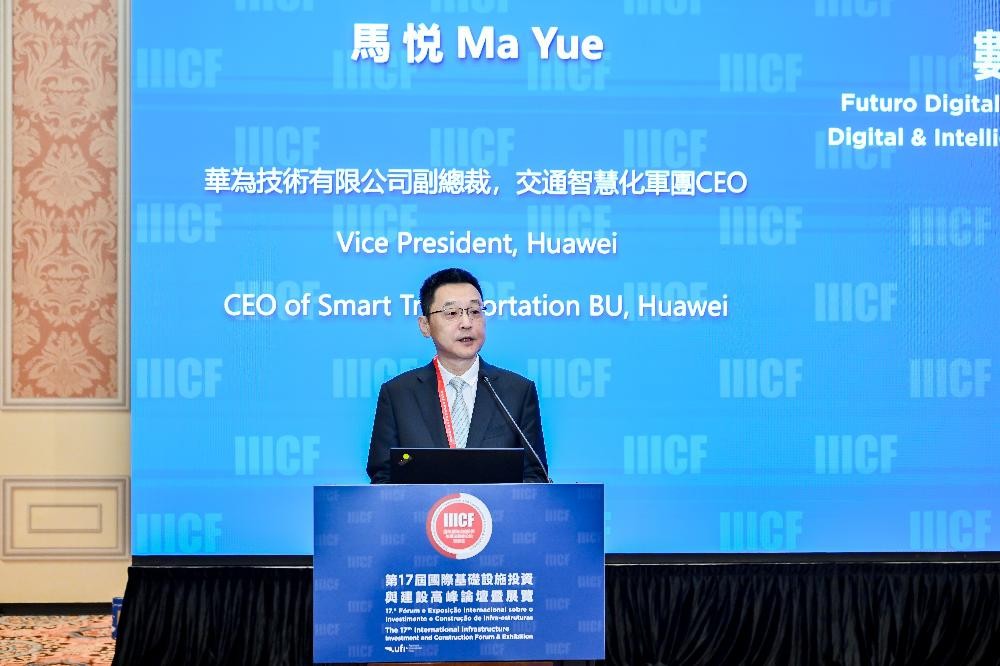
Ma Yue, Vice President of Huawei and CEO of Huawei's Smart Transportation BU
At the debut of international infrastructure innovation achievements, Huawei released five of its latest solutions for the transportation industry.
• Intelligent Logistics Document Recognition: The solution's core algorithm has been upgraded, and now supports unique document recognition layout sensing alongside intelligent segmentation and combination models. With calibration experts, it significantly enhances recognition accuracy and generalization. It automates document recognition, recording, and comparison, eliminating repetitive manual tasks. This shortens processing times, boosts efficiency, ensures compliance, and enables automatic, intelligent service closure from start to finish.
• Smart Hub Solution: Integrated security management creates a closed-loop security system encompassing detection, prediction, warning, and optimization. Integrated passenger services deliver E2E support with precise positioning, intelligent navigation, and multidimensional information queries. Integrated facility management enables green energy consumption oversight across all domains, allowing for anomaly location within hours and rapid handling. The integrated commercial operations mode manages the entire merchant-related process from tenant acquisition to lease termination.
• Road Traffic Agent: Centered on urban traffic management and highway operations, the solution adopts AI, big data, and cloud computing to enable traffic order management, signal management, emergency response, and mobility services. Huawei collaborated with partners to develop four agents: traffic order management, signal management, emergency command and dispatch, and road network traffic forecast. Together, the agents will enhance fine-grained urban traffic management and highway operations, as well as drive transformation and sustainable development within the transportation economy.
• Intelligent Horizontal Transportation 2.0: Designed for conventional terminal automation, the solution eliminates the need to modify current site layouts or processes. It removes collaboration barriers between Intelligent Guided Vehicles (IGVs) and manual vehicles, enabling the simultaneous access and dispatch of over 400 IGVs from multiple vendors with a manual takeover rate of under 0.1%. This supports mixed traffic for all terminal, yard, and port campus collaboration scenarios.
• Airline Large Model: The large model delivers over 90% accuracy in passenger flow forecasting and optimizes airline networks, enabling data-driven air route planning, revenue growth, and efficiency gains while swiftly adapting to emerging market changes. It advances intelligent customer services by deploying advanced voice bots that support multi-turn dialogs and natural language interaction, enhancing Q&A accuracy and automation. The AI Coding solution offers an enterprise-level intelligent programming base combining Ascend, SOTA models, and the Code Agent. It vastly boosts IT personnel's development efficiency and overcomes multiple technical obstacles like ultra-long context, low latency, and high concurrency.
During the forum, Huawei showcased a wide range of scenario-based solutions tailored for sectors like rail, road, aviation, port, customs, as well as logistics & warehousing, capturing the interest of attendees from around the world.
To date, Huawei has served more than 100 ports, more than 210 airports and airlines, over 300 urban rail lines, over 180,000 kilometers of railways, road networks extending over 200,000 kilometers, ITS projects across over 70 cities, and more than 200 logistics enterprises across the globe. Looking ahead, Huawei will remain committed to openness and collaboration for shared success. The company specializes in developing transportation hubs, transportation networks, and passenger/freight flows to establish a digital and intelligent foundation for comprehensive transportation and logistics. Huawei is dedicated to "driving mobility and logistics into the intelligent world," empowering smart transportation.
Copyright © 2026 Huawei Technologies Co., Ltd. All rights reserved.