ผลิตภัณฑ์ โซลูชั่น และบริการสำหรับองค์กรธุรกิจ
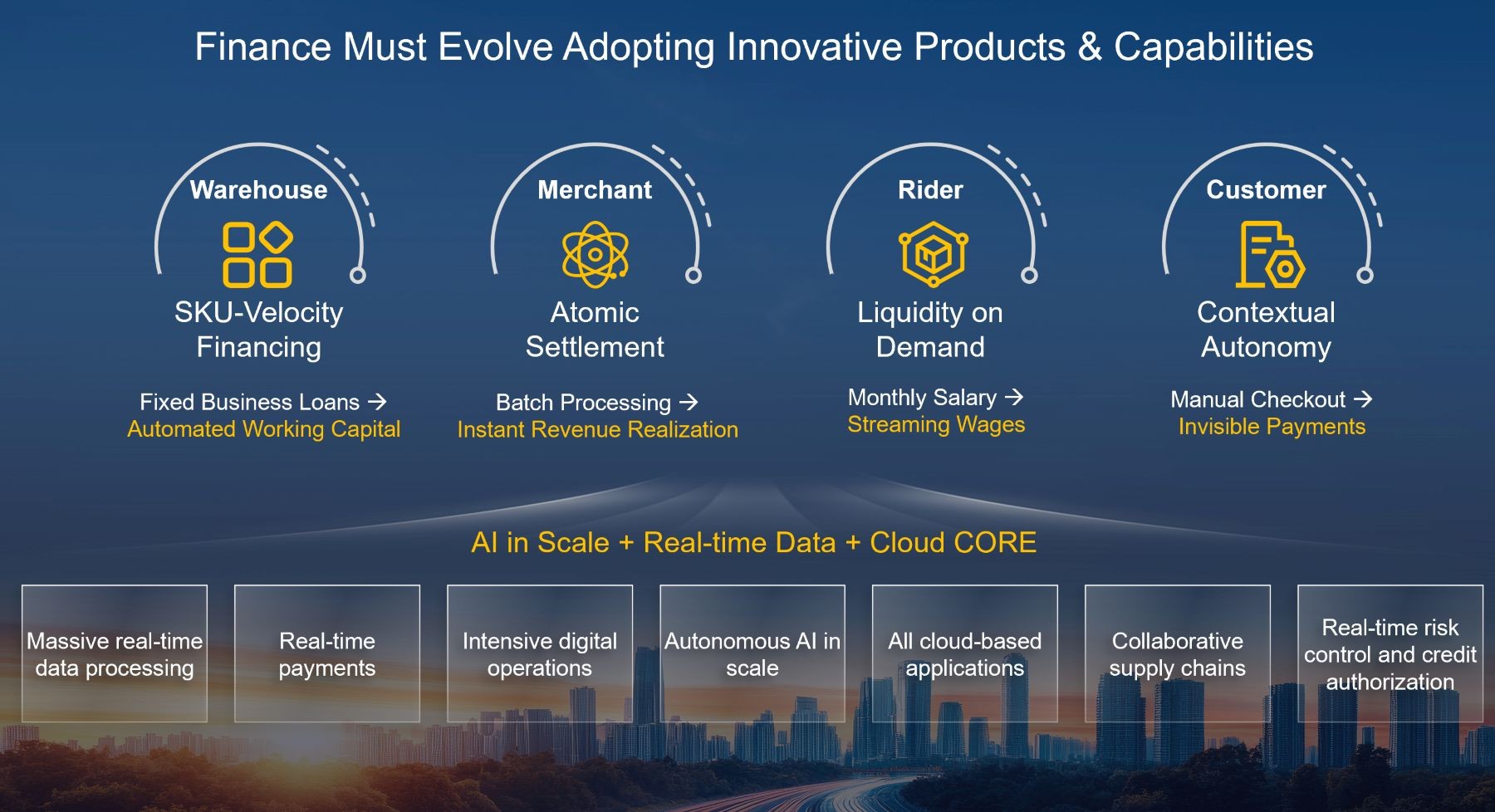
The financial services sector has reached the functional boundaries of standard cloud-native migration and passive automation. Legacy digitization successfully converted analog workflows into microservices and web interfaces, yet the underlying systems remain reactive. They require explicit human instruction or rigid, hardcoded rules to execute tasks.
The transition to Agentic Banking represents a fundamental shift from human-initiated workflows to autonomous, intent-driven operations. This architecture relies on specialized production-grade Agentic AI engines capable of independent reasoning, real-time context preservation, and cross-application tool execution. Implementing this paradigm requires a major upgrade across the enterprise technology stack, specifically in AI-optimized compute, core ledger processing, data pipeline orchestration, and automated resilience mechanisms.
To realize this transformation, financial institutions are utilizing open-source foundation models and hybrid AI architectures spanning on-cloud and on-premises deployments to balance data security, regulatory compliance, and cost control. By refining general-purpose foundation models into domain-specific applications, banks improve processing speed and scenario adaptation. This strategy is executed through six structural dimensions driven by Huawei: targeting high-value business scenarios, building secure hybrid architectures, establishing standardized engineering practices, optimizing data foundations, deploying high-performance AI computing infrastructure, and training 10,000 interdisciplinary experts over the next three years.
Building an agentic financial institution cannot be achieved through standalone technology procurement; it requires a systematic engineering strategy that combines robust ICT infrastructure with an open software layer and highly localized execution. Through the development of the RONGHAI Global Partner Ecosystem, Huawei has established a structured "4-Win" collaboration model to align its infrastructure with specialized Independent Software Vendors (ISVs) and local System Integrators (SIs). This ecosystem structure directly addresses the software and implementation layers required for agentic scale. By leveraging open-source models and an open ecosystem, Huawei, together with 10 RONGHAI ecosystem partners, has engineered nine specialized AI agent business solutions across four major domains: intelligent interaction, efficient operations, intelligent risk control, and revenue growth, turning abstract computing power into targeted operational workflows for the end customer.
Sustaining these hardware-level inference loops requires an adaptive core banking application layer. Legacy core banking platforms, typically built on monolithic mainframe architectures, create major structural barriers for autonomous systems. Because business logic is bound within rigid, procedural codebases, autonomous agents cannot easily discover APIs or execute transactions across different banking domains.
The Huawei Digital CORE Solution 6.0 modernizes these legacy systems into cloud-native architectures across credit cards, central bank payments, and insurance core platforms. Backed by Huawei CodeArts, the platform features integrated AI agents designed specifically for automated code refactoring and transcoding, achieving a mainframe code transpilation adoption rate of over 90%. This product-level modernization introduces critical core capabilities:
● Dynamic Application Containerization: Capitalizing on high-concurrency performance, it allows the underlying infrastructure to scale individual microservices in real time to support 10-fold traffic surges. Deployed across leading banks in Asia-Pacific and South Africa, it supports cross-platform container solutions for flexible application containerization.
● Linguistic API Integration: It structures internal system endpoints so they can be parsed and executed directly by Linguistic User Interfaces (LUIs). This setup replaces rigid graphical screens with a system where autonomous agents can trigger backend functions via standardized, model-readable API paths.
● Process Refactoring: Upgraded application refactoring and zero-downtime migration solutions shorten planning and design cycles by over 50%, utilizing a synchronized Switchover system to ensure seamless service transitions.
While a decoupled core enables application access, the autonomous agents within that core require immediate access to clean, real-time data to drive execution and eliminate model hallucinations. Traditional batch-processed data warehouses or delayed data lakes are inadequate, as agents running on stale data exhibit high operational execution error rates.
The Huawei Financial Data Intelligence Solution 6.0 addresses this data pipeline requirement through the strategic R.A.C.E. (Real-time, All-domain, Converged, Experience-driven) data capability framework. By unifying disparate data lakes and transactional systems into a single intelligent data plane, the solution processes both structured transaction logs and unstructured media streams simultaneously. By delivering a continuously updated data foundation, the platform allows specialized financial models to maintain an accurate contextual memory state, ensuring that risk assessment, fraud prevention, and customer-facing agents operate on real-time data rather than outdated historical records.
The execution of real-time data pipelines and autonomous core applications necessitates a self-healing operational tier to handle the systemic vulnerabilities introduced by multi-agent automation, such as potential system drift, API failures, and unexpected infrastructure bottlenecks. Facing the AI computing era, a converged general-purpose and AI computing resilience architecture is required to protect these interconnected layers.
The product framework of the Huawei R-A-A-S (Reliability, Availability, Autonomy, Security) solution is anchored by a strict "4 Zeros" resilience value proposition. Combined with specialized Agentic AIOps Appliances, this framework moves system operations from manual, reactive troubleshooting to automated prevention. This model deploys five distinct operational appliances tailored for end-to-end observability, automated change management, any alarm handling, fault diagnosis, and fault recovery.
By delivering capabilities that span Disaster Recovery (DR) consulting, intelligent traffic scheduling, and heterogeneous DR, Huawei upgrades active-active DR capabilities to a premium level. When the system detects a performance drop, an infrastructure anomaly, or a transaction bottleneck, these appliances perform automated root-cause analysis within minutes. Through its AIDC integrated inference and full-lifecycle intelligent DC O&M solutions, the system dynamically adjusts traffic distribution and initiates heterogeneous DR switchovers without human intervention. This active-active configuration minimizes the blast radius to maintain 99.999% high availability across the entire distributed cluster, ensuring the banking platform remains available around the clock.
Transitioning to production-grade Agentic Banking requires financial institutions to address long-term operational and engineering demands beyond initial product deployment. Organizations must focus on three core execution tracks:
● Token Cost Optimization: Systematically refining prompt engineering, model quantization, and caching strategies through specialized engineering to lower the marginal cost of multi-agent inference loops.
● Data Pipeline Consolidation: Eliminating remaining silos between legacy database systems and the real-time intelligent data plane to ensure absolute data consistency.
● Domain Model Fine-Tuning: Establishing internal continuous-training pipelines to update on-premise models with specialized institutional knowledge while maintaining strict data sovereignty and compliance.
Succeeding in this landscape requires a systematic engineering strategy that combines open computing architectures, unified data foundations, and production-grade agent deployment. Through collaboration with global System Integrators (SIs) and Independent Software Vendors (ISVs), Huawei provides the engineering capacity and localized expertise required to scale Agentic Banking and deliver measurable financial value.
Disclaimer: The views and opinions expressed in this article are those of the author and do not necessarily reflect the official policy, position, products, and technologies of Huawei Technologies Co., Ltd. If you need to learn more about the products and technologies of Huawei Technologies Co., Ltd., please visit our website at e.huawei.com or contact us.
Copyright © 2026 Huawei Technologies Co., Ltd. All rights reserved.