

Tane General Hospital: Building a Future-Proof Wi-Fi 7 Network
Realizing reliable, stable and high-speed communication environment, including visualization of signal strength
Productos, soluciones and servicios para los negocios

Realizing reliable, stable and high-speed communication environment, including visualization of signal strength
Social Medical Corporation Kikkokai Tane General Hospital has introduced Huawei's Wi-Fi 7 Access Point (AP) "AirEngine" as part of its digital transformation (DX) infrastructure development and built a wireless network. Looking into the future, they have adopted the latest standard Wi-Fi 7, which has increased communication speeds and enabled long-life operation. In particular, Huawei's technological skills, backed by a large global market share, and the reliability, stability, and excellent cost efficiency realized by conducting all processes from development to manufacturing in-house are also creating benefits that contribute to the management.
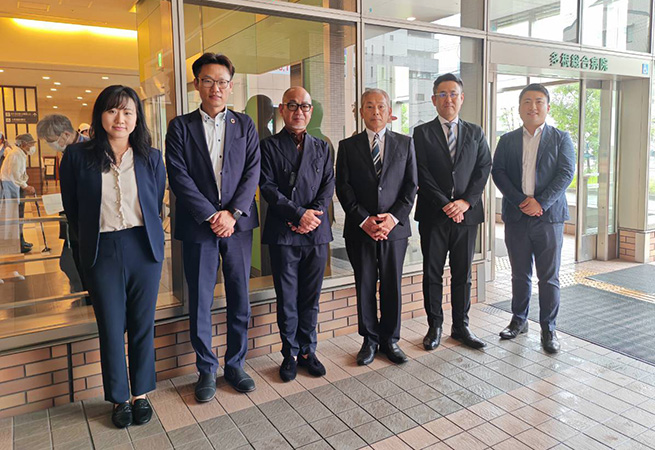
From the left: Sun Han, Product Manager, Public Healthcare Sales Department, Corporate
Business Division, and Zhang Daquan, Manager, Public Healthcare Sales Department (Huawei Technologies Co., Ltd.),
Yukinori Naoe, Deputy Director of Corporate Planning Division and Director of Information Systems Department,
and Kazuyuki Tane, Chairman (Social Medical Corporation Kikkokai Tane General Hospital),
Ken Yamamoto, Executive Officer, Corporate Business Division,
West Japan Headquarters, and Yoji Watanabe, General Manager, 1st Sales Department, West Japan Headquarters (Huawei Technologies Co., Ltd.)
Tane General Hospital is a 304-bed regional core hospital that is entirely engaged in acute medical care in the western area of Osaka City (Nishi-ku, Taisho-ku, Minato-ku). The hospital is currently accelerating its DX efforts in anticipation of a future shortage of medical professionals due to work style reforms for doctors as well as a decline in the productive-age population.
"We are seeing DX as not just the introduction of IT or digital technology, but overturning the conventional concept.", explains Naoe. And he insists, "From this perspective, we are paying attention to the work of nurses, and want to fundamentally change the way they work. Outside China, for example, nursing work is carried out efficiently by eliminating waste, with remaining IV drip amounts centrally managed on a system and vital signs automatically measured and recorded using smart watches. For our hospital to follow these initiatives, I believe that the top priority is to develop the infrastructure. If we build a stable, future-proof infrastructure, we will be able to flexibly respond to future innovations in technology." Based on this idea, the hospital introduced Huawei's Wi-Fi 7 AP "AirEngine" in September 2024 to build a future-proof, scalable wireless network based on the latest standards.
Wi-Fi 7 is the latest wireless standard that is a further evolution of the conventional Wi-Fi 6. It was approved in Japan in December 2023. Its highlight is the adoption of such technologies as communication speeds of up to 46 Gbps, wide band with a maximum bandwidth of 320 MHz, 4096QAM modulation scheme, MLO (Multi-Link Operation) that combines the 2.4/5/6 GHz bands for communication, and MRU (Multiple Resource Unit) that improves frequency resource utilization. This enables communication speeds 4x faster than Wi-Fi 6 (theoretical value is about 5x faster), and stable, low-latency communication even when using multiple devices.
After considering the options, it was decided that the Wi-Fi 7 wireless network proposed by Huawei could be implemented at the lowest cost.
The reason for this cost advantage is the city of Shenzhen, China. Huawei is based in Shenzhen, where its headquarters, R&D facilities, factories, etc. are located and it handles everything from development to manufacturing in-house. Therefore, the company can develop and manufacture high-quality products with solid technical capabilities and offer them at reasonable prices. Its strength, particularly with regards to Wi-Fi, is the large number of patents it holds. The company's Wi-Fi 7 share in the enterprise market in 2024 was the largest in the world.
In addition, the future potential and high scalability of Huawei's Wi-Fi 7 were also deciding factors in its adoption. "Many facilities are now replacing medical equipment and information systems spending longer periods of time. Considering the possibility of long-term use, it was important to introduce the latest standard, Wi-Fi 7. In addition, Huawei's AirEngine APs support not only W-Fi, but also communication standards such as Bluetooth, RFID, and ZigBee. In future, as we introduce medical equipment and IoT devices with communication capabilities to advance our medical DX, being able to consolidate APs in AirEngine will lead to the development of flexible systems at low cost.", explains Naoe.

Yukinori Naoe explains that the hospital introduced Wi-Fi 7 to break through conventional concepts in medical DX
Tane General Hospital's wireless network, starting in September 2024, is operating smoothly. Multiple AirEngine APs are deployed on each floor of the 12-story main building and the two-story cancer treatment building. The network is divided into different systems of "Medical", "Staff", and "Patient" using VLANs (Virtual Local Area Networks) to ensure both safety and convenience. The Medical system network ensures security by assigning a fixed IP address to each terminal. In addition, high-speed communication is allowed even if the terminal is not Wi-Fi 7 compatible, and DICOM images with large amounts of data can be displayed without stress.
The Staff system network is used for Internet connection. The hospital comments that high-speed communication enables online meetings or video viewing without delay. In addition, by quickly switching between APs when roaming, communication interruption can be prevented while moving. In particular, doctors and nurses move in a wide range of area and often have the opportunity to access the system while moving. Even in such cases, users can concentrate on their work with peace of mind.
Furthermore, the hospital plans to switch from PHS to smartphones in August 2025 and use the wireless network for voice calls as well. "I am hearing of many cases in other facilities where Wi-Fi calls were unstable and SIM cards were introduced. In our hospital, Huawei designed the wireless network and built an environment with high signal strength so that calls could be made anywhere in the building.", says Naoe. One of Huawei's strengths could be its ability to make proposals that meet the needs of users.
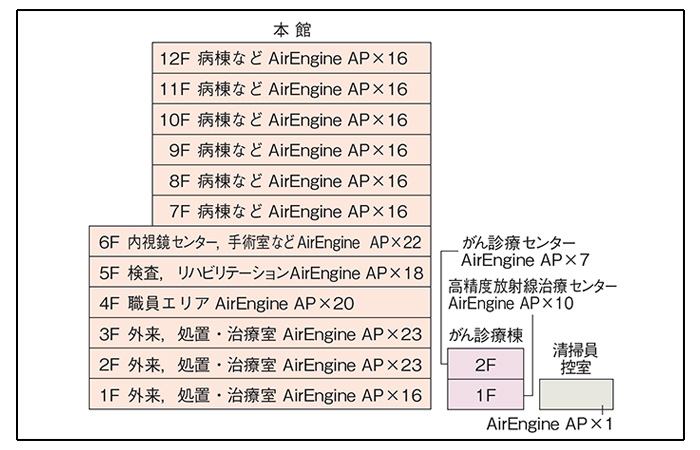
Wi-Fi 7 configuration diagram at Tane General Hospital
Huawei's Wi-Fi 7 wireless network also has benefits that contribute to the management of Tane General Hospital. One of these is the visualization of communication status using the network analysis platform "i Master NCE-CampusInsight", which was introduced at the same time as Wi-Fi 7. It monitors signal strength and communication traffic, and analyzes communication traffic using artificial intelligence (AI). It automatically adjusts signal strength to keep it at an optimal state at all times. This stabilizes high-speed communication and prevents delays from happening. In addition, when a failure occurs, it is possible to identify the cause and respond quickly. Naoe explains the benefits as follows:
"Whenever a network failure occurred, our hospital staff and the vendor's support staff would spend a lot of time identifying the cause. Now that we can visualize the cause of the failure, we can respond quickly. This is also useful from the perspective of manpower."
In addition, iMaster NCE-CampusInsight is also perfectly designed to deal with cyber attacks. "When the number of packets from outside reaches an abnormal value, the port is automatically disconnected. This function is reassuring in that it can limit the damage.", says Naoe. In addition, the hospital collects log data so that it can be analyzed to identify the infection route in the event of a cyber attack. Huawei is the second largest in the world in terms of the number of cyber-related patents (as of 2023), so it is superior in security technology. Thus, Naoe has complete confidence in the company.
In light of the reliability as such in addition to high-speed communication, the hospital is considering making wireless the primary for its in-house network in the future. For the wired networks, costs are high due to construction costs such as wiring, but wireless networks do not require this work, which reduces initial costs. Furthermore, Huawei's Wi-Fi 7 is highly reliable and easy to manage, so the running costs are also reasonable, and it can be said that it will contribute to management from a long-term perspective.
In promoting medical DX, Tane General Hospital made infrastructure development a top priority and adopted the excellent AirEngine Wi-Fi 7 network solution to realize a high-speed and stable wireless communication environment, which has had a positive impact on management as well. The hospital will work on "aggressive" medical DX based on this infrastructure.
"The important thing about DX is to clarify the issues at your own hospital and to think outside the box. The fact that we were able to build a future-proof infrastructure at low cost and in a short period of time is very valuable as we are going to start something new.", emphasizes Naoe. And he showed his expectations, saying, "I think Huawei has many patented technologies and abundant research and development personnel. I hope that they will bring products that break down conventional concepts and create innovation to the world." It will not be long before the company's products will help solve problems not only at Tane General Hospital but also in many other medical institutions.
Copyright © 2026 Huawei Technologies Co., Ltd. Todos los derechos reservados.

