
Matsunami General Hospital × Huawei:
Ransomware-Resilient Storage Delivers Peace of Mind in Healthcare

Matsunami General Hospital, a major regional healthcare provider in Japan's central Chubu region, is a key hub providing general care and emergency services, as well as fostering wider medical collaboration within the community.
With more than 600 beds, the hospital processes vast amounts of medical imaging and electronic health records (EHRs) on a daily basis. Its operations rely on multiple testing and core application systems, including its hospital information system (HIS), picture archiving and communication system (PACS), and radiological information system (RIS). Here, efficiency and resilience are essential to maintaining high-quality patient care. But, in recent years, the rise in ransomware attacks targeting healthcare institutions has left the hospital's information technology (IT) team facing a very real sense of threat.
Before Huawei's solution was in place, the hospital's legacy storage environment faced a series of critical challenges.
• Production data and backups resided within the same domain meaning that, in the event of an attack, backups could only be encrypted at the same time as production data, with independent encryption not possible, leaving data assets vulnerable.
• Recovery times were excessively long. Even with backups in place, restoring operations could take several hours—or even days.
• Insufficient tamper-proof capabilities meant that the reliability and traceability of backup data couldn't be fully ensured.
• Fragmented resilience management also made it impossible to establish an integrated monitoring and defense system.
So the hospital set out a clear objective: To build a data resilience platform that enables isolation, recovery, and verification, without interrupting medical treatment in any way.
Matsunami General Hospital chose Huawei's Ransomware Protection Storage Solution, built on OceanStor Dorado all-flash storage and combined with Air Gap offline isolation and immutable backups.
This approach delivers a closed-loop protection model that brings together high-performance production systems, physically isolated backup environments, and rapid recovery.
Air Gap Offline Isolation
• Backup systems are fully isolated from production systems—both physically and logically—preventing attacks from crossing domains.
• Links are automatically enabled and disabled on a scheduled basis, ensuring strong resilience without compromising operational efficiency.
Immutable Backups
• Backups are protected using write-once, read-many (WORM) technologies, preventing any form of modification or deletion.
• Every snapshot is fully traceable, ensuring data integrity and compliance.
Rapid Performance Recovery
• With OceanStor Dorado all-flash storage, recovery times are reduced from days to minutes.
• Mission-critical systems like PACS and HIS can be recovered rapidly for always-on healthcare services.
Intelligent O&M and Management
• Built-in artificial intelligence (AI)-driven anomaly detection automatically identifies potential threat behaviors.
• A visualized management platform provides centralized control over both primary storage and isolation backup systems, reducing operational overheads.
The solution was deployed and went live within just a few short weeks, delivering significant results for Matsunami General Hospital:
• Air Gap backup systems are fully isolated from production systems, effectively breaking the ransomware attack chain.
• Recovery speeds improved by approximately 10×.
• Mission-critical business systems can now be recovered within hours, minimizing the risk of disruption to patient care.
• Centralized management of data resilience policies simplifies IT operations and maintenance (O&M).
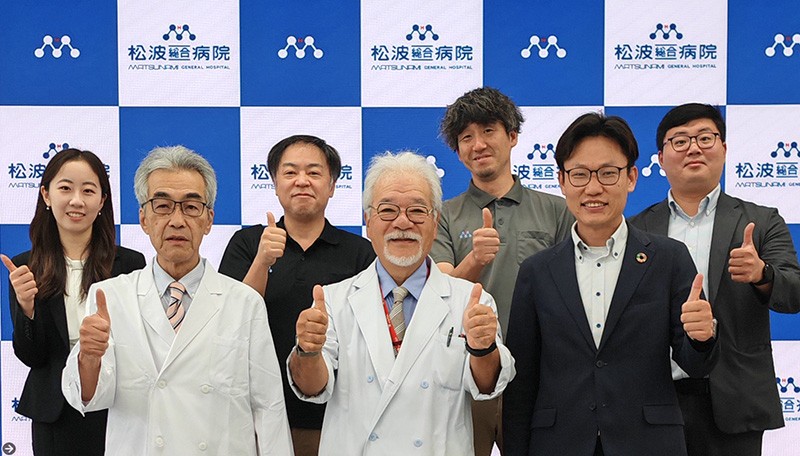
Matsunami General Hospital and Huawei Team Photo
Copyright © 2026 Huawei Technologies Co., Ltd. Všechna práva vyhrazena.

