Produkty, Rozwiązania i usługi dla przedsiębiorstw
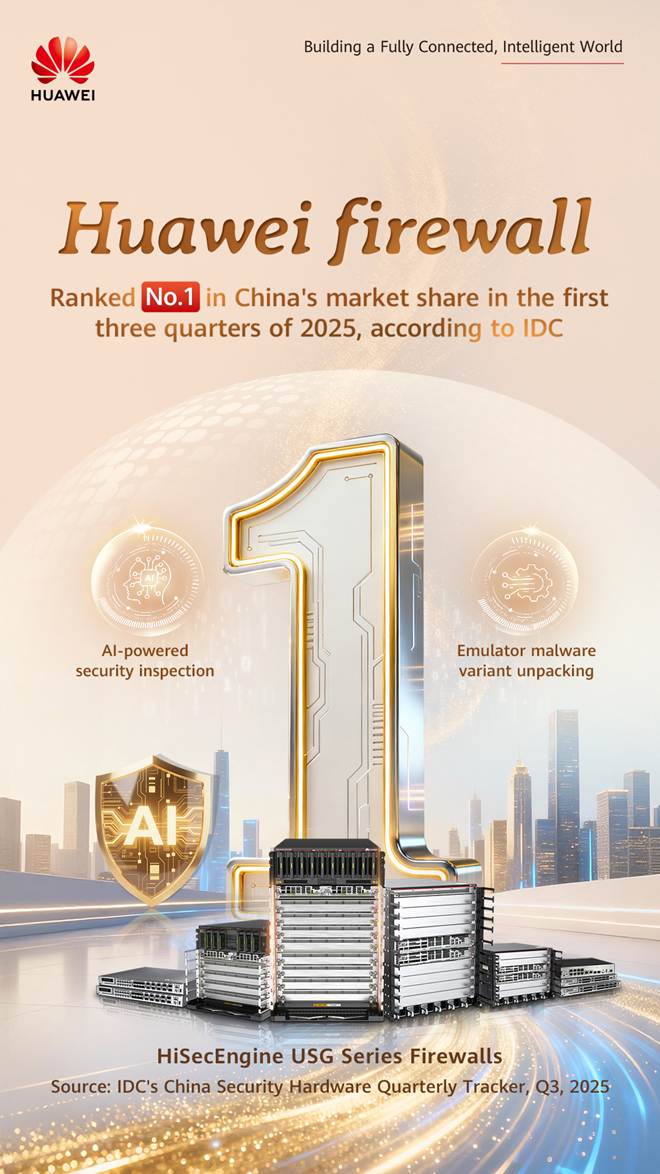
[Beijing, China, December 11, 2025] According to the newly released China Security Hardware Quarterly Tracker, Q3, 2025 by global authoritative IT market research firm IDC, Huawei's network firewall has secured the No. 1 market share in China for the total of the first three quarters of 2025, driven by its strong product capabilities. After leading in both Q1 and Q2, Huawei's network firewall once again maintained its lead in the cumulative results for the first three quarters, continuing to be the preferred product for key sectors such as government, finance, and healthcare.
As a core border security device in network security, firewalls serve as the "first line of defense" to isolate networks from external environments and form a pillar of any network security system. China's 14th Five-Year Plan underscores the importance of cyber security and sets forth more comprehensive development requirements—cultivating and expanding emerging digital industries such as cyber security, fostering a secure digital ecosystem, improving cyber security governance systems, and strengthening cyber security infrastructure. These policies provide a solid foundation for the development of the firewall industry and further expand market opportunities. Data shows that China's firewall market is expected to grow at a compound annual growth rate of 4.9% from 2025 to 2030. Estimates indicate that the market size will reach USD 2.9 billion in 2025 and is projected to grow to approximately USD 3.7 billion by 2030.
Huawei has invested in the security field for more than two decades, continuously enhancing the technical capabilities of its flagship firewall products to build strong competitiveness. Huawei firewalls integrate three dedicated security engines—NP acceleration, pattern matching, and encryption/decryption—which significantly improve application identification, intrusion prevention, IPsec performance, and more. With maximum service performance reaching 4 Tbps, they meet the high-throughput defense needs of enterprises. The firewalls also embed an Emulator microkernel unpacking engine and AI-powered security detection algorithms. The Emulator engine decrypts and unpacks packed files, while the AI detection technology performs dynamic analysis on the decrypted content, achieving a 95% detection rate for unknown threats. In addition, through unified management by the iMaster NCE network and security controller, Huawei firewalls can automatically coordinate with endpoints, network devices, and security products for one-click threat response, enabling near-source threat containment. Huawei firewalls adopt a three-layer separation design for management, detection, and data, ensuring that localized faults do not affect overall system operation. They support power and fan redundancy, allowing faulty components to be replaced online without disrupting service continuity, achieving zero service interruption.
Looking ahead, Huawei will further increase investment in network security innovation. Guided by the concept of "AI versus AI", the company aims to empower industries across the board to build intelligent security protection systems and safeguard enterprises in their digital and intelligent transformation.
Copyright © 2026 Huawei Technologies Co., Ltd. Wszystkie prawa zastrzeżone.