This site uses cookies. By continuing to browse the site you are agreeing to our use of cookies. Read our privacy policy>

This site uses cookies. By continuing to browse the site you are agreeing to our use of cookies. Read our privacy policy>
Enterprise products, solutions & services
With the insights shared at this event, one thing is clear: AI is advancing faster than ever. And the benefits are clear. No one is asking why we should use AI. The real question is how.
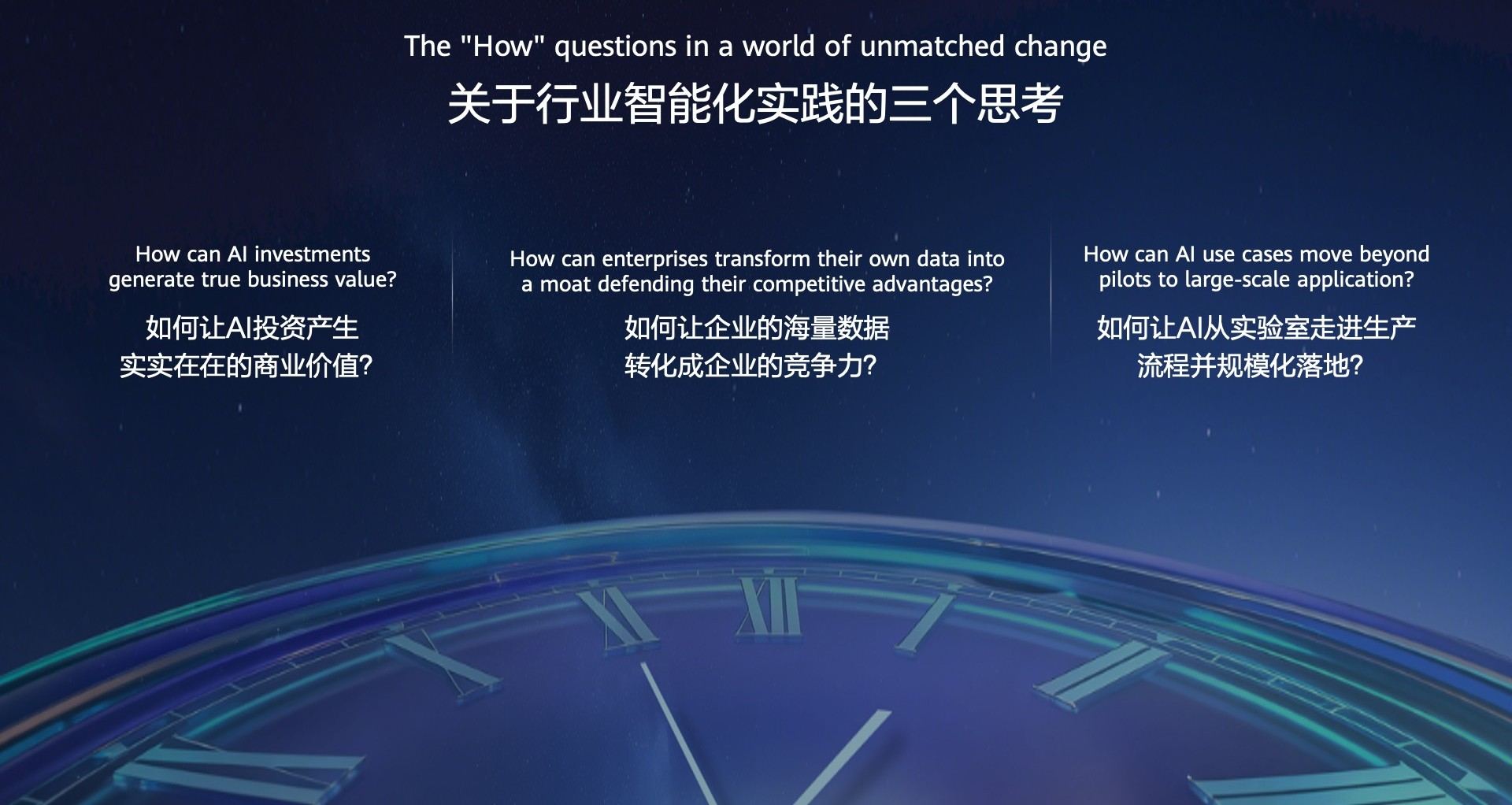
Many people have questions like:
1) How can AI create real value in my industry?
2) How can I make the most of my data – and stay competitive?
3) And what about large-scale application?
In Chinese, we have a saying: “Real knowledge comes from practice.” To answer these questions, today I would like to share three success stories from three different industries.
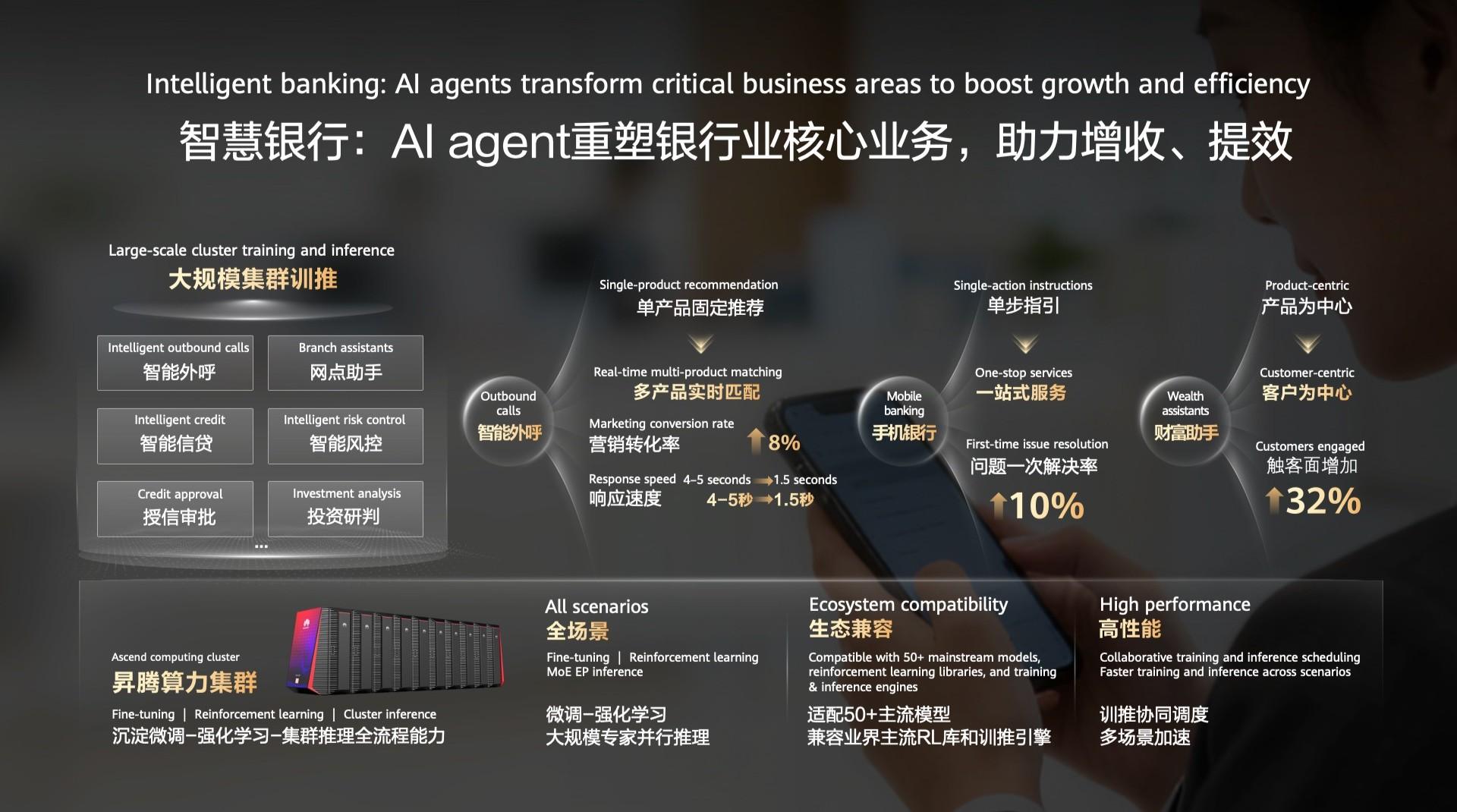
Our first example comes from the banking sector – a frontrunner in industry intelligence. Here, AI agents are reshaping critical business domains and customer journeys.
Together with a leading bank, we developed multiple AI agents for tasks like outbound calls and wealth management. These agents engage customers with natural, human-like conversation, while completing real-time tasks.
This was a challenging project. We needed high concurrency to support 500–1,000 interactions at the same time. We needed ultra-low latency – because even a 2 second delay causes most users to drop out. We also needed long-context understanding across 10 or more dialogue turns. This is critical for: identity verification, intent recognition, product inquiry, and transaction confirmation.
To meet these needs, Huawei developed a dynamic master–sub-agent architecture. The master-agent identifies customer intent, while each sub-agent handles different banking services. Based on real-time intent, the system invokes the right sub-agents to deliver an accurate response.
At the same time, we also applied our systematic engineering capabilities across the banking workflow. We were able to cut the overall latency of tasks like semantic recognition, intent understanding, and plug-in calls to under 1.5 seconds. After deploying this solution, the bank saw a 10% improvement in first-time resolution, and an 8% increase in outbound call success.
Building on this, we are now using AI agents for mobile banking and risk control.
These advanced use cases are powered by Ascend computing clusters, which support over 50 mainstream foundation models. Shared training and inference pools allow customers to select the most suitable model with no repeat deployments. It’s a huge boost for both efficiency and scalability.
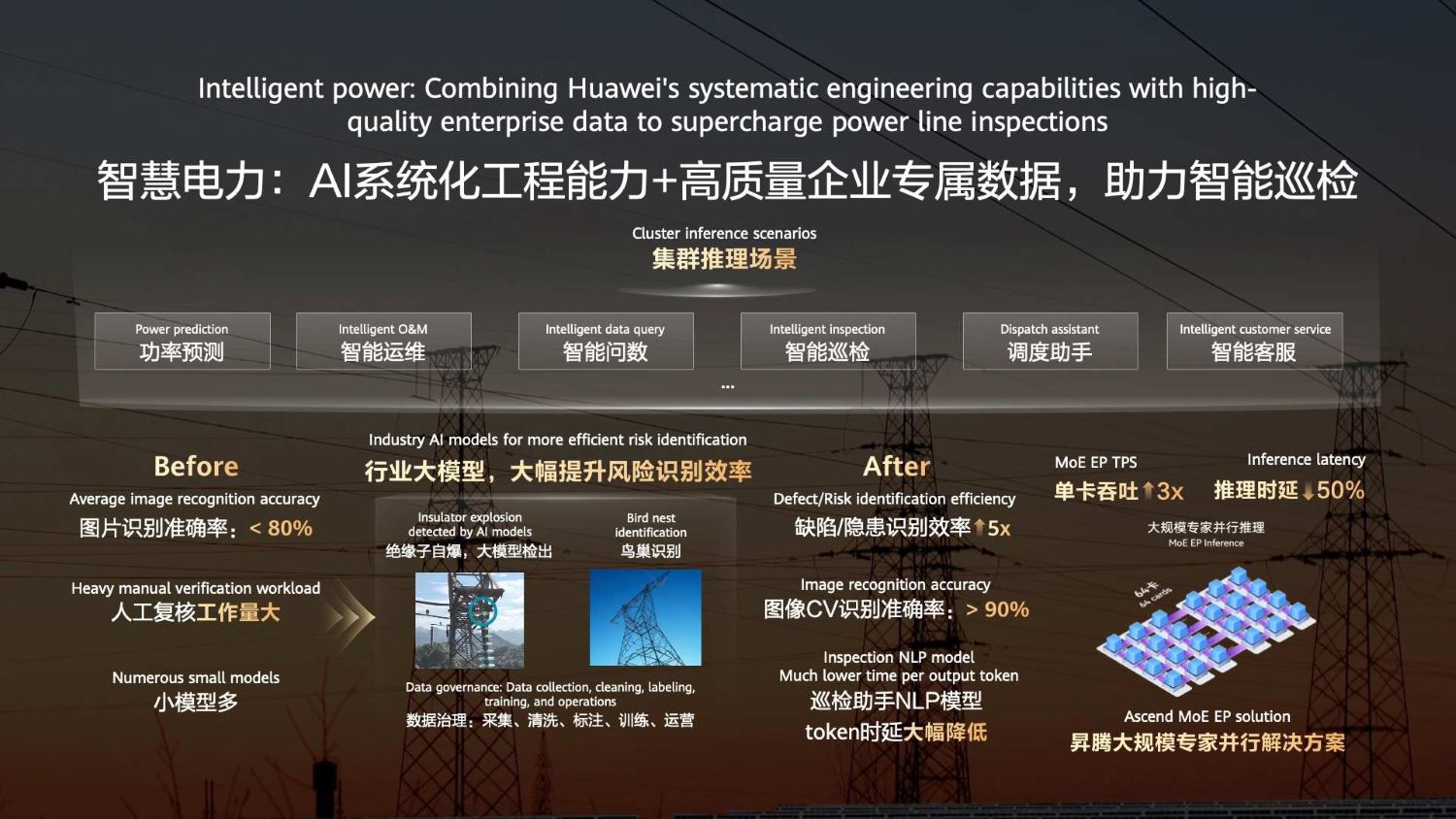
The second case occurred in the power industry.
China Southern Power Grid manages a vast amount of data. One of its critical challenges is figuring out how to leverage this data to identify defects in power transmission lines. China Southern Power Grid developed a large model for the power sector, called MegaWatt. They built this model on the Ascend computing platform and MindSpore AI framework, combining computer vision with NLP.
To prepare their data for training, we used end-to-end data governance to clean, process, label, and optimize the customer’s data. They also used Huawei’s optimized operators to speed up training and greatly improve model accuracy.
Since deployment, MegaWatt has boosted defect recognition efficiency by five times, raised accuracy to over 90%, and enabled full automation—from image recognition to report generation.
MegaWatt runs on Ascend’s MoE Expert Parallelism cluster (EP). EP is designed for high-volume, real-time tasks. It boosts per-card throughput by 3.3 times compared to traditional solutions, and greatly reduces inference latency.
This case shows that general-purpose models can’t directly solve industry-specific problems. Enterprises need to fine-tune models with their own quality data. This allows them to train custom models that solve business challenges and create lasting advantages.
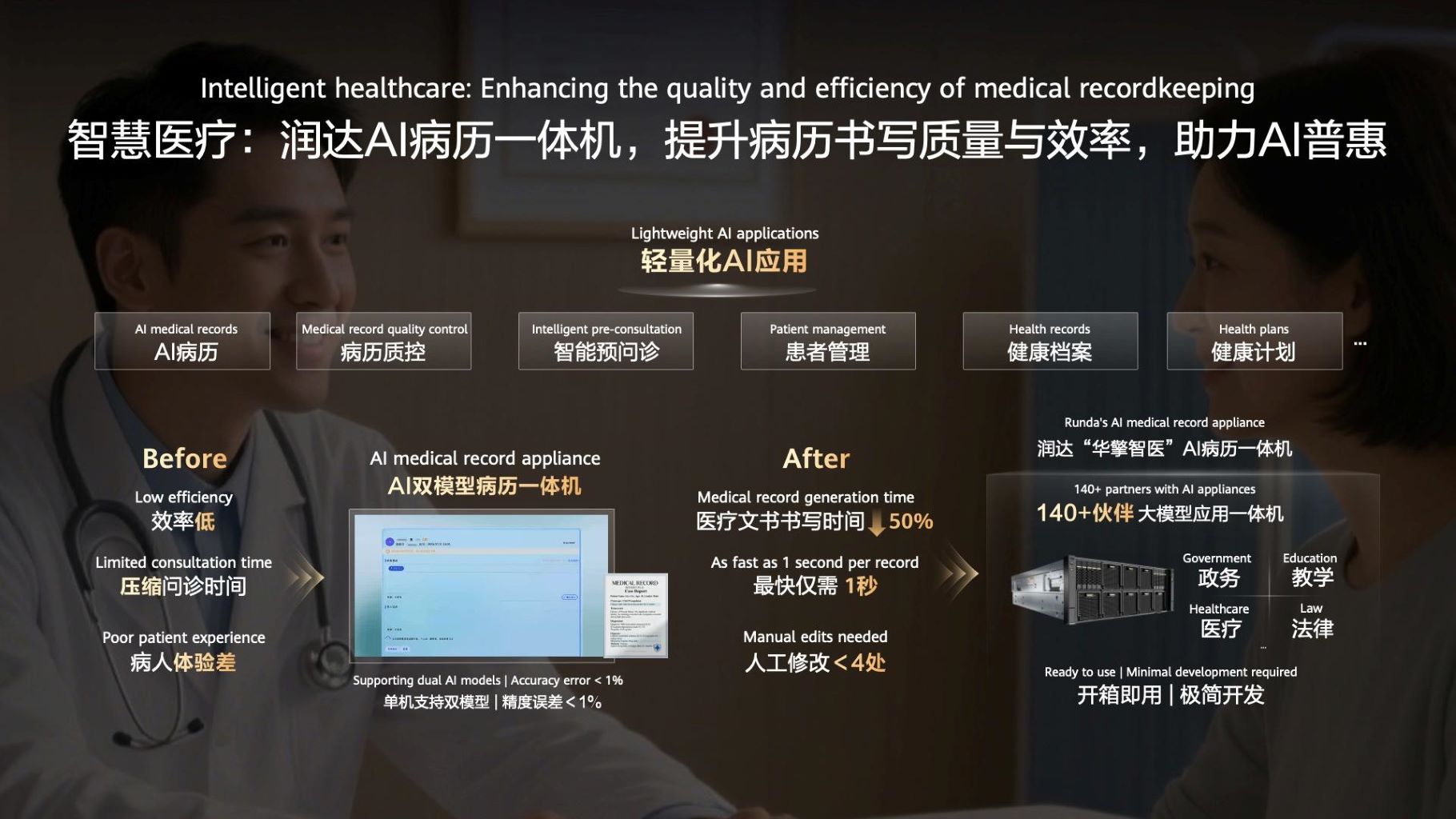
The next case comes from the healthcare industry, focusing on medical records – a critical step in the treatment process.
Huawei worked with our partner Runda to develop an AI-powered medical record system, built on an Ascend-based appliance. This solution combines open-source models for general tasks with industry-specific models for clinical understanding.
It automatically recognizes doctor–patient conversations and summarizes the patient’s complaints. It then interprets the doctor’s diagnosis, and generates accurate, high-quality records that meet hospital standards.
This medical record system was deployed at West China Hospital, where it generates medical records in one second. The system coordinates with a pre-diagnosis AI agent and a medical record quality control AI agent to ensure efficiency and quality. It allows doctors to finalize records with no more than four edits, and send them to the hospital information system (HIS) with a single click. This has greatly improved diagnosis and treatment efficiency, while giving doctors and nurses more time for meaningful interaction and communication with patients.
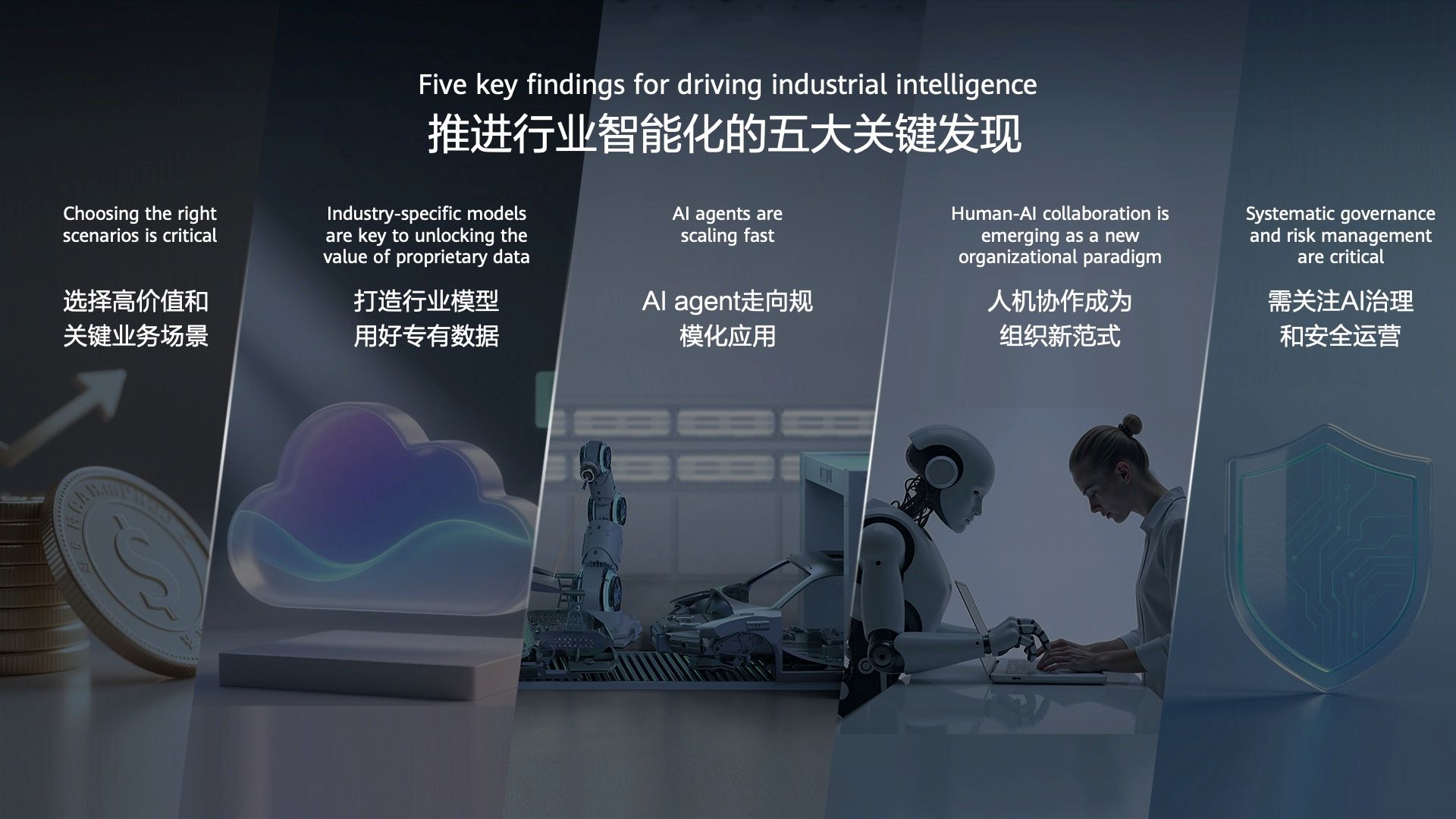
From these three cases, and our experience with many customers, we have five key findings:
1) First, choosing the right scenarios is critical. The true value of AI isn’t just efficiency. By integrating AI with core production scenarios, we can transform processes and deliver more intelligent products and services.
2) Second, general-purpose models are not enough. Out-of-the-box models are too generic. To make the most of AI, we need to fine-tune models on high-quality enterprise data. This helps our customers to customize models for their specific needs, and build competitive strengths.
3) Third, AI agents are scaling fast. All industries will consume billions of tokens every day, fueling demand for large-scale inference.
4) Fourth, human-AI collaboration will become a new organizational paradigm. AI systems are evolving from personal assistants to true partners, working closely with employees.
5) Fifth, systematic governance and risk management are critical. AI agents introduce risks like out-of-control autonomy and lack of trace-ability. All organizations need effective governance to ensure secure, sustainable, and trustworthy AI.
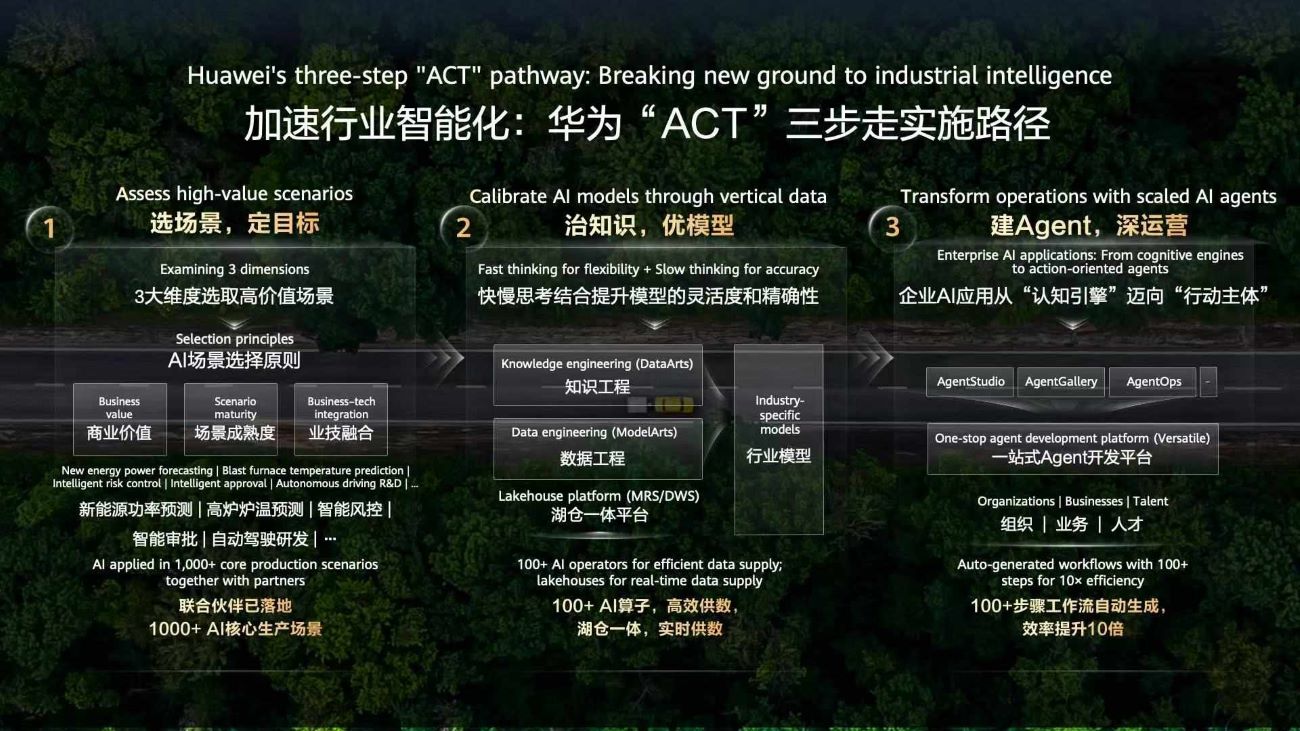
Based on these key findings, Huawei has designed a three-step ACT pathway to help our customers with large-scale AI adoption.
ACT stands for:
• Assess high-value scenarios
• Calibrate AI models using vertical data,
• and Transform business operations with scaled AI agents.
1) Let’s start with the first step – assessing high-value scenarios. Huawei has a robust AI Scenario Assessment Framework that evaluates business value, scenario maturity, and business–technology integration. This framework has already helped customers identify and implement more than 1,000 core AI production scenarios.
2) Once the right scenarios are identified, the second step is calibration, building industry models with vertical data. Training high-quality models begins with data governance. Huawei provides a full toolchain to help enterprises transform raw data into knowledge, and knowledge into models. For instance, with Huawei’s unified lakehouse platform, MRS, enterprises can stream massive raw data into a data lake, then convert it into structured data warehouse assets. This transforms idle data into ready-to-use data.
In addition, in terms of AI security, Huawei has built an end-to-end AI security protection system based on years of cyber security experience. This system works on multiple layers, from cloud, network, edge, and device, to models and applications. It helps guarantee secure and trustworthy AI applications.
3) The third step is transforming business operations with AI agents. Enterprise processes are complex, with many scenarios and heavy workloads. Huawei’s one-stop Versatile platform can automatically generate agents, as well as workflows with more than 100 steps. This makes agent deployment much faster.
Of course, as we move toward more human–AI collaboration, enabling people is just as important. Huawei has developed an AI talent enablement program that helps business professionals to effectively develop, deploy, and operate AI agents.
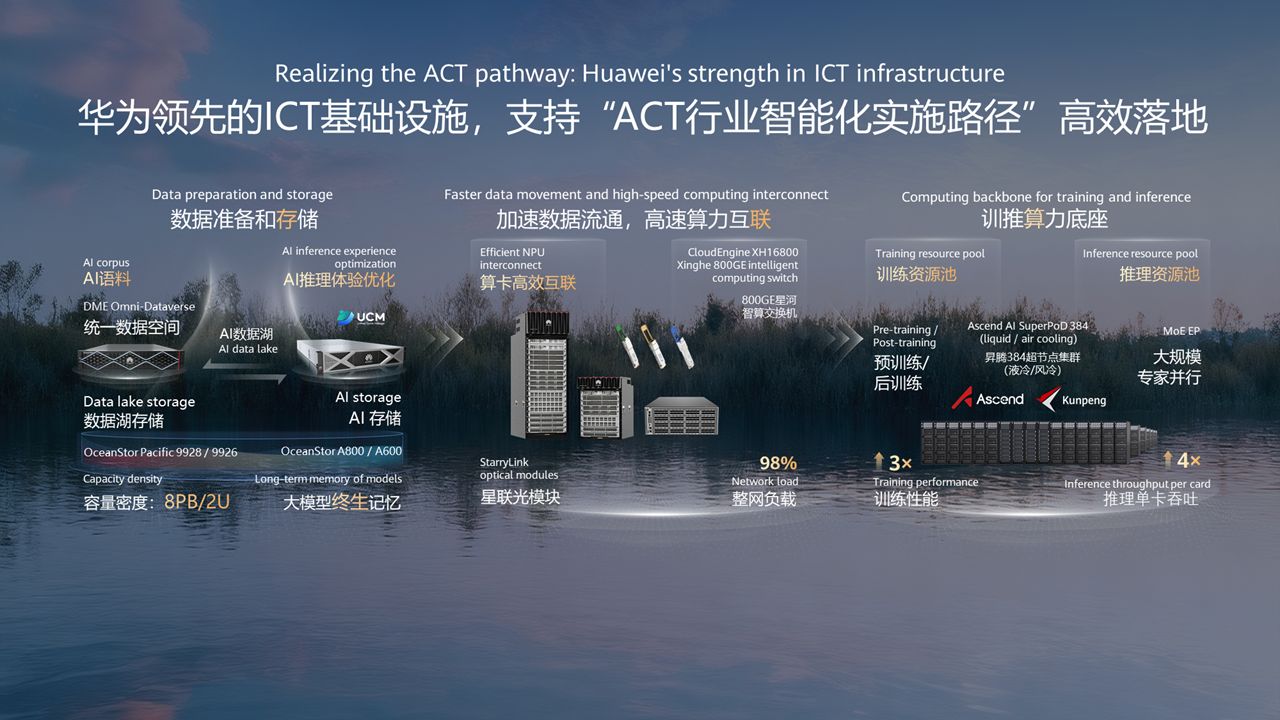
To follow the ACT pathway, enterprises need AI-oriented ICT infrastructure.
1) First, let’s look at data preparation and storage. In this area, Huawei has redefined AI storage with our Unified Cache Manager plugin. This plugin enables large models to move from minute-level memory to long-term memory, turning AI agents into lifelong partners. By replacing some computation with efficient retrieval, we can also cut first-token latency by up to 90%. This not only makes response times super-fast, it also doubles token throughput. So, enterprises can deliver faster services while reducing inference costs.
2) Second, let’s consider data movement and high-speed computing interconnect. Intelligent cluster computing centers require large-scale interconnects, efficient data flows, and stable training capacity. Huawei’s 800GE high-speed networking solution supports clusters four times larger than the industry standard. Also, with our Network Scale Load Balance algorithm, overall network utilization is increased from the industry’s 80% average to 98%. This helps boost training and inference efficiency by 10%. Huawei’s StarryLink optical module provides channel-level fault isolation, so systems still run if one link fails. This boosts network reliability by ten times and ensures that even month-long AI training tasks can run without interruption.
3) Third, let's dive into model training and inference. Our SuperPoD offers a high-performance solution. The solution can support training and inference for trillion- and 10-trillion-parameter MoE models, ultra-long sequences, and multi-modality. This solution combines 384 NPUs and 192 high-performance Kunpeng CPUs. With our SuperPoDs, training is three times more efficient than traditional solutions. Their inference performance is also four times greater than industry standard.
For inference, Ascend offers an MoE EP solution. This solution breaks through common bottlenecks, tripling T.P.S. and cutting system latency by 50%.
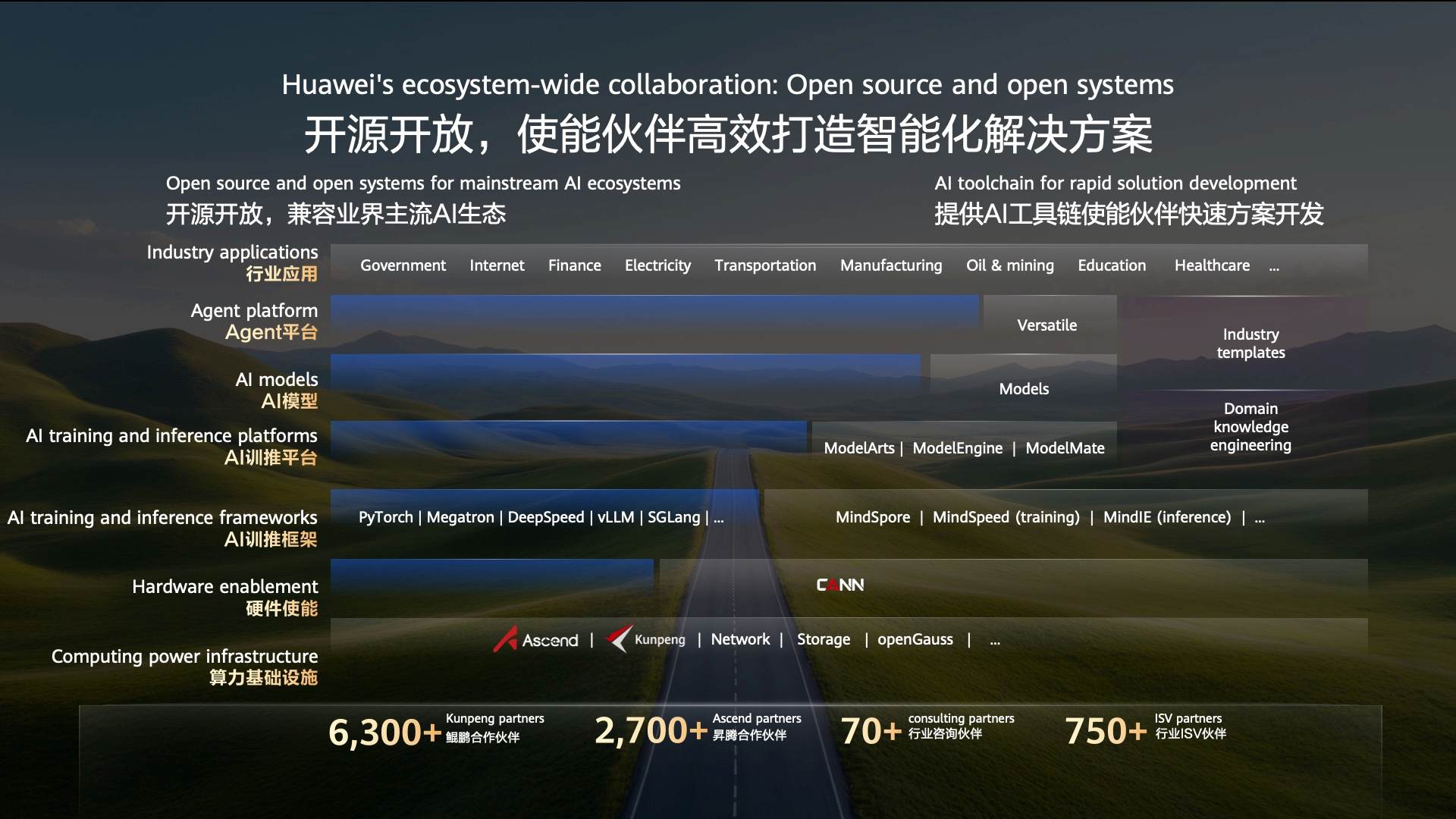
Of course, we can’t achieve true industry intelligence without our partners. We continue to strengthen the Huawei plus Partners ecosystem with three key initiatives.
1) First, we embrace open source. Alongside our open systems, like CANN and our Mind series toolkits, we support mainstream frameworks like Megatron, DeepSpeed, and SGLang. This gives our partners greater freedom to optimize and innovate on Ascend computing.
2) Second, we empower our partners with platforms and tools. We offer a full suite of frameworks, such as our training and inference framework, agent framework, and DataArts. These make it quicker and easier for partners to build intelligent applications.
3) Third, we enable rapid replication through industry expertise. Huawei has worked closely with our partners on joint development and marketing for more than 200 industry solutions, helping these partners speed up replication and delivery.
To date, this ecosystem includes over 6,300 Kunpeng partners, 2,700 Ascend partners, 70 consulting firms, and 750 ISVs.
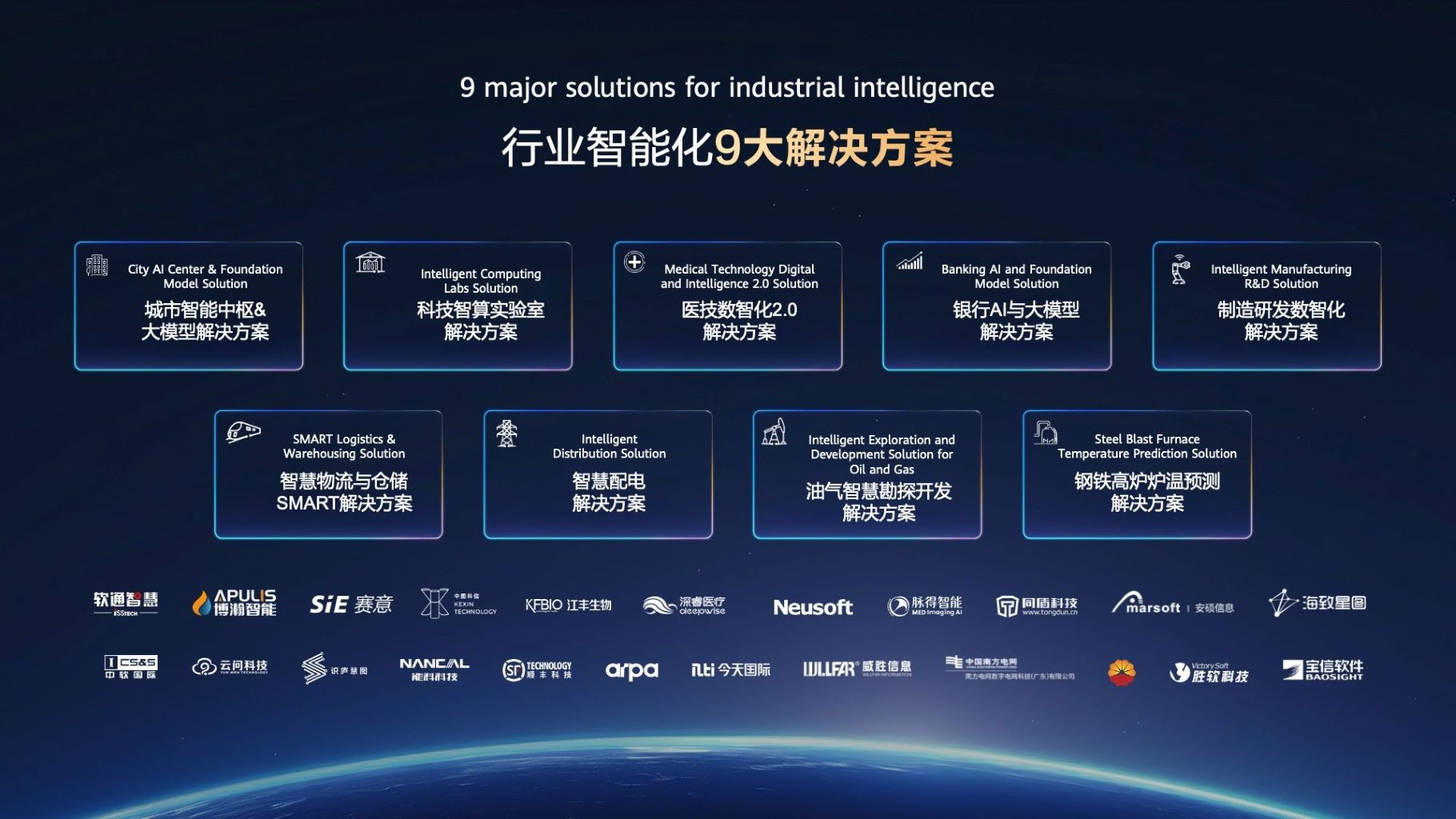
Today, we are excited to launch nine new industry-intelligence solutions, developed alongside our partners, including the City AI Center & Foundation Model Solution, Intelligent Computing Labs Solution, Medical Technology Digital and Intelligence 2.0 Solution, Banking AI and Foundation Model Solution, Intelligent Manufacturing R&D Solution, SMART Logistics & Warehousing Solution, Intelligent Distribution Solution, Intelligent Exploration and Development Solution for Oil and Gas, and Steel Blast Furnace Temperature Prediction Solution.
Ladies and gentlemen, AI is changing the world around us.
Our collective response to the changes brought by AI will determine whether it can truly deliver its “last mile” value, and transform technology breakthroughs into real-world benefits. In this sense, every one of us will serve as both a pathfinder and a torchbearer. And Huawei will stand by your side as we build an intelligent future together.
Copyright © 2026 Huawei Technologies Co., Ltd. All rights reserved.