
Education and Scientific Research RDM Data Lake Solution
Efficiently and FAIR-ly manage massive amounts of research data.
Produits, solutions et services pour les entreprises
Akıllı Telefonlar, Bilgisayar&Tabletler, Giyilebilirler ve Daha Fazlası

Efficiently and FAIR-ly manage massive amounts of research data.
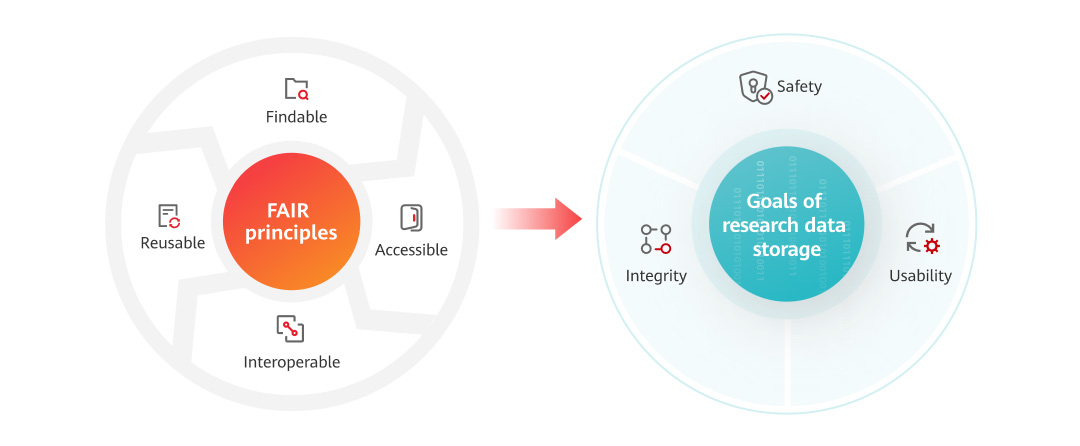
FAIR Principles and Goals of Research Data Management (RDM)
The FAIR principles are internationally recognized guidelines that underpin effective RDM. Ensuring data is FAIR (Findable, Accessible, Interoperable, and Reusable) helps guarantee the integrity, usability, and safety of scientific data storage.
RDM is a major topic in modern science that goes beyond conventional data collection and storage. It covers all necessary processes related to data flows to ensure that data can be securely collected, stored, and analyzed while remaining usable over long periods of time.

Insufficient Storage
• The data volume increases explosively from PBs to EBs.
Data Silos
• Data sharing across universities and institutions remains difficult, hindering interdisciplinary, cross-institutional, and cross-border collaboration that is essential for advancing open science.
Complex Management
• Diverse storage devices used across universities and institutes result in various access modes and increased management complexity.
Architecture
The Education and Scientific Research RDM Data Lake Solution is designed for education and scientific research scenarios. Built on the DME data management platform and OceanStor Pacific all-flash scale-out storage, the solution enables efficient RDM. The solution uses the industry's unique 3-site synchronous multi-active and 12-site asynchronous multi-active technologies based on the object S3 protocol to achieve both flexible research data sharing and reliable disaster recovery as well as on-demand data mobility between the HPC platform and RDM data lake. The solution additionally enables retrieval from tens of billions of files in just seconds using DME (Omni-Dataverse) for unified scheduling of data across data centers and clusters.
Benefits
High Density & Green
• High capacity density: The performance pool houses 36 × 61.44 TB SSDs in 2 U space and the capacity pool houses 120 disks in 5 U space.
• Unparalleled capacity utilization: High-ratio EC in a single cluster achieves 91.6% utilization. HyperGeoEC across clusters ensures that only EC fragments are stored.
Cross-Region Sharing
• Across universities and institutions: EC can be deployed across up to 12 sites, with data accessible from any site.
• Between the RDM and HPC platforms: SmartSync enables data synchronization and mobility between service pools.
• Cross-service data sharing: Seamless multi-protocol interworking allows multiple services to access a single data copy, eliminating the resource waste caused by multiple copies.
Unified Management
• Solid data security: WORM and data encryption measures secure data from unauthorized changes or malicious access.
• Ease of use: A wide library of APIs support the integration of different applications, and tenant self-management interfaces facilitate on-demand management for different organizations.
Products
OceanStor Pacific 9928
Each 2 U chassis houses 1 node and 36 disk slots that support palm-sized NVMe SSDs with a capacity of up to 61.44 TB. Each node delivers up to 150 GB/s bandwidth and 3 million IOPS.
Daha Fazla Bilgi
OceanStor Pacific 9920
OceanStor Pacific 9920 is a performance-optimized all-flash scale-out storage product. OceanStor Pacific 9920 is ideal for applications such as virtualization/cloud resource pools, databases, HPC, and big data analytics.
Daha Fazla Bilgi
OceanStor Pacific 9550
A large-capacity scale-out storage system that houses 120 disks per 5U chassis, offering superb cost-effectiveness and scalability, and supporting large-scale unstructured data workloads.
Daha Fazla Bilgi
OceanStor Pacific 9546
OceanStor Pacific 9546 is a balanced scale-out storage product. OceanStor Pacific 9546 is ideal for applications such as HPC, big data analytics, and mass data backup and archiving.
Daha Fazla Bilgi
Copyright © 2026 Huawei Technologies Co., Ltd. Tüm Hakları Saklıdır.
