The data flywheel effect is accelerating, turning data into the primary engine of enterprise growth. According to the IDC Global DataSphere Forecast, 2026–2030, global data volume will exceed 700 ZB by 2030, with a CAGR of over 30%. Data storage systems are experiencing explosive growth in both scale and complexity.
Handling alarms, analyzing metric anomalies, expanding capacity, migrating data, and generating reports—this is the everyday reality for many storage administrators. These administrators often find themselves bogged down in repetitive, manual tasks, which hinders organizational efficiency. How can we break through this bottleneck? The best way is to integrate AI into the O&M workflow, in a shift from AI-assisted operations to a new era of agentic operations (AgenticOps). This will enable comprehensive improvements in quality and efficiency across personnel, processes, and systems.
The past few years have seen AIOps (AI for IT Operations) deliver significant results in traditional storage O&M by leveraging technologies such as machine learning and big data analytics, and it has become a widely adopted approach to IT operations. For example, anomaly detection algorithms can capture subtle fault patterns from millions of IOPS, millisecond latencies, and terabytes of throughput curves that the human eye would easily miss. Root cause analysis (RCA) algorithms can pinpoint fault sources, slashing Mean Time to Repair (MTTR) from hours to under 10 minutes. Capacity and performance prediction algorithms have shifted procurement and expansion from being based on expert experience to being based on data. However, despite being powerful, AIOps has limitations:
Rootedness in prior knowledge and inability to handle unknown risks: AIOps training relies heavily on fault sample histories and expert annotations, triggering responses using rule detection and threshold checks. The algorithms may fail or even misdiagnose unfamiliar fault patterns.
Lack of goal-based autonomous capabilities: Most AIOps tools are limited to the awareness-diagnosis-suggestion process. For example, after predicting that storage pool usage will exceed 90% in 30 days, an AIOps tool cannot perform the further step of autonomously deciding whether to perform online expansion, reclaim resources, or migrate data. This gap between awareness, decision-making, and action hinders O&M efficiency.
The rapid development of AI models and agent technologies has made it possible to develop O&M agents capable of understanding business objectives, making plans, safely executing tasks, and continually evolving. AgenticOps architecture consists of four main components. The large language model (LLM) acts as the "brain" for inference and planning. The knowledge base, which includes O&M manuals, best practices, and fault patterns, provides long-term memory and experience. The skill library contains specific O&M skills. The tool library contains APIs for metric queries, configuration adjustments, fault location, and more. This architecture enables storage O&M to undergo three major capability upgrades over traditional AIOps:
1. Conversational human-machine interaction, bridging the experience gap: Administrators input instructions in natural language, and AgenticOps, which comprehends the intent, autonomously handles task orchestration, invokes performance metrics, uses configuration management tools, aggregates results, and generates readable conclusions. Troubleshooting processes that once required navigating multiple interfaces and executing dozens of commands can now be simplified into a single conversational interaction. More importantly, instead of having to spend half a decade training IT O&M experts, enterprises can now use knowledge and skill libraries to turn accumulated O&M expertise into on-demand skills. This significantly speeds up the development of professional O&M talent.
2. Risk situation awareness and proactive response for upgraded security: AgenticOps no longer evaluates a single metric in isolation. Instead, it uses combined knowledge graphs and real-time data streams to systematically assess storage threats, proactively generate preventive measures, assess impact scope, and create work orders. This transforms risk management from reactive "firefighting" to a proactive "shift-left approach". AgenticOps offers strong generalization across scenarios.
3. Goal-driven automated orchestration towards autonomous O&M: Administrators no longer need to provide step-by-step instructions. Instead, they can simply set specific business objectives, such as keeping tier 1 storage latency below 1 millisecond while maintaining available capacity above 30%. AgenticOps can then analyze real-time system status, predict risks, and identify the optimal approach with the lowest impact. Through goal-driven operations, it forms a complete closed-loop process of awareness, decision-making, execution, and verification.
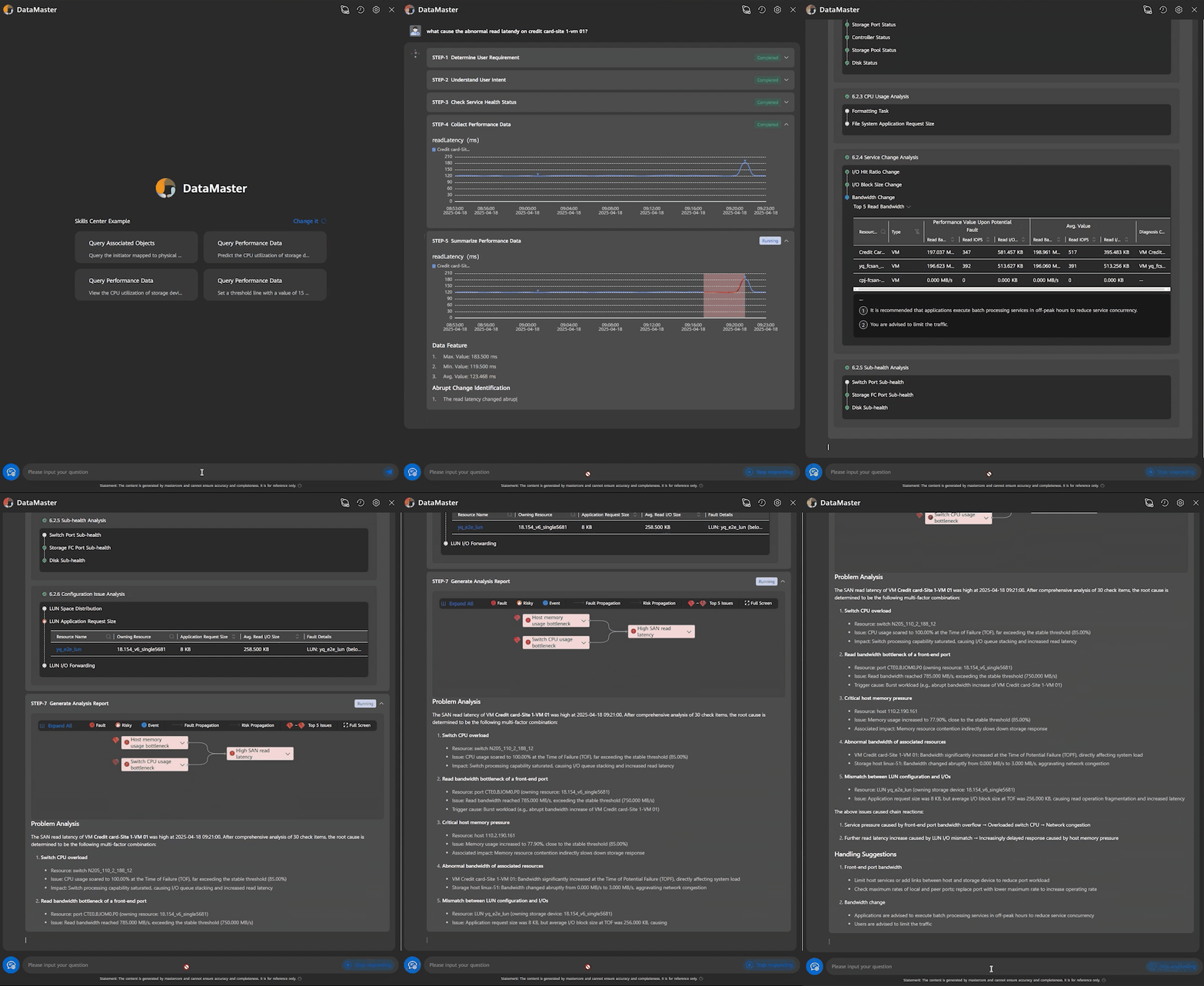
Huawei has developed the DataMaster storage O&M agent as part of its iMaster DME storage management software. AgenticOps is applied to free administrators from repetitive manual tasks while keeping storage systems running reliably and efficiently. The DataMaster storage O&M agent has four key features:
1. An O&M copilot for storage administrators: Thanks to natural-language interaction, administrators no longer need to memorize complex procedures or search for clues and anomalies from among massive numbers of alarms and KPIs. A simple prompt such as "Analyze the cause of the performance degradation in virtual machine A" is enough for the agent to automatically generate analyses and conclusions. Searching for answers in manuals, online communities, and vendor support channels becomes a thing of the past.
2. A fault agent for proactive prevention and recovery in minutes: Rare events such as transmission jitter and optical module anomalies can occur during storage operations. These events can degrade upper-layer application performance or, in severe cases, cause major outages. It is extremely difficult to identify these types of events using traditional alarms and KPI thresholds. Huawei has developed a multimodal risk awareness mechanism. In addition to detecting known faults through rules and thresholds, it analyzes time-series changes in logs and KPI metrics in real time to identify latent risks. It then generates remediation recommendations based on cause-effect inference models and knowledge graphs. Traditional diagnostics is characterized by reactive notification, many different tools and interface types, inefficiency, and high risk of error. This mechanism transforms diagnostics and enables faster issue resolution with proactive, real-time O&M through a single entry point.
3. An optimization agent for goal-oriented autonomous optimization: The effectiveness of optimization tasks, including capacity management, latency optimization, hot/cold data placement, and resource reclamation, has traditionally depended heavily on the experience of individual administrators. Now, with the optimization agent, these tasks can be automated based on predefined service-level objectives (SLOs). When optimization is needed, it invokes the relevant skills to develop an optimization plan, with administrator confirmation required before executing high-risk operations.
4. Cloud-premise synergy for continual online iteration of the agent: An agent's models, knowledge bases, and skills need to be upgraded frequently while ensuring compliance with data regulations. Huawei uses a cloud-premise synergy working mechanism: an agent brain is built in the cloud to provide Model-as-a-Service (MaaS) with weekly iteration and upgrade; in the local data center, the agent invokes MaaS services and local tools to analyze and process configurations, KPIs, and logs. This mechanism balances rapid technological iteration with user data security, ensuring that agents are both effective and trustworthy.
While AgenticOps technology has demonstrated enormous potential, there are still barriers to truly autonomous O&M.
Agent hallucination and safety: Agents may generate seemingly rational but dangerous operational suggestions, such as rebooting a device. Before we can have fully autonomous O&M, the action layer must incorporate permission guardrails, blast-radius controls, and cross-validation mechanisms to ensure that critical operations are auditable and interruptible.
Expected optimization results: Although agents can propose optimization strategies, real-time simulation in digital-twin environments is needed to ensure that those strategies achieve the desired outcomes. Building a unified storage semantic data foundation and causal graphs will give agents a deeper understanding of storage operations, helping them move from correlation-based inference toward cause-effect inference.
Cross-domain agent collaboration: As agents collaborate across data centers, business domains, and devices from different vendors, new challenges will emerge, including semantic gaps, agent negotiation, and conflict resolution. Huawei is actively exploring these frontiers with customers and partners through joint innovation projects.
AIOps isn't about replacing people; it's about empowering them. The value of AgenticOps for storage management lies in deeper human-agent collaboration—freeing administrators from repetitive routines so they can focus on architecture design, cost optimization, and business innovation. Huawei will continue to innovate in storage O&M agent technology, working with customers and partners to navigate the opportunities and challenges of the intelligent era.
Disclaimer: The views and opinions expressed in this article are those of the author and do not necessarily reflect the official policy, position, products, and technologies of Huawei Technologies Co., Ltd. If you need to learn more about the products and technologies of Huawei Technologies Co., Ltd., please visit our website at e.huawei.com or contact us.
Copyright © 2026 Huawei Technologies Co., Ltd. Tüm Hakları Saklıdır.