Enterprise products, solutions & services
[Shenzhen, China, June 15, 2026] Recently, Gartner unveiled the Critical Capabilities for Enterprise Wired and Wireless LAN. Huawei ranks No. 1 for the first time in the Hands-Off NetOps use case thanks to the robust intelligent O&M capabilities of Huawei Xinghe AI Campus.
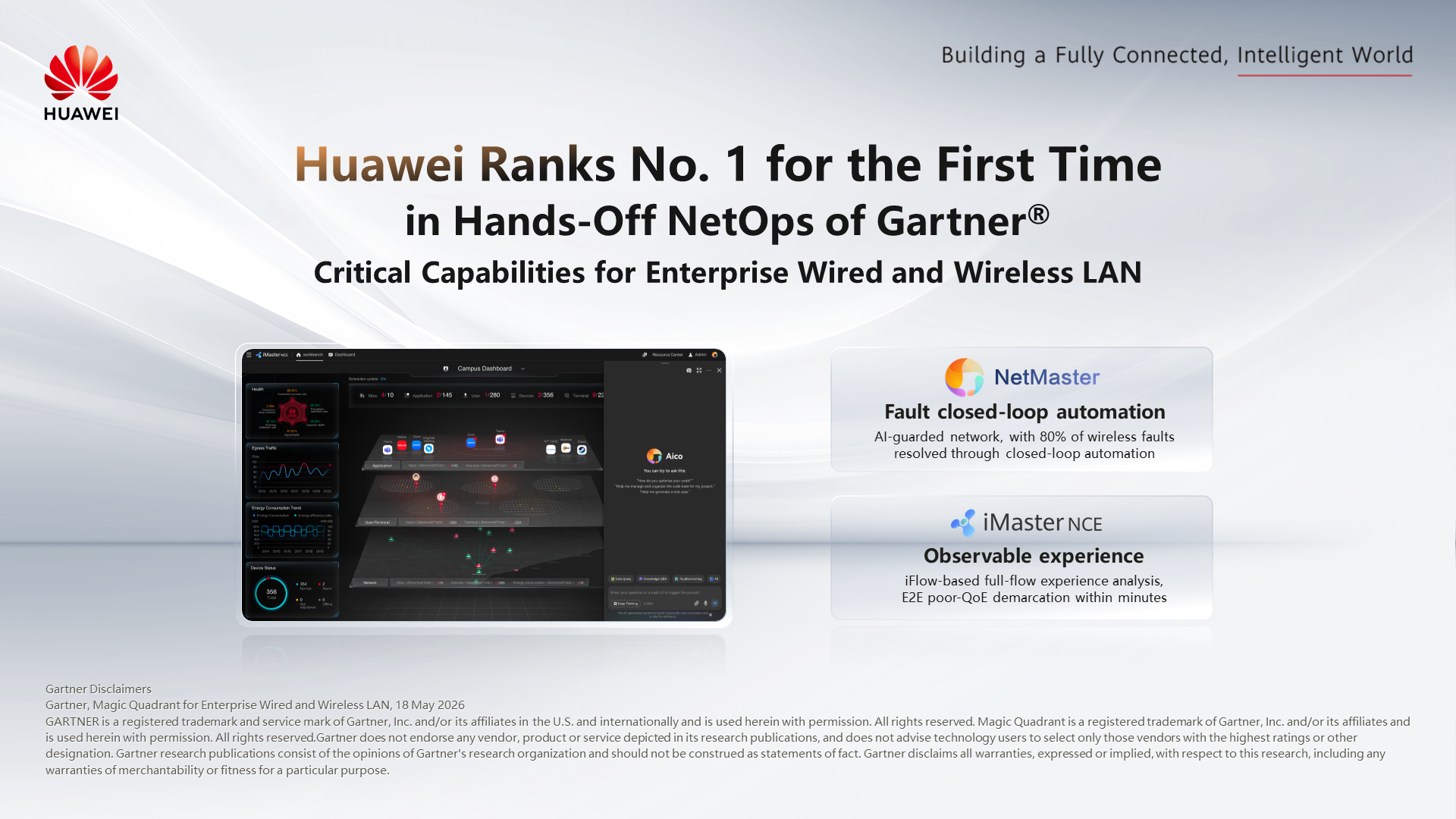
Huawei ranks No. 1 for the first time in Hands-Off NetOps of Gartner® Critical Capabilities for Enterprise Wired and Wireless LAN
The intelligent O&M system powered by iMaster NCE Network Digital Map and NetMaster enables experience visualization and automatic fault rectification, thus delivering an AI-guarded campus network.
• 4-dimensional network digital map:
The digital map offers a holographic visualization of networks, users, terminals, and applications, moving away from conventional device-centric O&M. This device-to-experience shift enables a clear overview of the network status, precise location of fault impact scope, accurate measurement of poor-QoE experience, and the ability to make informed O&M decisions.
• Observable user experience
Traditional O&M faces two major pain points: a high false positive rate and the difficulty in evaluating real experience, as fixed weighted scoring cannot adapt to complex scenarios. To address these pain points, Huawei has developed a self-learning scoring algorithm for user experience. This algorithm preprocesses KPI data, intelligently identifies user scenarios, and dynamically adjusts indicator weights to more accurately reflect the actual network experience. For example, it increases the bandwidth weight when users watch HD videos and decreases it when they browse web pages. Consequently, this approach provides comprehensive insights into user experience across both spatial and temporal dimensions, enabling detailed tracking of each user's experience at every moment.
• Observable application experience
The packet conservation algorithm for Internet (iPCA) is utilized to automatically color UDP/RTP packets, facilitating hop-by-hop demarcation across the campus network. iFlow analyzes the round-trip loss and delay of TCP packets, enabling segment-by-segment demarcation. Additionally, intelligent application identification, in-situ flow information telemetry (IFIT), and simulation dialing tests dynamically simulate audio and video services, achieving over 80% accuracy in WAN link detection and quality awareness on the WAN side. This LAN-WAN collaboration reduces the time required for application fault demarcation and location from hours to mere minutes.
NetMaster, a network O&M agent developed by Huawei, offers 34 types of fault chain-of-thoughts (CoTs) in eight categories. It automatically diagnoses and resolves 80% of wireless faults, slashing the mean time to repair (MTTR) from days to minutes, facilitating autonomous O&M. The agent monitors more than 15 proprietary key indicators of terminal experience in real time, proactively identifying issues such as poor signal coverage, high interference, and roaming stickiness without the need for onsite surveys or manual inspections. Leveraging a multi-objective adaptive reinforcement learning algorithm, the agent balances coverage, interference, capacity, and switching stability to identify the globally optimal solution, overcoming the traditional optimization dilemma. The agent possesses expert-like cognition, delivering timely optimization policies to implement one-time, imperceptible self-healing. This ensures that 80% of wireless issues are resolved without human intervention.
We are stepping into a new era of AI-guarded campus network O&M. Looking ahead, Huawei will continue to drive innovation and leadership in AI O&M technologies for campuses, enabling global enterprises to transition from the manual mode to a new standard where 24/7 virtual agent presence becomes the norm across various industries.
Copyright © 2026 Huawei Technologies Co., Ltd. All rights reserved.