Enterprise products, solutions & services
[Hamburg, Germany, June 25, 2026] Huawei has upgraded its storage-computing-networ5 solution for HPC + AI to help universities and research institutions improve performance and efficiency across end-to-end workflows. The upgraded portfolio combines storage, computing, and networking capabilities and addresses infrastructure requirements to enable large scale AI implementation. Huawei will present the solution at ISC High Performance 2026, held at the Congress Center Hamburg from June 23 to 25, at Booth D40.
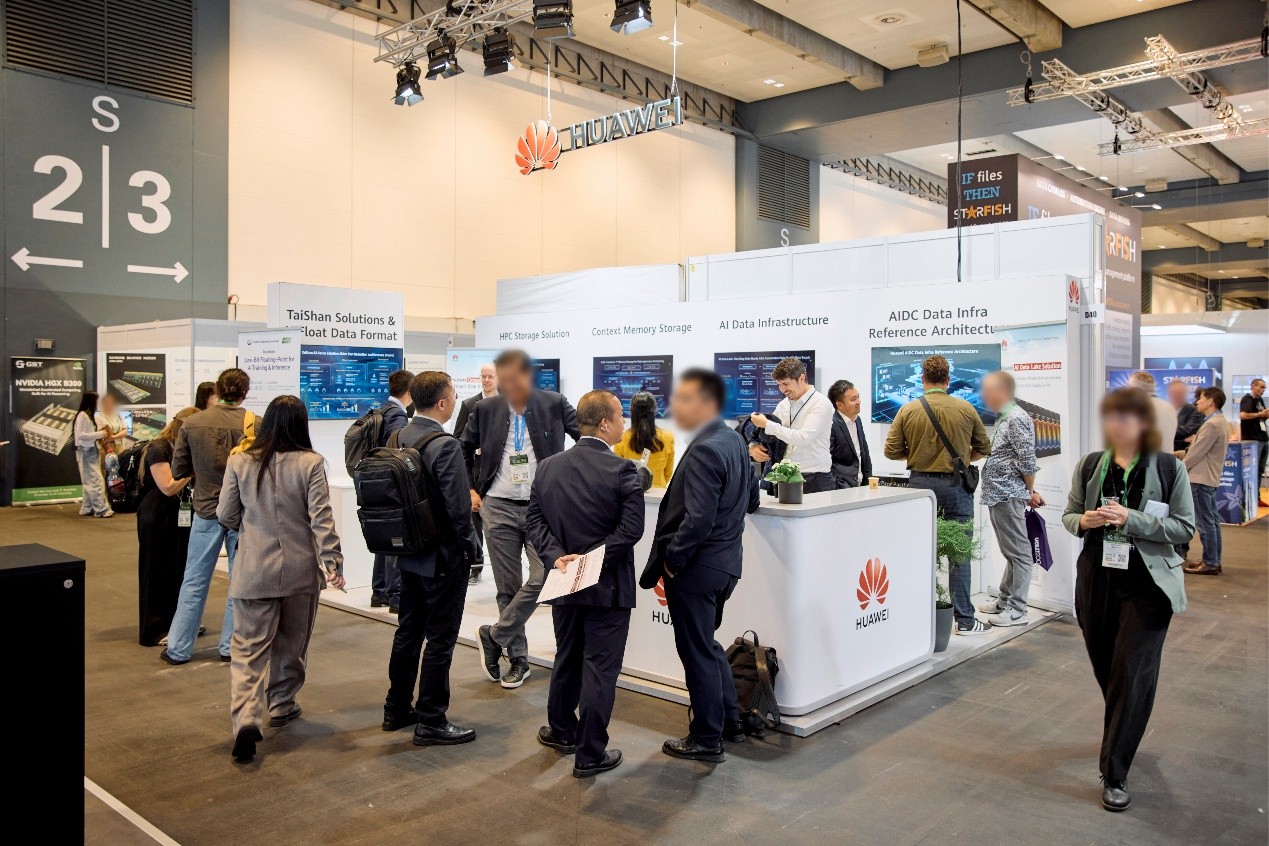
(Huawei booth at ISC High Performance 2026, June 23-25, Hamburg, Germany)
Huawei presented its AI data infrastructure for AI data centers for the first time at the Innovative Data Infrastructure (IDI) Forum in Paris in May. The technology responds to a clear challenge: AI applications and digital agents are rapidly driving up token consumption in enterprises—and existing IT architectures are reaching their limits. Huawei addresses this with an end-to-end AIDC IT stack that ranges from the AI Data Lake to AI Data Platform and Context Memory Storage platforms, model engineering, agent frameworks, and data resilience:
In the field of research data management, traditional RDM (Research Data Management) platforms are rapidly evolving into AI data lakes. Huawei's AI Data Lake Solution helps research organizations achieve the goals of storing, managing, and utilizing data effectively. Among its features, OceanStor Pacific scale-out storage offers industry-leading high-capacity density of 11 PB per 2U, enabling efficient storage of massive scientific research data and optimal TCO. Leveraging the DME Omni-Dataverse unified data space, it supports real-time ingestion of multimodal and cross-site data into the lake, along with global visibility and management. Additionally, it provides the capability to perform second-level retrieval of hundreds of billions of multi-dimensional vector data, further accelerating the aggregation, provision, and mining of high-quality scientific research data.
In the field of high-performance computing, research workloads are continuously expanding from traditional HPC toward AI training and AI inference.
For AI training scenarios, Huawei OceanDisk 1610 Smart Disk Enclosure builds the optimal storage foundation for parallel file systems, delivering 220 GB/s bandwidth and 4 PB per 2U of high-capacity density. While improving the efficiency of training data supply, it also significantly reduces data center space usage and energy consumption costs.
For AI inference scenarios, Huawei has pioneered a "3+1" AI Data Platform, integrating the knowledge base, KV cache, memory, and unified data management capabilities. This platform uses the UCM inference memory data management technology that can achieve knowledge retrieval with an accuracy of over 95%.
Huawei's CMS (Context Memory Storage) revolutionizes traditional storage architectures by leveraging core capabilities such as multi-modal media storage, innovative 3-in-1 disk architecture, and KV semantic bypass. It is specifically designed for KV cache acceleration and context memory storage. In terms of computing ecosystem integration, it supports diverse computing clusters with GPUs and NPUs, and its network protocols are compatible with RoCE and Unified Bus (UB). Compared to traditional solutions, CMS enhances the throughput performance of AI foundation model inference by 3x to 5x, reduces the latency of the first token by up to 90%, and simultaneously cuts costs by 30%.
For universities and research institutions, modern HPC + AI environments depend on network performance and stability as much as on compute and storage. The Xinghe AI Data Center Network addresses these requirements by combining high bandwidth scaling with operational efficiency.
Based on Open Ethernet, it cuts O&M costs by 30% and supports large AI cluster growth with high-density frame boxes (up to 128\times800GE or 128\times400G in air- or liquid-cooled configurations), enabling a networking scale four times the industry level and reducing network construction TCO by 40% for the same scale.
StarryLink optical modules add per-packet load balancing to achieve 98% network throughput and improve training and inference efficiency by 7%. Built-in telemetry provides sub-millisecond sampling and visualization of key network KPIs, enabling fault location within minutes, while iFlashboot 2.0 supports a 5-second restart to reduce interruptions during training and inference.
Storage is a defining element for HPC and AI workflows because it determines how fast data moves from ingestion to training and inference. With its AIDC storage stack — spanning AIDP, AI Data Lake, Context Memory Storage and HPC storage solution.
Huawei aims to help universities and research institutions build a data foundation that scales with growing model and simulation demands. In Europe, Huawei works with a broad base of public institutions and education customers, including more than 600 universities/institutions and more than 80K schools, and cooperates with research institutes across the region.
ISC High Performance is Europe’s forum for high-performance computing, drawing more than 3,500 attendees from academia, government, and industry. It covers HPC, AI, quantum computing, and cloud. The event provides a platform for vendors and users to discuss performance, energy efficiency, and cost-effective infrastructure for HPC and AI.
During the event Huawei will also participate as a stakeholder in the Open Edge and HPC Initiative (OEHI) programme.
For more information, visit https://e.huawei.com/eu/products/storage
Copyright © 2026 Huawei Technologies Co., Ltd. All rights reserved.