This site uses cookies. By continuing to browse the site you are agreeing to our use of cookies. Read our privacy policy>

This site uses cookies. By continuing to browse the site you are agreeing to our use of cookies. Read our privacy policy>
Enterprise products, solutions & services
[Fuzhou, China, April 29, 2026] During the 9th Digital China Summit, the electric power forum themed "AI+ Supercharging Electric Power" was successfully held at the Fuzhou Strait International Conference & Exhibition Center. At the forum, State Grid Fujian Integrated Energy Service Co., Ltd. and Huawei Technologies Co., Ltd. signed a framework agreement to deepen their cooperation. Under the agreement, both parties, guided by China's carbon peak and carbon neutrality goals, will leverage their core strengths in green energy, energy saving, carbon reduction, and digital technologies to jointly develop solutions, drive technological innovation, and expand market reach. This will drive intelligent upgrades across the energy sector and accelerate a full-scale green transformation of the economy and wider society.
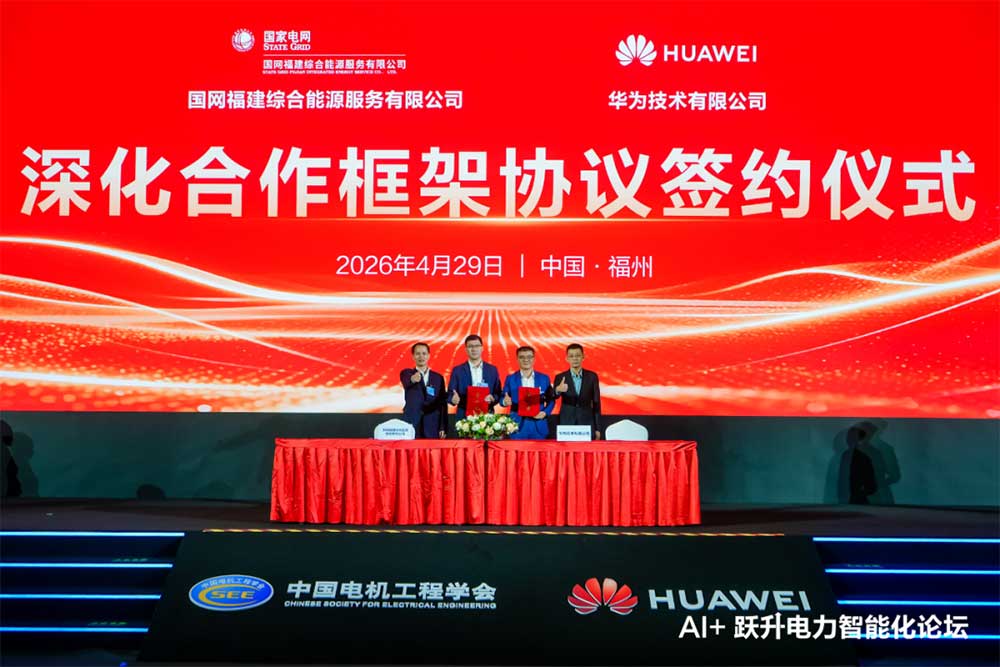
State Grid Fujian Integrated Energy and Huawei signing a framework agreement to deepen ties
Lin Tingge, Deputy General Manager of State Grid Fujian Integrated Energy, and Zheng Xin, General Manager of Huawei's China Government & Enterprise State Grid Group Account Dept, signed the agreement. The signing was witnessed by Xu Zhiyong, Chairman of State Grid Fujian Integrated Energy, and Li Chen, President of Huawei's Integrated Energy Services BU.
The new energy sector is expanding rapidly, with steady progress being made in the construction of new power systems. The industry is certainly experiencing growing pains, including challenges regarding the large-scale renewables, poor coordination between generation, grid, load, and storage, uneven digitalization across the energy sector, and incomplete carbon asset management systems. To enhance grid operational safety, meet carbon goals, and drive high-quality upgrades in the energy industry, the two companies will focus on areas such as zero-carbon campuses, virtual power plants, new energy storage, smart microgrids, and power-computing synergy. This partnership combines State Grid Fujian Integrated Energy's practical experience and resource advantages accumulated in recent years in intelligent energy services for zero-carbon campuses, carbon asset management, market-based energy trading, and integrated energy project operations, with Huawei's advanced capabilities in cloud computing, big data, AI models, and the HarmonyOS ecosystem. Together, they will develop replicable, scalable integrated energy solutions and exemplary practices, setting a new benchmark for the transformation of the energy industry.
For State Grid Fujian Integrated Energy, the signing of this agreement marks a major step forward in driving low-carbon innovation and expanding its footprint in the integrated energy service market. By joining forces with Huawei, the company will integrate its strengths in energy resource aggregation and localized services while exploring new AI-driven applications across areas such as energy dispatching, efficiency management, carbon accounting, and equipment O&M, helping to enhance both the quality and efficiency of the energy industry.
Huawei, for its part, will continue to open up its digital technology ecosystem, offering the energy industry a leading computing foundation, technical tools, and transformation support built on its expertise in digital power and intelligence. This collaboration with State Grid Fujian Integrated Energy is a strategic move to drive the energy revolution through technology. Together, they will tackle core industry pain points.
Going forward, this partnership will serve as a launchpad for joint innovation, with a focus on core technologies to build industry-leading AI capabilities. The two parties aim to develop a portfolio of replicable, scalable integrated energy benchmark solutions and exemplary practices, supporting the creation of a modern energy system that is defined by reliable power supply, energy savings, cost reduction, efficiency gains, and low-carbon leadership. In doing so, they will contribute to the development of a digital China and the achievement of the national carbon goals.
Copyright © 2026 Huawei Technologies Co., Ltd. All rights reserved.