
This site uses cookies. By continuing to browse the site you are agreeing to our use of cookies. Read our privacy policy>

This site uses cookies. By continuing to browse the site you are agreeing to our use of cookies. Read our privacy policy>
Enterprise products, solutions & services
Energy systems are undergoing a regulatory and technological transformation. Assets are under increasing pressure to improve quality of service and integrate renewables and distributed energy resources, while the availability of field crews is limited, either due to a lack of skilled labor or tariff pressure and OPEX restrictions. Extreme weather events add urgency to operational resilience. In Latin America, utilities often manage remote assets across large territories, where travel can be costly and time-consuming, and access can be difficult in certain regions.
As a result, the challenge becomes operating more effectively what is already - or will soon be - connected: when a substation concentrates automation, telecommunications, sensors, and video, it shifts from being “just” an electrical asset to becoming a critical digital node, changing how the power system is operated.
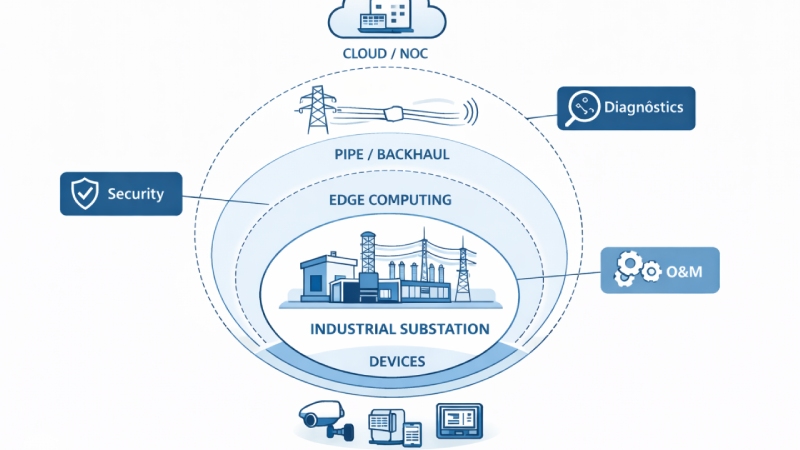
Companies often rely on multiple tools and "system islands", which can fragment operations and maintenance and slow diagnosis and response. In many cases there are too many low-reliability false alarms – triggered by wind, rain, animals or vegetation - while real events may go unnoticed. The goal is to reduce uncertainty: to know quickly what happened, where it happened, and what the next action should be.
An integrated Cloud, Network, Edge Computing, and Field Devices architecture is a modern approach to digitalization solutions:
• Field devices (cameras, sensors, IEDs, switches).
• Edge computing close to the asset (faster decisions, less dependence on backhaul links).
• A reliable network to connect assets to the operations center.
• Cloud systems for management, analytics, and integration.
This "Cloud-Pipe-Edge-Device” architecture is designed for high availability and observability (monitoring) and supports security by design. Advanced deployments may use MACsec (AES-256), which acts as a "lock" on Ethernet traffic between devices, helping reduce the risk of interception and tampering within the industrial local network. In substations and power plants, communication security and availability should be built into the design - not treated as add-ons.
Integrated digitalization can shorten the path between detection, decision, and action:
• Fault localization tends to become faster and more specific – identifying whether the issue is in a link, port, device, or network segment- reducing time to understanding and resolution.
• High-definition cameras (including models with strong optical zoom/PTZ capabilities) can enable remote inspections, with AI supporting the identification of anomalies (e.g., an open door, smoke, or unauthorized presence) and helping prioritize response. By combining video with sensors and operational data (multimodal fusion), it is possible to reduce false alarms and improve the quality of dispatch decisions.
• Faster and more standardized configuration changes can be enabled through templates and assisted provisioning, accelerating commissioning and reducing human error.
The approach can also enable condition-based maintenance, supporting more reliable data, better planning, and fewer emergency interventions and rework.
Technology delivers value when it is coupled with processes, people, and integration – and when operational metrics are defined from the start.
In practice, this requires:
• Systems integration across SCADA, O&M and asset management.
• Data and evidence governance.
• Cybersecurity by design across OT and IT.
• Closed-loop processes: detect, validate, dispatch, verify, and record.
• Procedures, training, and operational discipline.
This debate has gained momentum globally.
For Brazil and Latin America, the opportunity is to translate these approaches into our regulatory, operational, and environmental realities - focusing on what truly matters: operating with greater predictability, safety, and efficiency.
Disclaimer: The views and opinions expressed in this article are those of the author and do not necessarily reflect the official policy, position, products, and technologies of Huawei Technologies Co., Ltd. If you need to learn more about the products and technologies of Huawei Technologies Co., Ltd., please visit our product pages or contact us.
Copyright © 2026 Huawei Technologies Co., Ltd. All rights reserved.