Enterprise products, solutions & services
[Barcelona, Spain, March 2, 2026] At MWC Barcelona 2026, Huawei launched the industry's first L4 Autonomous Driving Network (ADN) solution for campuses, opening a new chapter in the evolution toward network autonomy. The launch event was attended by Aleksandr Merkinger, Infra VP of Müller from Germany and Shawn Zhao, President of Campus Network Domain of Huawei's Data Communication Product Line.
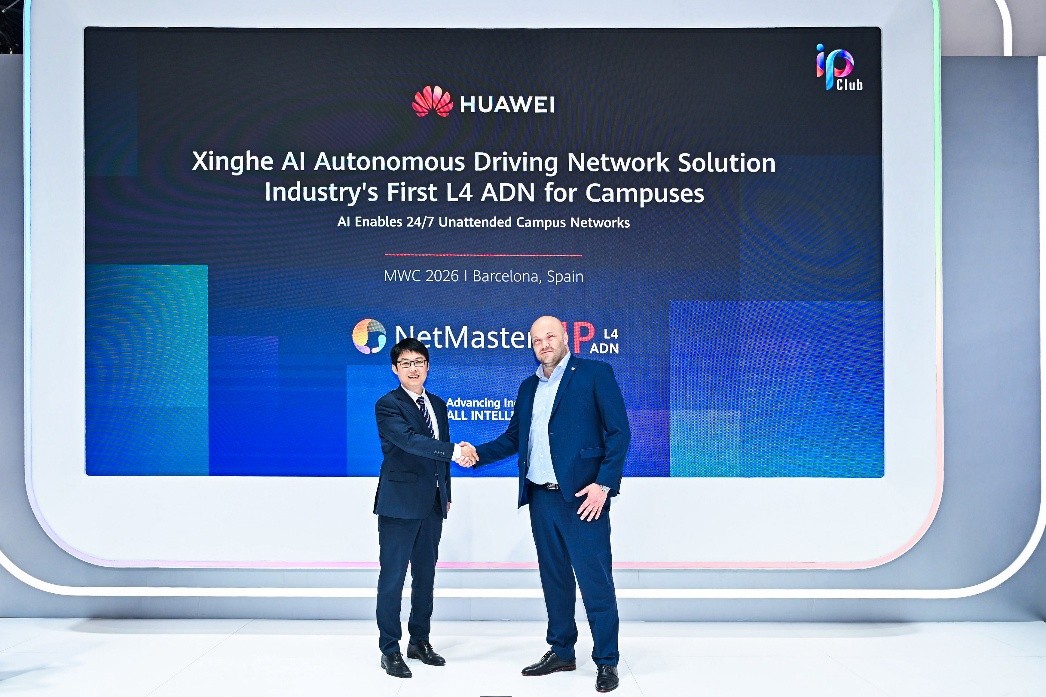
Huawei Unveils Industry's First Campus L4 ADN Solution
With digital and intelligent transformation reshaping every industry, enterprises are facing a broader and more complex set of challenges, such as slow service rollout, difficult fault locating, and lagging experience assurance. To address these challenges, Huawei introduces its industry-first Xinghe AI L4 ADN solution for campuses, redefining campus O&M around four "zero" capabilities:
Zero-error service changes: To address slow service rollout and frequent errors introduced during service changes, the solution automatically generates configurations based on user intent and delivers them within minutes. This shortens time to market (TTM) by 75% while safeguarding the network from configuration mistakes through a closed-loop process.
Zero-freezing service experience: Powered by Huawei's intelligent iFlow full-flow quality detection technology, the solution proactively identifies application performance degradation, and automatically orchestrates intent-based assurance policies for key applications. Together, these capabilities enable pre-event simulation, in-event root cause analysis, and post-event assurance report generation to ensure uninterrupted performance for critical services.
Zero-impact fault handling: Fault diagnosis and locating remain among the most challenging tasks in today's networks, requiring specialized O&M expertise and often consuming significant time—factors that can severely degrade user experience. Huawei's solution adopts the AI-powered algorithm and uses the exclusive global optimal decision-making algorithm to automatically resolve faults within three minutes, eliminating service interruption.
Zero-intrusion security defense: Using the Indicator of Attack(IOA) graph-based correlation algorithm, the solution aggregates discrete alarms into a complete kill chain, automatically isolates compromised devices, and generates security orchestration, automation, and response (SOAR) remediation plans to eliminate malicious software. Meanwhile, continuous learning from historical handling actions further strengthens security protection. Together, these capabilities deliver robust defense that prevents intrusion risks from taking hold.
Huawei's Xinghe AI L4 ADN solution for campuses—built on self-perception, self-analysis, self-decision-making, and self-handling capabilities—enables autonomous, 24/7 campus network O&M. It lays the foundation for the transition from "people-to-people" connectivity to the agentic era of AI where intelligent agents interact and collaborate.
Copyright © 2026 Huawei Technologies Co., Ltd. All rights reserved.