

Future-Ready Network Infrastructure Driving Medical DX and Supporting Hospital Management
Establishing Highly Reliable and Scalable Infrastructure to Enhance Quality of Care and Patient Services
Prodotti, soluzioni e servizi per le aziende

Establishing Highly Reliable and Scalable Infrastructure to Enhance Quality of Care and Patient Services
Kano General Hospital, operated by Kyowakai Social Medical Corporation and supporting regional healthcare in Kita Ward, Osaka City, completely overhauled its in-hospital network in conjunction with the renewal of its electronic medical record system. The hospital built a new network using Huawei products, including the CloudEngine S5732-H-V2 network switches, and began operations in March 2025.
The new network delivers high-speed 10 Gbps connectivity and high stability, enabling seamless voice calls on work smartphones and smooth access to electronic medical records. It also provides complimentary Wi-Fi for patients, improving both the quality of care and patient services.
This article highlights the hospital’s efforts to advance medical DX through investment in a network that balances cost performance with future scalability, helping it continue to serve as a vital provider of regional healthcare.
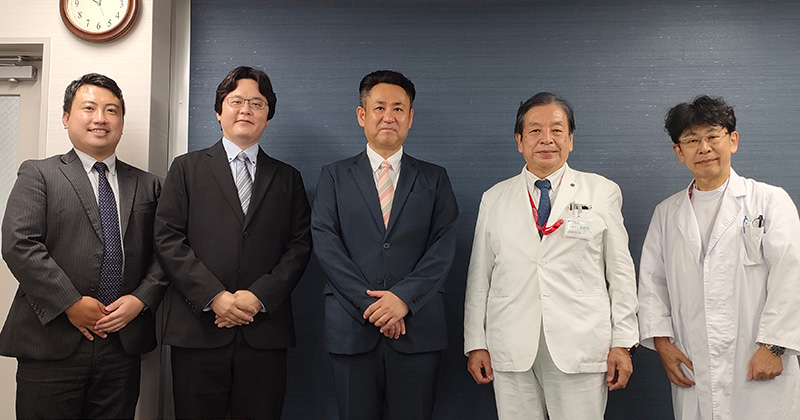
From right in the photo: Shinji Kubota, Director of Kano General Hospital, Kyowakai Social Medical Corporation; Shigeteru Kano, Chairman of the corporation; Ken Yamamoto, Senior Executive Officer and Deputy Head of the Enterprise Business Division, Huawei Technologies Japan K.K.; Hayato Kai, Sub-leader of the Technical Sales Department, SSNet Co., Ltd.; and Yoji Watanabe, General Manager of Sales Department No. 1, West Japan Headquarters, Enterprise Business Division, Huawei Technologies Japan K.K.
Kano General Hospital is a care-mix hospital that provides regional healthcare in Kita Ward, Osaka City, across the continuum from ultra-acute and recovery care to chronic care. In addition to maintaining a system capable of delivering advanced medical services, including a 24-hour emergency center, the hospital provides patient-centered care tailored to each stage of illness through facilities such as a convalescent rehabilitation ward and long-term care wards. As a medical corporation, the group also includes Kita-Osaka Hospital, Heartful Clinic, and the Yodogawa Heartful Geriatric Health Services Facility, enabling it to provide integrated healthcare within the community.
This care is supported by the hospital’s medical information systems, including its electronic medical record system, and the network infrastructure that connects them. In March 2025, as part of its medical DX initiatives, the hospital upgraded its electronic medical record and ordering systems and launched Software Service’s Shin-ban e-Karte and NEWTONS 2. It also introduced work smartphones and renewed its nurse call system. In addition, to enhance patient services, it adopted PokeMed, a mobile patient card application also provided by Software Service, as well as the Raku-da post-payment medical billing system, and began providing information through digital signage within the hospital. At the same time, the hospital has been working toward standardizing databases across the group’s other facilities. To support these medical DX initiatives at the infrastructure level, the hospital also renewed its network.
Yoko Tanaka of the hospital’s Information Systems Department explains: “As we advance medical DX, we expect communication traffic to continue rising steadily. In addition, the construction of One DB, a shared database across the group’s facilities, will further promote information sharing between sites. For that reason, we decided to renew the network as well in order to establish a high-speed, stable communications environment.”
Against this backdrop, the hospital built a network using Huawei’s CloudEngine S5732-H-V2 network switches, the AC6508 access point controller, and AirEngine 6761-21 access points, and began operating it in March 2025.
The hospital began concrete discussions on upgrading its electronic medical record system and network around the spring of 2024. For the network, it defined specifications for the overall configuration and equipment such as network switches, then evaluated products from both domestic and overseas vendors. Tanaka notes, “Our key criteria in the selection process were reliability, cost performance, and future scalability.”
With the introduction of work smartphones expected to increase the number of devices connected to the network, the hospital decided to build out a high-speed 10 Gbps network in phases with future scalability in mind. During the evaluation process, there were initially concerns about Huawei products because Huawei was an overseas vendor and information about its products was limited. However, after reviewing case studies of Huawei products being adopted by medical institutions, the hospital concluded that the solutions could be operated safely and stably even in healthcare settings. The strong cost performance of Huawei’s products, which offer high performance and advanced functionality at an appropriate price, also proved to be a decisive factor in the final selection.
The CloudEngine S5732-H-V2 selected by the hospital features flexible multi-gigabit Ethernet ports supporting communication speeds of 1, 2.5, 5, and 10 Gbps, and is also compatible with high-speed wireless communications via Wi-Fi 6. Through RTU (Right to Use) licensing, licenses can be assigned to individual ports, allowing communication speeds to be increased on demand. This enables the hospital to build an optimal network tailored to its budget and needs while maintaining a high degree of scalability. The switches also offer high reliability and security, and support AI-driven traffic optimization, anomaly detection, and centralized management through the iMaster NCE automation platform. In addition, their energy-efficient design helps reduce electricity costs.
The AC6508, introduced to manage the Wi-Fi network, can control up to 512 access points and 4,096 client devices. It supports 10 Gbps high-speed network communication, enabling smooth transmission and reception of data such as medical images. Its SmartRadio function enables intelligent roaming by distributing the load across access points, ensuring stable communication even while users move around the facility with their devices. Meanwhile, the Wi-Fi 6-compatible AirEngine 6761-21 delivers communication speeds of up to 3.55 Gbps and supports roaming through independent RF scanning, helping reduce network interference and enabling high-quality data transmission and voice calls.
The new network went live in March 2025 in conjunction with the electronic medical record system upgrade. It operates through VLANs in two separate segments, one for the electronic medical record system and the other for internet access. Within the hospital, approximately 300 work smartphones used for voice calls, access to electronic medical records, and nurse call functions, together with around 250 notebook PCs used as electronic medical record terminals, are connected to the Wi-Fi 6 network. In addition, about 250 desktop PCs used as electronic medical record terminals are connected via the wired network. The deployed CloudEngine S5732-H-V2 switches each have 48 ports, of which 12 are used as 10GE ports for the Wi-Fi 6 network, while the remaining 36 are used for the wired network at 1 Gbps. If the number of work smartphones increases in the future, there will be no need to replace or add network switches, as the hospital can simply change the licenses and switch the relevant ports to 10GE.
A total of 226 AirEngine 6761-21 access points were installed throughout the facility following a prior radio-wave survey. Using FMC (Fixed Mobile Convergence), work smartphones can make both internal and external calls over the Wi-Fi 6 network while inside the facility. Roaming optimization through the AC6508 ensures that communication remains stable even while users are moving, except in locations such as elevators, thereby enabling high-quality voice calls.
Since operations began, the network has been running smoothly without any major issues. Although some problems arose during the implementation phase, they were resolved promptly. Tanaka recalls, “Huawei’s engineers and representatives came immediately and worked in coordination with their headquarters in China to address the issue. We highly value the speed of the support we received at that time.” For a medical institution, a network failure can be potentially devastating, making Huawei’s support structure especially reassuring.
The establishment of a high-speed 10 Gbps communication environment has also enabled staff to use work smartphones and notebook PCs on the Wi-Fi 6 network without noticeable delay. In addition, with the infrastructure for medical DX now in place, positive effects are already being seen in clinical practice. Because work smartphones, which are used primarily on the Wi-Fi 6 network, allow access to electronic medical records even from outside the hospital, staff can now check information such as prescription details while viewing it on screen. Compared with the previous voice-only communication, this has deepened communication and contributed to improvements in both the quality and safety of care. The hospital has also newly begun offering complimentary Wi-Fi service for patients, further enhancing patient services. Since Japan’s public PHS service ended in 2023, medical institutions in Japan have increasingly shifted to smartphones. The network renewal at Kano General Hospital offers a valuable reference for other facilities considering the introduction of smartphones.
With the network infrastructure now in place, the hospital plans to further accelerate its medical DX initiatives going forward. Looking ahead, it intends to expand the use of work smartphones and notebook PCs and, in line with the development of One DB, the shared database for the group’s facilities, to increase the number of 10GE ports and further strengthen the Wi-Fi 6 network. The flexible and scalable network environment enabled by the CloudEngine S5732-H-V2 has allowed the hospital to plan medium- to long-term medical DX initiatives and make appropriate, future-oriented capital investments without unnecessary waste. Tanaka emphasizes, “This time, we were able to build a network designed with the next decade or more in mind. We believe this also contributes to hospital management.” Through medical DX, Kano General Hospital is well positioned to continue serving as a vital provider of regional healthcare in Kita Ward, Osaka City.
Copyright © 2026 Huawei Technologies Co., Ltd. Tutti i diritti riservati.

